

TL;DR
- ai governance best practices protect users, reduce legal exposure, and improve model reliability when implemented early.
- Define roles, policies, and oversight up front; require vendors to document data handling and meet a minimum 70/100 security/privacy score.
- Use a vendor due-diligence checklist and a scoring rubric to compare providers consistently.
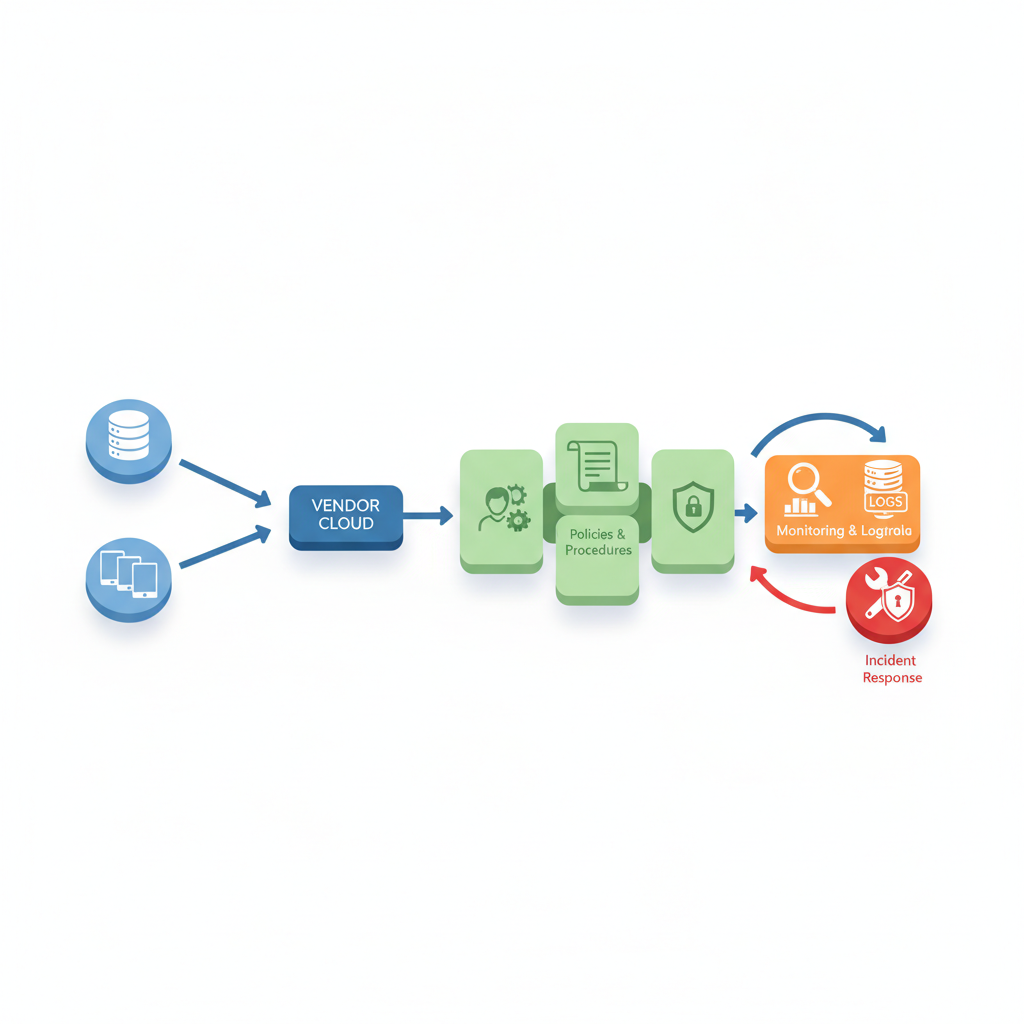
- Monitor models continuously (data drift, performance, safety) and maintain an incident playbook that ties to logging and retention rules.
- Regional rules differ: EU favors data residency and consent; US emphasises consumer privacy laws like CCPA/CPRA; India and APAC vary rapidly—treat them case-by-case.

Introduction
ai governance best practices set the rules that turn a promising AI prototype into a responsible production system. You need policies that cover people, processes, and technology; vendor questions that prove controls; and measurable artifacts for procurement and audits. This guide gives website owners, marketers, and developers a step-by-step playbook: the governance components to assign, the data rules to enforce, the vendor questions to ask, and the artifacts you can copy into procurement and operations.
Who this is NOT for
This guide is not for organizations that have no plans to process user data, have zero-touch AI features (purely client-side models that never see user data), or operate only in highly regulated industries where an existing regulator-provided compliance program already dictates controls. It also isn’t a substitute for legal advice: consult counsel for binding interpretations of GDPR ai compliance and CCPA/CPRA obligations.
Why governance matters for AI implementations
Without governance, model failures become business failures. If a recommendation engine starts promoting disallowed content, or a form-filling assistant leaks PII, you pay in brand trust, support cost, and potential enforcement actions. Governance creates repeatable controls that reduce those risks while preserving speed to market.
Concrete example: a content-moderation widget used on a publishing site initially relied on manual review and a third-party API. When traffic spiked, moderators lagged, and the API began returning hallucinated policy statements sourced from training data. A governance program that required a vendor data handling for ai statement and a documented fallback reduced incidents by creating an automated low-confidence route that queued questionable outputs for human review.
Governance also supports measurable business goals: reduce false positives by 25% on user-facing moderation, keep P95 inference latency under 300ms for chat helpers, and hold vendors to a minimum 70/100 security/privacy score. Those thresholds make decisions objective in procurement and renewal cycles.
Quotable: "Governance turns unpredictable model behavior into measurable operational risk."
Core governance components (roles, policies, oversight)
Governance is organizational as much as technical. Assigning roles prevents gaps and finger-pointing when an issue occurs. A minimal governance model includes three groups: (1) owners who define acceptable use and KPIs, (2) engineers who implement controls, and (3) a review board that approves vendor relationships and exceptions.
- AI owner / product manager: defines acceptable use, business KPIs (e.g., conversion lift, reduction in support tickets), and escalation paths.
- Data steward: owns data classification, consent mapping, and retention schedules (e.g., PII level, retention 90 days by default unless consented longer).
- Security lead / SRE: enforces runtime requirements (encryption, TLS 1.2+, key rotation every 90 days), response SLAs, and monitoring hooks.
- Ethics/review board: a cross-functional panel that reviews high-impact models and approves release criteria.
Policies to create immediately (examples you can copy): acceptable use policy for models, data classification policy, vendor data handling for ai policy, model release checklist, and an incident response playbook that maps to legal and communications teams.
Step-by-step for a governance kickoff:
- Run a one-day impact assessment with stakeholders to map which services will use AI and what data flows into them.
- Classify data by sensitivity and residency requirements; tag production datasets in your catalog.
- Create a model card for any model touching user data, capturing purpose, training data sources, limitations, and performance metrics.
- Set acceptance criteria: accuracy thresholds, bias checks, and minimum privacy/scoring thresholds for vendors.
Quotable: "Every production model should have a model card and an owner who can answer ‘why this model exists’ in one sentence."
An AI feature is production-ready only when an owner, data steward, and rollback plan exist.
Data privacy, residency and consent — practical rules
Data rules are where governance meets law. Implement practical, enforceable rules: classify what counts as personal data, require explicit consent flows for sensitive uses, and enforce residency when regions require it.
Practical rules you can adopt immediately:
- Default to pseudonymization for analytics and full anonymization for training unless explicit consent exists.
- Use consent records tied to user IDs with timestamps and purpose codes so you can prove lawful basis for a processing activity.
- Apply a data residency rule: if data originates from the EU, do not export raw personal data to non-EU regions unless the vendor provides adequate safeguards or you have a lawful transfer mechanism.
- Retain raw PII no longer than necessary: example threshold—retain identifiable chat logs for 90 days, aggregate logs for 2 years for trend analysis.
Example for xproductlist.com: when listing a conversational AI tool on the directory, require vendors to state whether they collect user prompts, whether prompts are used for training, and the residency location of stored prompts. If a vendor accepts user-provided files for model inputs, ensure the vendor documents their deletion process and retention period.
GDPR considerations
GDPR places obligations on controllers and processors that affect design and vendor selection. Declarative definition: "GDPR requires lawful basis for processing personal data, mandates data subject rights (access, rectification, erasure), and enforces data protection by design and default."
Practical GDPR steps for AI projects: perform a Data Protection Impact Assessment (DPIA) before deploying high-risk models, map data flows to show where personal data travels, and ensure contracts with processors include the mandated clauses. For AI, document whether outputs can be linked back to individuals and whether models were trained on personal data—this feeds your DPIA and vendor checks for gdpr ai compliance.
Quotable: "A DPIA is the single best document to demonstrate GDPR controls for AI features."
CCPA / CPRA notes
CCPA/CPRA require transparency, consumer opt-outs for sale or targeted advertising, and data access/deletion rights for California residents. Declarative definition: "CCPA/CPRA give California residents the right to access, delete, and opt out of sale or targeted profiling of their personal information."
Practical steps: map where Californian data is processed, add clear disclosures if model outputs may include inferred profiling, and provide mechanisms to honor access/deletion requests. Maintain an audit log of requests and the actions taken—this is measurable evidence for compliance and supports ai risk management efforts in the US context.
Vendor due-diligence checklist — 12 essential questions
Vendors are where many governance programs fail. Use a consistent set of questions so evaluations are comparable. Below are 12 essential questions to ask any vendor that will process your data or provide models.
- Do you collect or retain customer prompts or inputs? If yes, for how long and for what purpose?
- Are prompts or inputs used to retrain models? If so, is customer data excluded by default?
- Where is customer data stored (data residency)? List regions and cloud providers.
- What encryption is used at rest and in transit? Describe key management and rotation policies.
- Do you perform background checks and access controls for staff with production data access?
- Provide your SOC2 / ISO27001 / comparable certifications and the date of the latest report.
- What is your breach notification SLA (hours) and incident response process?
- How do you handle deletion requests and proof of deletion for datasets used in training?
- Do you offer on-premises or private cloud deployments if required for data residency?
- Provide details of third-party subprocessors and how changes are communicated and approved.
- Are there documented model cards, evaluation reports, and known failure modes available for review?
- Do you support contractual clauses for GDPR ai compliance, including data processing addenda (DPAs)?
For procurement, convert these into scored responses. Require evidence (logs, certificates, screenshots) rather than verbal answers. Sample decision rule: vendors scoring under 70/100 on a security/privacy rubric should not be approved for production use with personal data.
Copyable 10-question checklist (paste into procurement):
- Do you retain customer prompts? Purpose and retention length?
- Are prompts used for training? Opt-out available?
- Where is data stored (regions)?
- Encryption at rest/in transit and key management?
- Access control and admin logging for data access?
- Certifications (SOC2, ISO27001)?
- Breach notification SLA and playbook?
- Deletion process and proof of deletion?
- Subprocessor list and change policy?
- Model cards and evaluation reports available?
Security scoring rubric and privacy scoring templates
A scoring rubric converts vendor answers into procurement decisions. Below is a simple, copyable rubric and a privacy scoring template with concrete thresholds you can adjust to your risk appetite.
| Category | Weight | Threshold / Notes |
|---|---|---|
| Data handling & residency | 25 | Full points if EU/region-specific storage available; partial if only controls exist |
| Encryption & key management | 20 | Full points for AES-256 at rest, TLS1.2+ in transit, HSM-based keys |
| Access controls & logging | 15 | Full points if RBAC, MFA, privileged access logging present |
| Certifications & audits | 15 | SOC2 type II or ISO27001 within last 12 months |
| Incident response & SLA | 10 | Full points if breach notification <48 hours and tabletop exercises annually |
| Model transparency | 10 | Model cards, evaluation reports, and known failure modes documented |
Scoring example: add weighted scores and normalize to 100. Decision rule: accept vendors scoring >=70; require remediation plan for 50–69; reject <50.
A vendor is approved when documentation, evidence, and tests match their written controls.
Monitoring, logging and incident response for AI systems
Monitoring turns governance from paperwork to action. Instrument models with three monitoring layers: performance, safety, and infrastructure. Performance metrics include accuracy, calibration drift, and latency; safety monitors track toxic outputs, PII leakage, and rate of low-confidence answers.
Concrete monitoring rules to implement:
- Log every model call with hashed user id, input fingerprint, latency, and confidence score. Retain logs for 90 days by default.
- Set automated alerts: e.g., if false positive rate increases by 20% week-over-week, open an incident.
- Detect drift: monitor feature distributions and model outputs using P90/P95 comparisons to historical baselines.
Incident response tie-in: map alerts to a runbook with roles, severity levels, and rollback steps. Example severity mapping: Sev 1 = data exfiltration or PII leakage, trigger immediate shutdown of affected endpoints and notification to legal; Sev 2 = significant degradation of model quality, trigger rollback to previous model and start retraining plan.
Logging considerations: ensure logs are tamper-evident and segregated from vendor-accessible storage unless explicitly required. Include a forensic snapshot process so you can preserve evidence when investigating incidents.
Policies for model updates, retraining and drift detection
Model change policies reduce surprise. Define a release policy that separates routine updates (small weight updates) from major retrains (new architecture or data sources) and requires different levels of approval.
Policy template:
- Minor update: performance delta <2% and no change to training data sources — auto-approve by engineering and register change in model registry.
- Major retrain: adds new data sources or architecture changes — requires review board sign-off, regression tests, bias and privacy re-assessment, and staged rollout.
- Emergency rollback: defined rollback button with go/no-go criteria and postmortem within 72 hours.
Drift detection steps:
- Baseline key metrics at release (accuracy, false positive/negative rates, calibration).
- Daily automated checks comparing input distribution percentiles and output distributions to baseline; flag 10% shift in any critical feature.
- Trigger retrain when drift persists >7 days or when user-facing metrics cross SLA thresholds.
Example KPI: P95 inference latency < 300ms, model accuracy degradation <5% from baseline; if either fails, open a remediation ticket with a 48-hour SLT for mitigation.
Playbooks and templates teams can copy
Practical artifacts save time. Below are two templates you can copy: an incident playbook outline and a model release checklist.
| Incident playbook | Actions |
|---|---|
| Detect | Alert created, initial triage by SRE within 15 minutes |
| Contain | Isolate endpoint, reduce user exposure, enable throttling |
| Eradicate | Rollback model or revert config, apply hotfix |
| Recover | Restore service, validate tests, monitor closely for 48 hours |
| Review | Postmortem within 72 hours; update playbooks and training |
Model release checklist (copyable):
- Model card created and reviewed
- Performance regression test passed
- Bias assessment completed and approved
- Privacy impact (DPIA) assessed if needed
- Monitoring hooks instrumented and smoke tests green
- Rollback mechanism tested
Regional compliance snapshots (EU, US, India, APAC)
Quick regional snapshot to guide immediate decisions. These are concise and declarative—consult regional counsel for final determinations.
- EU: Strong data residency expectations and rigorous consent rules; perform DPIAs for high-risk AI. Use contractual safeguards or EU adequacy mechanisms for transfers. (See EU guidance linked below.)
- US: State-level laws (CCPA/CPRA) matter; federal AI rules are emerging. Focus on transparency, opt-outs for profiling, and consumer access/deletion processes.
- India: Regulations are evolving; expect stricter requirements on government access and data localization in some sectors. Track local guidance before vendor selection.
- APAC (general): Fragmented—some countries require local storage or enhanced notice. Treat each market separately and document decisions.
Practical decision rule: if you process EU personal data, require vendors to offer EU-only storage or explicit contractual transfer mechanisms. If you process California residents' data, ensure you can honor CCPA/CPRA access and deletion requests within the statutory timeframe.
Conclusion and policy starter kit
Implementing ai governance best practices means combining clear roles, data rules, vendor controls, and operational artifacts. Start with a one-week governance sprint: map your AI surface, score current vendors, create model cards for top 5 features, and implement logging and alerts for high-risk models.
Starter kit checklist (copy into an internal wiki):
- Assign an AI owner and data steward for each product area.
- Create model cards for production models and register them.
- Run vendor due-diligence using the 12-question list; require a minimum 70/100 score.
- Instrument monitoring for latency, accuracy drift, and safety signals.
- Publish an incident playbook and run a tabletop exercise within 30 days.
Quotable: "Require evidence, not promises—ask vendors for logs, certificates, and model cards before signing a contract."
Frequently asked questions
What is ai governance & data security for implementations? ai governance best practices are the policies, roles, procedures, and technical controls that ensure AI systems operate safely, respect privacy, and meet legal and business requirements.
How does ai governance & data security for implementations work? Governance works by assigning ownership, creating policies (data classification, model release, incident response), enforcing vendor controls through due diligence and scoring, and operating monitoring and logging that detect and remediate issues.