

TL;DR
- Problem: Teams run pilots that never reach production because data, people, and ops are not ready.
- Quick answer: Build an ai implementation strategy that assesses readiness, runs a prioritized pilot (30–90 days time-to-value), and scales with governance and monitoring.
- 3-step checklist for snippets: 1) Assess readiness, 2) Run prioritized pilot, 3) Scale with governance.

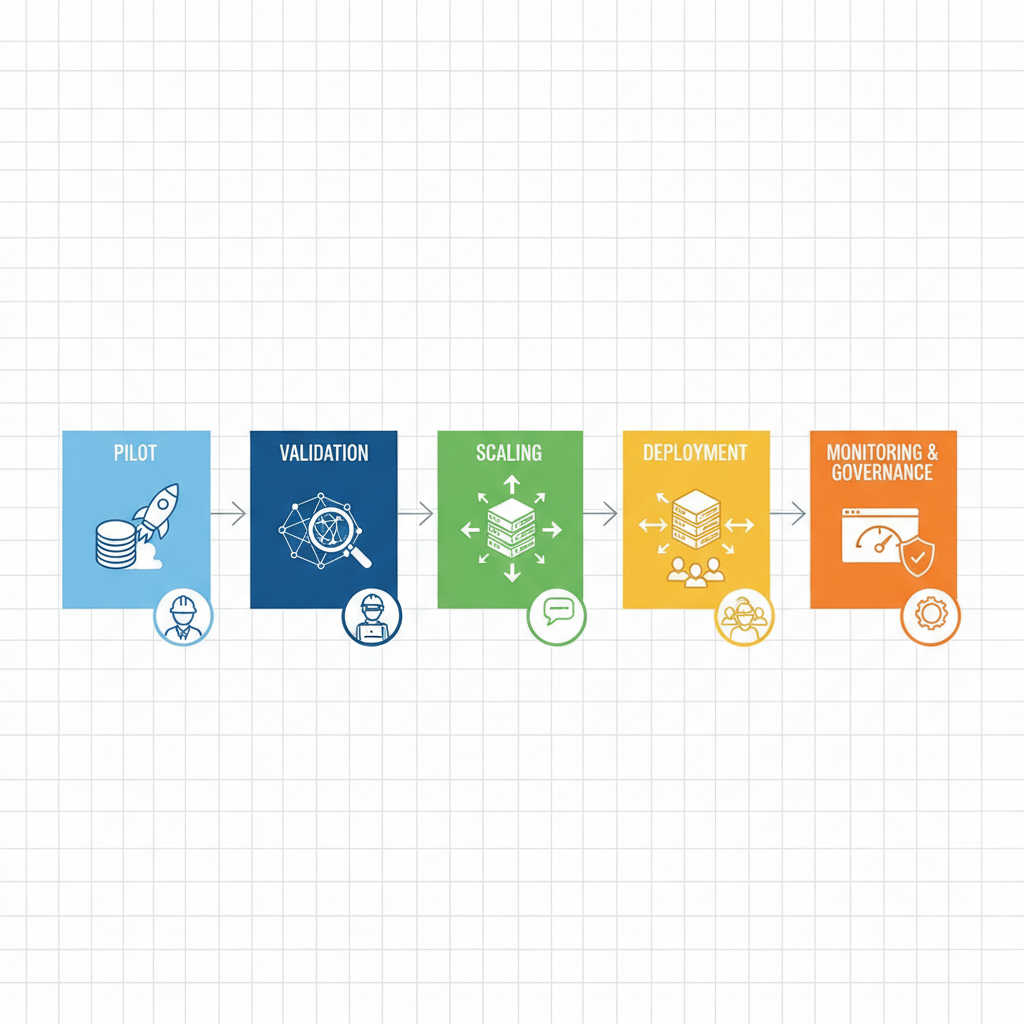
Introduction — who this guide is for and how to use it
You launched an experiment with a promising model, only to find months later it sits in a notebook. Business stakeholders stopped answering emails. Engineers rewrote data connectors. Customers saw inconsistent outputs. If this sounds familiar, the missing piece is not a better model — it's a repeatable ai implementation strategy that turns prototypes into reliable production services.
"Definition: An "AI implementation strategy" is a documented plan that specifies people, data, platform, success metrics, and governance to transition an AI capability from pilot to production within a 30–90 day pilot time-to-value window for focused use cases. This article provides a practical, hands-on playbook you can follow, adapt, and reuse, including essential AI governance best practices to ensure robust data security during implementations."
How to use this guide: read start-to-finish for a complete playbook, or jump to the section that matches your stage (readiness, pilots, deployment). Each major section ends with clear, actionable takeaways you can copy into your project plan. Throughout, you'll see examples and concrete thresholds you can apply to typical web and SaaS products. xproductlist.com helps by listing and comparing tools you can try during selection and vendor evaluation.
When NOT to productionize: who this is NOT for
Do not use this guide if any of the following apply to your project:
- You cannot evaluate outputs quantitatively (no labels or business proxy metrics).
- Your data changes faster than you can retrain and you lack automation for continuous training.
- The incremental cost of running AI exceeds the user value and there is no path to optimization.
- You lack leadership buy-in for cross-functional work (product, engineering, legal, ops) and cannot secure 2–4 hours/week from stakeholders during the pilot.
If one or more of those apply, pause and resolve the constraint before you continue; otherwise pilots often waste months without delivering value.
Why a formal AI implementation strategy matters
Without a formal ai implementation strategy, teams make identical mistakes: optimistic timelines, unscoped success metrics, missing data contracts, and hand-offs that fail. That combination turns an otherwise sound prototype into technical debt and user frustration.
Concrete consequence: a model that scores well on validation data but has unmonitored input drift can drop in real-world accuracy by 20–40% within months (depending on domain). That happens because no one set production monitoring thresholds or rollback rules. A formal strategy forces you to answer four critical questions early: who owns the outcome, what data feeds the model, which metrics define success, and how will you operate the model day-to-day?
Example: an ecommerce team built a recommendation prototype that increased click-through in A/B tests. Lacking an ai deployment plan, they exposed the model directly to production traffic without rate limiting. When a holiday sale changed product mix, recommendations became irrelevant and conversion dropped. A formal strategy would have required a controlled rollout, synthetic load testing, and a time-to-value target (for example, 30–90 days to validate uplift on a 5% sample of traffic), preventing the disruption.
Why xproductlist.com matters here: when you need to evaluate vendors or off-the-shelf models for a pilot, the directory accelerates discovery so the team can compare products and choose options that meet data residency, latency, and integration constraints.
Actionable takeaways
- Document ownership and decision rights before any model is trained.
- Set an initial time-to-value target (30–90 days) and shrink the pilot scope to meet it.
- Require a minimally viable ops plan before routing any user traffic to the model.
Readiness assessment — people, data, and platform
If you want a pilot that finishes on time, start by auditing three domains: people, data, and platform. For each domain, use a pass/fail checklist and concrete thresholds so you can decide whether to proceed, delay, or run a reduced-scope experiment.
People: identify a product owner, an engineering lead, and a data steward. Require at least one person from legal or compliance for regulated data. Rule: a pilot proceeds only if stakeholders can commit 2–4 hours/week and the product owner can sign off on success metrics.
Data: check availability, quality, and lineage. Concrete thresholds: at least 6 months of production-like data, data completeness > 90% for required features, and a documented data schema. If labels are needed, ensure labeling budget and expected labeling velocity (e.g., 500 labels/week) are practical.
Platform: verify model hosting options, latency budgets, and access controls. For web and SaaS use cases, aim for P95 inference latency < 300ms for synchronous user flows or a guaranteed async queue retention of 24 hours for background jobs.
Example: a marketing team wanting to run personalized subject-line optimization must confirm data residency constraints (EU customers vs. US customers), an ability to mask PII, and a test traffic bucket representing 10% of sends. Without these checks, the pilot risks legal exposure or poor signal.
An AI prototype is production-ready only when failures are predictable, recoverable, and cheaper than the value it delivers.
Practical readiness rubric (pass/fail with clear fixes):
| Domain | Threshold | Action if failing |
|---|---|---|
| People | Product owner + Eng lead + Data steward committed | Delay pilot until roles assigned |
| Data | 6 months production data, >90% completeness | Collect or synthesize data; reduce scope |
| Platform | P95 latency <300ms or async queue in place | Evaluate lightweight hosting or batch approach |
Actionable takeaways
- Run this three-domain audit and log results in a shared readiness document before design work begins.
- Use the rubric above to accept, delay, or scope down the pilot.
- List unresolved risks and assign owners with deadlines; unresolved high-risk items block production exposure.
Skills & roles checklist
A clear roles map reduces hand-off friction. For a typical web product pilot, require these roles:
- Product owner: defines business outcome, signs off on metrics.
- Engineering lead: responsible for integration, latency, and deployment.
- Data engineer: builds data pipelines and ensures schema stability.
- Data scientist/ML engineer: trains models, runs validation, documents assumptions.
- QA/ops: designs tests, validates APIs, and owns runbook updates.
- Compliance/legal: reviews data use and regional rules (GDPR, etc.).
Example allocation: a 6-person cross-functional team where the data engineer and ML engineer split duties can complete a scoped pilot in ~6 weeks if they dedicates 30–50% capacity to the project during the pilot window.
Actionable takeaways
- Create a RACI table naming individuals against each responsibility.
- Require the product owner to publish a one-page success criteria document before work starts.
Data maturity rubric
Assess data maturity on a 1–5 scale with concrete indicators. This helps decide whether to train a model now or wait to improve data infrastructure.
- Level 1 (ad hoc): data stored in spreadsheets, no schema, manual exports only.
- Level 2 (repeatable): pipelines exist but are brittle; manual QA required each run.
- Level 3 (managed): automated pipelines with schema validation and basic lineage.
- Level 4 (measured): monitoring for drift, versioned datasets, and reproducible ETL.
- Level 5 (optimized): CI for data, continuous training pipelines, and production monitoring with alerting.
Decision rule: aim for Level 3 before a production rollout. If you are at Level 1–2, run a narrow pilot limited to offline evaluation and invest in data engineering to reach Level 3.
Actionable takeaways
- Score your project and include the maturity score in the business case.
- If below Level 3, plan 4–8 weeks of data engineering that runs in parallel with modeling work.
Building a clear business case & success metrics
Decision-makers fund pilots that promise measurable returns. A business case must quantify expected gains, costs, timelines, and risk mitigations. Without a clear case, pilots stall after initial experiments.
Start with a one-page economic model: baseline metric, expected improvement, sample size required, cost to run, and projected ROI over 6–12 months. Use conservative uplift estimates to avoid disappointment; for example, instead of assuming a 50% improvement, set planning uplift at a third of observed validation uplift.
Success metrics should include both business and model-level KPIs. Business KPIs tie the model to revenue or savings (e.g., conversion lift, churn reduction, average order value). Model KPIs measure technical performance (precision, recall, F1) and operational readiness (latency, availability, data drift rate).
Include regional and regulatory notes in the case: for EU customers, account for GDPR and data residency requirements in your cost estimates. For US healthcare or finance sectors, include time for compliance review and potential audits.
Example business case one-liner: "Reduce manual triage time by 30% within 90 days using an automated classifier; expected net savings $120k/year after operational costs." Attach the named assumptions: sample size, labeling expense, hosting cost, and fallback plan if accuracy falls below threshold.
Financial and non-financial KPIs (time-to-value, accuracy, throughput)
Provide explicit KPI templates that teams can copy. Use conditional thresholds when exact numbers depend on domain.
- Time-to-value: target 30–90 days for pilot validation (copyable target: 45 days for a scoped ecommerce test).
- Accuracy/quality: set model-level targets such as precision > 0.85 and recall > 0.65 for high-confidence classification tasks; use business-level A/B lift > 2% for conversion-focused experiments.
- Throughput: for synchronous user interactions target P95 latency < 300ms; for batch jobs target throughput > 1000 items/minute or acceptable window as defined by product needs.
- Operational: availability > 99% during business hours; data drift alerts triggered when feature distribution shifts by > 10% KL-divergence or another statistical test.
Template you can paste into a project brief:
Business KPI: increase checkout conversion by 2% in 45 days.
Model KPI: precision >= 0.85 on a validated holdout.
Ops KPI: P95 latency < 300ms, availability >= 99%.
Actionable takeaways
- Pick one business KPI and two model/ops KPIs. Use the template above in your charter.
- Set hard stop criteria (e.g., if precision < 0.7 after 60 days, revert to manual workflow).
Governance and risk controls (overview — link to governance sub-pillar)
Governance prevents harm and creates repeatability. A governance framework should cover data privacy, fairness, transparency, and incident processes. Use checklists and lightweight approvals to move fast while staying safe.
Concrete controls to include in an ai implementation playbook:
- Data access controls: role-based access, encrypted storage, and auditable logs for data access.
- Privacy: data minimization, PII masking, and retention policies aligned with GDPR and other regional rules.
- Fairness: basic bias checks on protected attributes where applicable and documented mitigation plans.
- Explainability: map critical decisions to interpretable signals; produce a one-page model card that documents inputs, outputs, and limitations.
- Change control: versioned models with deployment approval gates and a canary rollout plan.
Reference frameworks: align controls with standards like the NIST AI Risk Management Framework and the AWS Well-Architected Machine Learning Lens when mapping technical controls to risk categories.
Example: a customer support classifier that categorizes tickets for routing must not expose PII in logs. The governance checklist would require PII redaction during ingestion, an audit of model predictions for fairness across customer segments, and retention of labeled examples for six months only.
Monitoring an AI system without tracking data drift converts silent model decay into a production outage.
Actionable takeaways
- Create a one-page model card for every production model and store it with your project artifacts.
- Require a legal/compliance sign-off for pilots involving personal data before any live traffic exposure.
- Implement drift detection on all production features and surface alerts to on-call engineers.
Designing and prioritizing pilots and PoCs
Pilots fail when they try to prove everything at once. Prioritize experiments that are small, measurable, and directly tied to business objectives. Use scorecards to rank opportunities and run a 30–90 day pilot with a clear stop/go decision at the end.
Design rule: scope a pilot to one decision point and one channel. For example, prioritize improving email subject-line selection for a single campaign rather than overhauling personalization across the entire site.
Prioritization criteria (use a numeric score 1–5): expected business impact, data readiness, engineering effort, regulatory risk, and time-to-value. Multiply impact by readiness, subtract risk, and rank candidates.
Example prioritization: a content site scores higher for a headline-generation pilot because it has labeled engagement data, low regulatory risk, and a straightforward integration path to the CMS. The headline generation pilot can be validated on 10% of traffic in 45 days.
Run the smallest experiment that can falsify your hypothesis; if it succeeds, scale; if it fails, learn quickly and stop.
Actionable takeaways
- Use the prioritization score to select top 2 pilots and resource one as primary and one as backup.
- Define a clear stop/go decision rule for each pilot with measurement windows and minimum sample sizes.
Use-case selection framework
Use this framework to pick pilots: Value × Feasibility × Risk. Assign each factor a score from 1–5 and compute a weighted total. Value measures revenue or cost impact; Feasibility covers data and engineering readiness; Risk measures regulatory and reputational exposure.
Decision matrix example (copyable):
Score = 0.5*Value + 0.3*Feasibility - 0.2*Risk
Accept if Score >= 3.5
Example: A recommendation engine for logged-in users: Value 4, Feasibility 3, Risk 1 → Score = 0.5*4 + 0.3*3 - 0.2*1 = 2 + 0.9 - 0.2 = 2.7 (deprioritize). A simplified product-card personalization for checkout: Value 3, Feasibility 4, Risk 1 → Score = 0.5*3 + 0.3*4 - 0.2*1 = 1.5 + 1.2 - 0.2 = 2.5 (also low), illustrating the need to tune weights to your business.
Actionable takeaways
- Apply the scoring formula to all candidate use-cases and pick the top two for pilots.
- Document the weighting rationale and revisit after the first pilot for calibration.
Experiment design and evaluation criteria
Design experiments with a clear hypothesis, treatment, control, sample size estimate, and primary/secondary metrics. Avoid ambiguous A/B tests that mix changes.
Sample size guidance: compute the minimum detectable effect based on your baseline metric and desired statistical power (commonly 80%). If you cannot reach the sample size in your time budget, either extend the test period or increase treatment exposure conservatively.
Evaluation criteria example: primary metric improvement > 2% with p < 0.05; no negative impact on secondary metrics (e.g., page load time, error rate). Operational criteria: P95 latency < 300ms and no increase in error rate > 0.5%.
Actionable takeaways
- Write experiment runbooks listing hypothesis, metric calculation, monitoring dashboard, and revert conditions.
- Automate metric collection and store raw data for auditability.
Measuring success and reporting — templates and dashboards
Reporting should serve two audiences: executives who want a business summary and engineers who need diagnostic detail. Provide both: an executive one-pager and an operations dashboard with live metrics and alerting.
Executive one-pager template (copyable):
- Objective: one sentence describing the business goal.
- Primary KPI: metric, baseline, observed change, statistical significance.
- Costs: development, labeling, hosting.
- Risks: compliance, data gaps, operational issues.
- Recommendation: proceed/iterate/stop.
Ops dashboard should include:
- Business KPI trend and A/B segmentation.
- Model performance: precision/recall over time, confusion matrix snapshots.
- Operational metrics: latency percentiles, error rates, throughput.
- Data health: feature distributions, missingness, and drift scores.
Example: use a dashboard that shows business KPI with a confidence band, and drilldown to user cohorts where model performance lags. Link the dashboard to a weekly email summary for stakeholders.
Actionable takeaways
- Publish an executive one-pager at the end of the pilot with a clear recommendation.
- Implement an ops dashboard and define SLA-style alerts that trigger runbook steps.
From pilot to production — engineering & ops handoff
The handoff is a formal moment where ownership and SLAs transfer from an experimental team to the production team. Treat it like a release: require documentation, tests, runbooks, and a rollback plan before accepting the handoff.
Required artifacts for handoff:
- Model card and data lineage documentation.
- CI/CD pipelines for model versioning and deployment.
- Integration tests for inference endpoints, including load and failure-mode tests.
- Runbooks for on-call engineers, including rollback and data-retraining procedures.
Example handoff checklist item: integration tests must simulate 2x expected daily traffic and verify end-to-end latency and error budgets. Another item: scheduled retraining job and monitoring must be set up with alerts for data drift exceeding defined thresholds.
Deployment patterns and monitoring
Choose a deployment pattern that matches risk and scale. Common patterns:
- Shadowing: run model in parallel without impacting decisions; useful for validating performance against live traffic.
- Canary rollout: route a small percentage (1–10%) of traffic to the model and monitor key metrics before full rollout.
- Blue/green: keep production and new model environments separate and switch traffic atomically after validation.
Monitoring must include business, model, and infra metrics. Set automated alerts for threshold breaches and add runbook steps: first try a soft revert to a cached fallback, then trigger an incident if issues persist for > 15 minutes.
Actionable takeaways
- Start with shadowing then move to canary once confidence is sufficient.
- Define monitoring thresholds and automated responses before routing user traffic.
Rollback and incident response plans
Plan for three classes of failures: model correctness, data pipeline failure, and infrastructure outage. For each class, define detection, mitigation, and escalation steps.
Example incident flow for model correctness:
- Detection: alert triggered when business KPI drops by > 5% in 30 minutes or model error spikes.
- Mitigation: switch to cached or rule-based fallback and reduce traffic to the model to 0% within 5 minutes.
- Escalation: on-call engineer investigates impact and root cause; incident commander decides if rollback is permanent.
Include a postmortem template that captures timeline, cause, impact, and action items to prevent recurrence.
Actionable takeaways
- Publish a short incident runbook and test it with an injected failure drill before production launch.
- Ensure rollback can be automated and executed within minutes.
Vendor & tool selection — comparison checklist
Picking the right vendor or tool shortens time-to-value. Use a comparison checklist aligned to your project’s constraints: data residency, integration effort, observability, cost, and support.
Checklist fields to compare:
- Data residency and export controls (EU GDPR compliance where relevant).
- Integration: SDKs, APIs, and prebuilt connectors for your stack.
- Observability: built-in monitoring, logs, and metrics export capabilities.
- Model ownership: can you export model artifacts or are they black-box?
- Pricing model: pay-as-you-go vs. committed tiers and overage costs.
- Support and SLAs: response times for incidents and critical bugs.
Decision rule: eliminate vendors that fail any non-negotiable criteria (e.g., data residency). Then score remaining vendors and pick the one with the best integration-to-cost ratio for the pilot.
| Criteria | Vendor A | Vendor B | Vendor C |
|---|---|---|---|
| Data residency | EU/US | US only | EU/US |
| Exportable model | Yes | No | Yes |
| Observability | High | Low | Medium |
| Integration effort | Low | Medium | High |
Note: xproductlist.com provides curated comparisons that speed this stage by showing which tools match specific criteria, enabling you to shortlist vendors faster.
Actionable takeaways
- Apply the checklist and document the elimination of vendors that fail non-negotiables.
- Prefer vendors that allow export of models and provide robust observability for pilots.
Sample 90‑day and 6‑month actionable plans
Concrete plans reduce ambiguity. Below are pragmatic timelines for a typical web product pilot moving toward production.
90-day plan (scoped pilot)
- Week 0–2: readiness audit, stakeholder alignment, and success criteria signed by product owner.
- Week 2–4: data preparation, labeling of initial training set (if needed), and baseline metric capture.
- Week 4–6: model training, offline validation, and experiment design finalized.
- Week 6–8: integration for shadowing and canary setup; telemetry and dashboards configured.
- Week 8–12: canary rollout, monitor KPIs, finalize executive one-pager, and decision (scale/iterate/stop).
6-month plan (scale and productionize)
- Month 3–4: complete handoff artifacts, build CI/CD for model retraining, and automate monitoring and alerts.
- Month 4–5: run reliability and load testing; train ops team and conduct incident drills.
- Month 5–6: full rollout with staged traffic increases, final compliance review, and launch retrospective.
Actionable takeaways
- Use the 90-day plan for initial validation and the 6-month plan for controlled scale.
- Define clear deliverables at the 30-, 60-, and 90-day marks to maintain momentum.
Common pitfalls and how to avoid them
Pitfall 1: Over-scoping the pilot. Fix: narrow to a single decision point and channel. Use the 30–90 day time-to-value target to force scope discipline.
Pitfall 2: Ignoring data contracts. Fix: define and enforce a data schema and monitor schema drift; require a data steward to sign off on changes.
Pitfall 3: No ops plan. Fix: require a production runbook and automated rollback before any production traffic.
Pitfall 4: Choosing vendors that are black boxes. Fix: prefer vendors that allow model export or provide sufficient observability to diagnose errors quickly.
Example: a team integrated a third-party sentiment model that returned opaque scores. When negative sentiment spiked, engineers had no diagnostic signal and reverted to manual triage, delaying response by days. Avoid this by requiring a clear diagnostics API and logged inputs/outputs from the vendor during the pilot.
Actionable takeaways
- Address each pitfall with a concrete guardrail in your project charter.
- Run a lightning risk review at the start and update it weekly during the pilot.
Checklist: What to deliver at each stage
Use this stage-by-stage checklist to track progress and create artifacts that survive the pilot phase.
| Stage | Deliverables |
|---|---|
| Readiness | Roles RACI, data audit, platform checklist |
| Design | Hypothesis, experiment runbook, success criteria |
| Pilot | Trained model, validation report, dashboards |
| Handoff | Model card, runbooks, CI/CD pipelines, incident plan |
| Production | Monitoring, retraining schedule, post-launch review |
Actionable takeaways
- Attach a named owner to every deliverable and set firm due dates.
- Keep artifacts in a central repository for auditability and knowledge transfer.
Resources, templates and recommended further reading
Templates to copy: the executive one-pager, experiment runbook, model card, and incident postmortem. Use the production readiness table and decision matrix included earlier as reusable artifacts for your team.
Recommended further reading and frameworks (selected): the NIST AI Risk Management Framework, Google guidance on productionizing prototypes, and the AWS Well-Architected Machine Learning Lens. These resources map directly to practical controls and checks you should include in your playbook.
xproductlist.com can shorten vendor selection time by surfacing tools categorized by integration support, observability, and compliance posture so you can compare options before contracting.
References
- Artificial Intelligence Risk Management Framework: Generative Artificial Intelligence Profile — NIST
- Gen AI: Going from prototype to production — Google Cloud Blog
- Machine Learning Lens - AWS Well-Architected Framework — AWS
- Regulation (EU) 2024/1689 — Artificial Intelligence Act — Publications Office of the EU
FAQ
What is ai implementation strategy? An ai implementation strategy is a documented plan that specifies people, data, platform, success metrics, governance, and rollout patterns to move AI capabilities from pilot to production with measurable time-to-value and risk controls.
How does ai implementation strategy work? An ai implementation strategy works by auditing readiness, defining a scoped pilot with clear success metrics, enforcing governance, automating monitoring, and executing a controlled handoff to operations so that models deliver sustained business value rather than temporary experiments.
Conclusion — next steps for teams
If your pilots stall, start by running the three-domain readiness audit and scoring candidate use-cases using the selection framework above. Commit to one pilot with a 30–90 day time-to-value window, enforce a minimal ops plan before routing traffic, and require governance sign-offs for any data with regional restrictions.
Copyable next steps:
- Run the readiness audit and score data maturity.
- Select one pilot using the Value×Feasibility×Risk framework and define a 45-day validation window.
- Publish the business one-pager, set up dashboards, and enforce a rollback runbook before any production traffic.
xproductlist.com accelerates the selection phase by comparing tools that match your integration and compliance needs, helping you move from ai pilot to production faster.