

TL;DR
- Define ai pilot success metrics before you launch: tie at least one directional business KPI to a quantitative model metric.
- Track business, model, data, operational, and UX KPIs simultaneously to avoid narrow wins that fail in production.
- For short 30–90 day pilots, focus on directional business KPIs plus at least one quantitative model metric (e.g., F1 score or latency) tied to acceptance criteria.
- Use a simple weekly reporting cadence and a lightweight dashboard CSV with fields for baseline, current, delta, and confidence level.

Launching an AI pilot without clear ai pilot success metrics turns experimentation into guesswork. This guide walks website owners, marketers, and developers through practical KPI choices, experiment design, sampling rules, a copy/paste ai pilot reporting template, and artifacts you can reuse on xproductlist.com or any platform. Follow the steps below to measure impact, control risk, and decide go/no‑go with confidence.
When NOT to run an AI pilot
Do not run an AI pilot when one or more of these conditions is true:
- Your outputs cannot be evaluated against objective labels or business outcomes (no ground truth available).
- Data access or regional rules prevent you from collecting the metrics required to measure success (for example, personal data restrictions under GDPR block necessary logging).
- Business value is small relative to the cost and risk of failure (expected lift under 1% and high human-review cost).
- Operational support is unavailable: no monitoring, no rollback plan, or no owner to act on failures within 24–48 hours.
- The pilot requires full production reliability from day one (pilots should tolerate controlled failures and fast recovery).
Why define success metrics before launching an AI pilot
"Without a pre-defined set of AI pilot success metrics, teams chase anecdotes and false positives. Defining metrics up front forces alignment on what “success” looks like, sets acceptance criteria for vendors or internal teams, and reduces bias in analysis. A good definition contains: the metric name, business rationale, baseline value, target value, measurement window, and the owner accountable for the metric. This process is essential when selecting and managing AI vendors for pilots."
Example: for a content recommendation pilot on a publishing site, define a primary business KPI (increase in article CTR), a model metric (F1 score for category prediction), and an operational threshold (P95 latency < 300ms). The acceptance criteria: CTR lift > 5% relative to baseline and F1 > 0.72 for two consecutive weeks. Stating these values upfront makes vendor invoices and go/no‑go decisions objective.
Types of KPIs (H3s below)
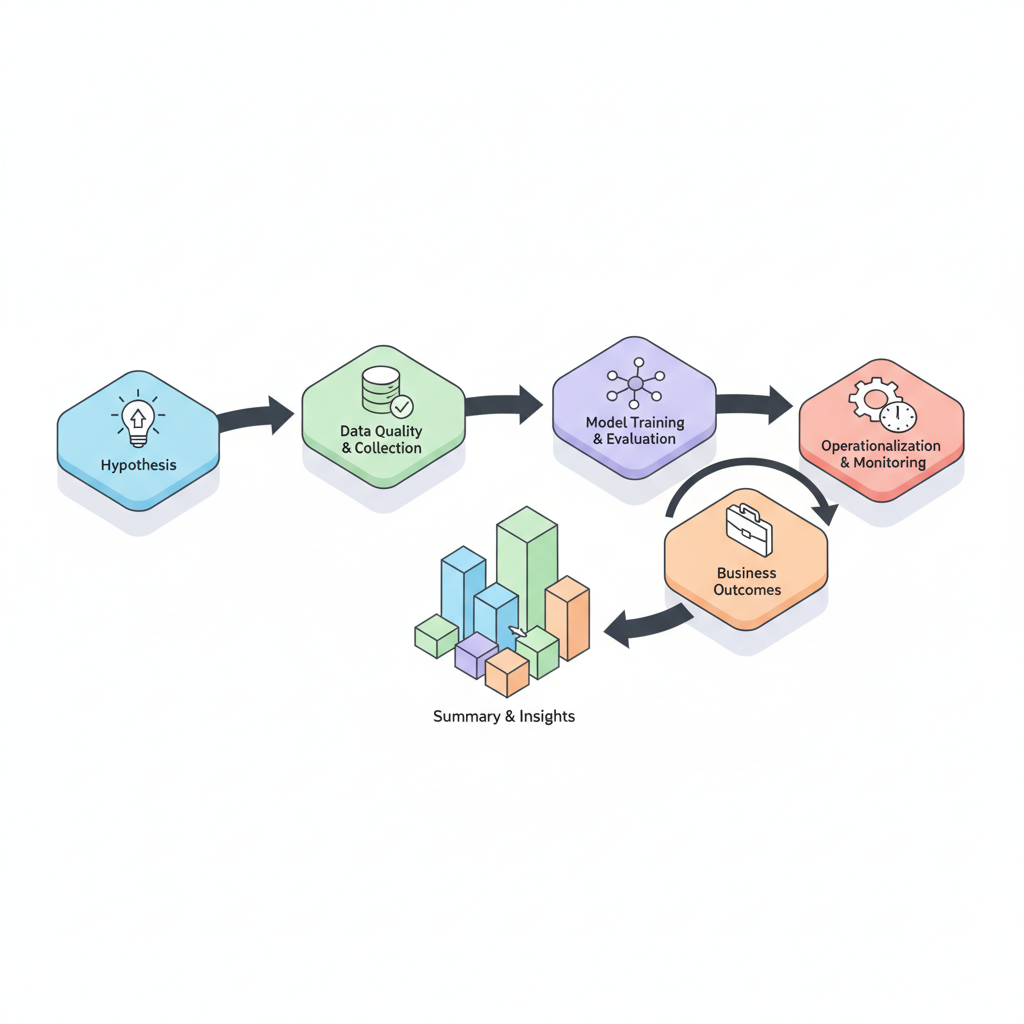
ai pilot success metrics span five categories: business outcomes, model performance, data quality, operational health, and adoption/UX. Tracking all five prevents narrow wins — for example, a model with great accuracy that increases friction at checkout. Each H3 below lists concrete metrics and sample thresholds you can adapt.
Business outcome KPIs (revenue, cost, time saved)
Business outcome KPIs answer whether the pilot moves the bottom line. Pick 1–2 primary business metrics and 1–2 secondary metrics. Common choices for websites and marketing use cases:
- Revenue or conversion lift (relative % change vs baseline). Example threshold: target > 5% conversion lift for a marketing CTA pilot.
- Cost per acquisition (CPA) or cost savings (reduced manual review hours × hourly cost).
- Time saved per transaction (average seconds saved multiplied by volume = staff-hours saved).
Concrete example for xproductlist.com: measure increase in email signups attributable to personalized tool recommendations, with baseline signup rate recorded for 30 days before the pilot and an acceptance rule of at least a 3% absolute uplift over 60 days.
Link model metrics to a single business KPI to avoid optimizing for irrelevant wins.
Model performance KPIs (accuracy, precision/recall, latency)
Model KPIs are the quantitative measures of the algorithm itself. Choose metrics that reflect the task and the business consequence: classification tasks use precision, recall, and F1; ranking tasks use NDCG or mean reciprocal rank; regression uses MAE or RMSE. For real-time features, include latency and tail latency.
- F1 score: balanced measure for uneven class distributions. Example acceptance: F1 > 0.7 on held-out test set.
- Precision at k (precision@10) for recommendation lists.
- Latency: median < 100ms, P95 < 300ms as a conditional target for interactive apps (adjust for your stack).
Quotable: "Measure both central tendency and tail behavior; median latency hides spike failures."
Data quality KPIs (coverage, drift, label accuracy)
Data drives model behavior. Track dataset coverage (percent of records with required fields), label accuracy (manual review error rate), and drift indicators (feature distribution changes). Specific measures include:
- Coverage: > 95% of records have all required features.
- Label accuracy: sample a random 1% of labels for manual audit; target < 5% label error.
- Feature drift: daily JS divergence or population shift; alert when divergence exceeds a set threshold (for many systems JS > 0.1 indicates meaningful change).
Actionable step: add a daily job that computes per-feature missing-rate and pushes alerts when any field’s missing-rate increases by > 5 percentage points week-over-week.
Automate basic data checks; manual audits should confirm automated alerts, not replace them.
Operational KPIs (uptime, integration errors, time-to-resolution)
Operational KPIs reduce production risk. Track integration error rates, system uptime, and mean time to detect/resolve incidents. Typical thresholds and artifacts:
- Uptime: target SLA or internal goal (for pilots aim for > 99% availability during business hours).
- Integration errors: error rate per 10,000 calls; alert on sustained increases.
- Time-to-resolution (TTR): target < 24 hours for incidents impacting core metrics.
Sample artifact: an incident log with timestamp, error type, impact metric delta, and owner. Use it to feed retrospective decisions about production readiness.
Adoption & UX KPIs (user engagement, task completion rate)
Adoption KPIs measure whether users accept the AI. Common metrics: feature usage rate, task completion rate, abandonment rate, and Net Promoter Score (NPS) for users exposed to the pilot. Examples:
- Engagement: percent of eligible users who use the feature at least once in 7 days (target > 20% for new features).
- Task completion: increase in successful task completion compared to baseline.
- User feedback: average satisfaction score > 3.5/5 in targeted surveys.
Concrete implementation: instrument the UI to tag activity with a pilot flag so you can compare exposed vs control cohorts cleanly. For more on this, see Ai implementation strategy.
Designing an experiment and choosing baselines
Design experiments so they answer the business question and control for confounders. Choose a baseline that reflects current production behavior (A/B control or historical baseline), define the treatment clearly, and pre-register analysis rules: primary metric, secondary metrics, and how you’ll handle outliers or missing data.
Example design for a recommendation pilot: randomize users into control and treatment at the session level, run for a minimum time window (see sampling section), and compute lift on primary metric using both raw and normalized models to account for traffic seasonality. Pre-specify a winner: e.g., “declare success if two-week average lift > 3% and p < 0.05.”
Sampling, duration, and statistical significance for short pilots
Statistical significance tells you whether an observed difference likely reflects a real effect rather than random noise. For proportions, a standard two-sided test at alpha 0.05 and 80% power uses Z-values 1.96 and 0.84 respectively. A simple rule-of-thumb sample size approximation for small businesses:
Approximate sample size per group: n ≈ 2 / d² where d is the absolute detectable difference (as a decimal). Example: to detect a 10% absolute uplift (d=0.10) you need roughly 200 users per group; for 5% uplift, roughly 800 per group.
Quotable: "For short 30–90 day pilots, focus on directional business KPIs plus at least one quantitative model metric (e.g., F1 score or latency) tied to acceptance criteria."
Note regional data limits: GDPR and other privacy rules can reduce available sample size by restricting tracking or logging. Always document which regions or users are excluded and report sample composition alongside results.
Reporting cadence, dashboard fields, and a simple template (spreadsheet + visualization guidance)
Choose a reporting cadence that matches decision speed: weekly for active pilots, daily alerts for critical operational KPIs. Keep dashboards focused: primary business KPI, model metric, data quality flags, operational status, and adoption metrics. Include a confidence column (statistical significance or sample size).
| Column | Description |
|---|---|
| date_range | Week of reporting |
| cohort | Control or Treatment |
| primary_kpi_baseline | Baseline value |
| primary_kpi_current | Current value |
| delta_pct | Percent change vs baseline |
| model_metric | F1 / precision / latency |
| data_quality_flag | OK / Warning / Fail |
| sample_size | Users or events used to compute metric |
| confidence | p-value or power indicator |
| owner | Metric owner |
Visualization guidance: use a single line chart for primary KPI over time with bands for confidence intervals, a bar chart for cohort comparison, and a small table for operational alerts. This ai pilot reporting template is intentionally simple so teams can replicate it in Sheets or any BI tool.
Tying metrics to contract milestones and payment triggers
When working with vendors, tie payment milestones to measurable acceptance criteria. Specify the metric, measurement method, evaluation window, and remediation steps if thresholds aren’t met. Example contract clause: "Milestone 2 payment occurs if treatment cohort achieves ≥4% CTR lift over baseline for a continuous 14-day window and F1 ≥0.70 on a held-out test set."
Include dispute-resolution steps: independent audit sample, re-run analysis with shared scripts, or escrowed payments released after verified acceptance. Clear, measurable triggers reduce ambiguity and speed decision-making.
How to detect and handle model drift during a pilot
Detect drift with automated monitoring: compare daily feature distributions to a reference window, track rolling changes in model confidence, and monitor ground-truth performance where labels are available. Define clear triggers and remediation actions.
- Trigger example: JS divergence > 0.1 for a core feature or 10% increase in low-confidence predictions; action: pause automated rollout and run a diagnostic.
- Remediation workflow: collect recent labeled samples, retrain or adjust thresholds, test on validation sets, and redeploy behind a canary flag.
Quotable: "Monitoring an AI system without tracking data drift converts silent model decay into a production outage."
Post‑pilot review: go/no‑go checklist and handoff to production
Run a structured review that confirms metrics, risks, and readiness. Use the checklist below during the decision meeting.
| Checklist item | Pass/Fail |
|---|---|
| Primary business KPI met for required window | |
| Model metrics meet acceptance on held-out data | |
| Data quality checks OK (coverage, label accuracy) | |
| Operational monitoring and rollback plan in place | |
| Support and ownership assigned for production |
Handoff artifacts: final dashboard export, evaluation scripts, data schema, incident runbook, and a short runbook entry on expected maintenance cadence.
Appendix: downloadable dashboard CSV and sample reporting slide
Below is a sample CSV header you can copy into a spreadsheet for the ai pilot reporting template:
date_range,cohort,primary_kpi_baseline,primary_kpi_current,delta_pct,model_metric,data_quality_flag,sample_size,confidence,owner
Sample reporting slide structure (one slide): title, one-line executive decision, left: three small visualizations (trend line, cohort bar, operational status), right: key numbers and recommendation. Use this slide for stakeholder reviews and attach the raw CSV as backup.
References
- AI Risk Management Framework | NIST
- NIST AI 600-1: AI RMF Generative AI Profile
- ISO/IEC 5259-2:2024 - Data quality measures
- The five-layer AI measurement framework | McKinsey
- Microsoft Copilot Dashboard Metric Interpretation
FAQ
- What is ai pilot success metrics & reporting plan?
ai pilot success metrics & reporting plan is a documented set of business, model, data, operational, and adoption KPIs plus a cadence and dashboard that together define how a pilot will be evaluated and reported.
- How does ai pilot success metrics & reporting plan work?
The plan specifies primary and secondary metrics, baselines, acceptance thresholds, sampling and duration rules, reporting templates, and escalation procedures so stakeholders can make an objective go/no‑go decision.