
TL;DR
- The most common pain: you evaluated a single AI vendor, paid for a pilot, then found gaps in accuracy, latency, or data residency — and now procurement needs a defensible side‑by‑side comparison.
- Quick answer: use an ai tool comparison template that includes a weighted scoring matrix mapping feature fit, integration cost, and regional performance to expected ROI; measure API round‑trip latency from your target regions and include regional availability, data residency, and language support in the matrix.


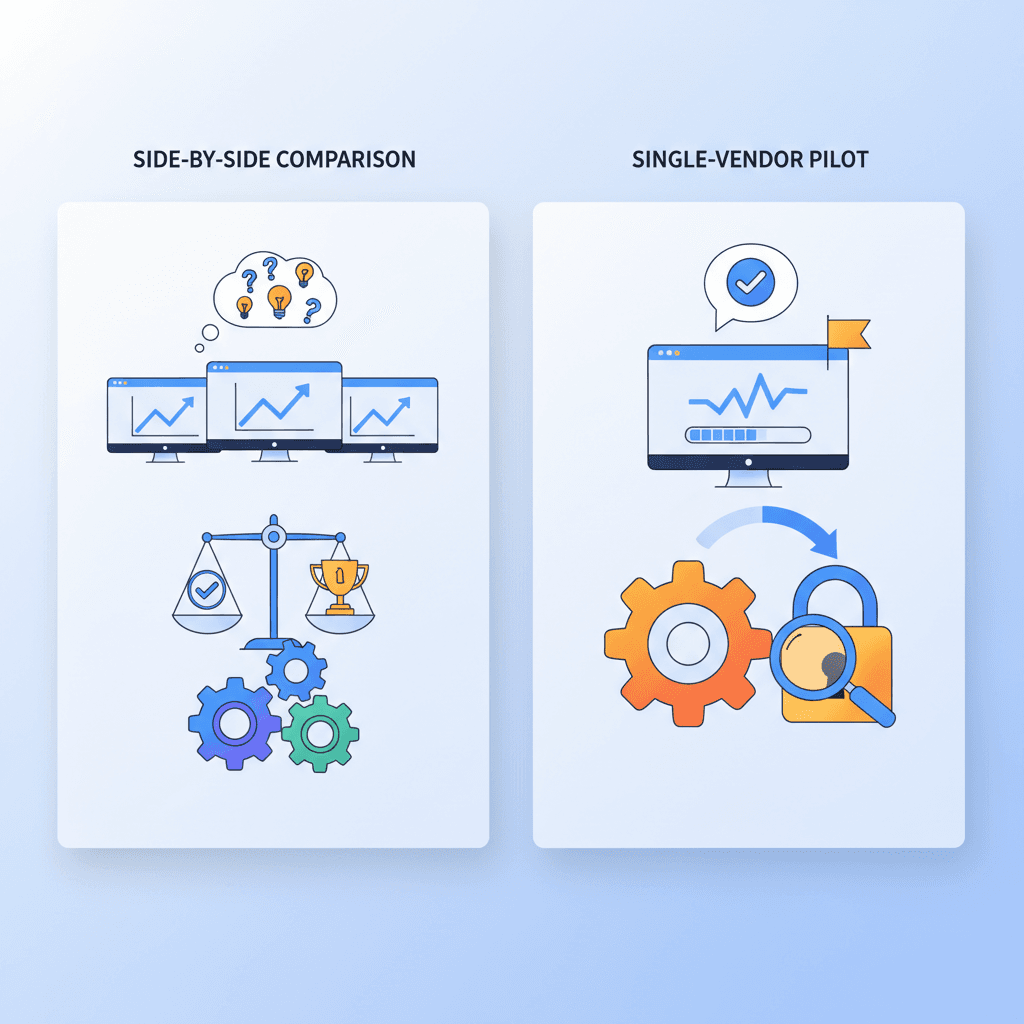
When to run a side‑by‑side comparison vs. a single-vendor pilot
If your project must meet explicit accuracy, privacy, or latency thresholds before launch, running a side‑by‑side comparison reduces risk. When you pilot only one vendor, you learn that vendor’s strengths — but you don’t learn how it stacks up against competitors on metrics that matter to stakeholders. Use a side‑by‑side evaluation when failure costs are measurable (revenue loss, compliance fines, or user churn), when multiple products claim overlapping capabilities, or when procurement requires competitive bids.
Concrete triggers for a side‑by‑side comparison:
- Requirement: API P95 latency target under 300ms from your primary region (e.g., EU) — test at least three vendors to see which meets it.
- Risk: Data residency or local compliance is mandatory (e.g., you must keep personal data in‑region) — compare vendor data residency options explicitly.
- Scale: Expected 10k+ daily requests in steady state — run throughput and cost projections across vendors.
Example: xproductlist.com needed a document‑extraction model that recognizes invoices for EU customers and keeps data in EU residency. A single‑vendor pilot showed good recognition but failed the residency requirement. A side‑by‑side comparison revealed a competitor with in‑region hosting and slightly lower cost per call that met all requirements. That difference made procurement comfortable with the recommendation.
When a single‑vendor pilot is appropriate: choose a one‑vendor pilot when the problem is narrow, low‑risk, and you need speed — for example, proofing a single workflow component where integration effort is minimal and the vendor already meets legal/regulatory needs. This saves time but accept the tradeoff: fewer comparison data points will be available for procurement and execs.
Quotable: "Use a weighted scoring matrix that maps feature fit and integration cost to expected ROI — this makes vendor selection defensible to procurement and execs."
Building your scoring matrix — categories and weighted criteria
If you don’t define what "good" means up front, scores become subjective. A scoring matrix turns subjective impressions into a numeric decision rule. Start by defining evaluation categories, assign weights reflecting business priorities, and create scoring rubrics for each criterion. Weights should sum to 100; keep the number of criteria to 7–12 to avoid noise.
Step-by-step to build the matrix:
- List categories that matter: accuracy, latency, integration effort, security/privacy, cost, vendor stability, regional availability, language support, feature parity, and support/SLAs.
- Assign business weights. Example weights for a customer‑facing NLP product: accuracy 30, latency 15, privacy/residency 20, integration effort 10, cost 15, vendor stability 10 (sum=100).
- Define scoring rubrics per category: use numeric bands (0–5) tied to concrete thresholds (e.g., accuracy: 0=<60% F1, 3=75–85% F1, 5=≥90% F1 on target dataset).
- Create a template table (below) and fill it during tests using real test sets and regional latency measurements.
| Criterion | Weight | Scoring rubric (0–5) | Notes / measurement |
|---|---|---|---|
| Accuracy | 30 | 0: <60% F1; 1: 60–69; 2: 70–74; 3: 75–84; 4: 85–89; 5: ≥90 | Use holdout set from xproductlist.com invoices |
| Latency (P95) | 15 | 0: >1500ms; 1: 1000–1500ms; 2: 500–999ms; 3: 300–499ms; 4: 150–299ms; 5: <150ms | Measure API round‑trip from EU and US |
| Privacy & data residency | 20 | 0: No controls; 3: Shared regional hosting; 5: Dedicated in-region residency | Check contracts and SOC/ISO docs |
| Integration effort | 10 | 0: Significant SDK work + infra; 5: Simple API with SDKs matching stack | Estimate engineering hours |
| Cost | 15 | Score by TCO model: 5 = lowest 20% cost, 1 = highest 20% | Use projected 6‑month usage |
| Vendor stability | 10 | 0: No public track record; 5: Established vendor, customers, long history | Assess funding, customers, SLAs |
Run sample calculations: multiply each criterion score by weight, sum, and normalize to 0–100. Decision rule example: choose vendors scoring ≥85, keep those 70–84 for a second round, and reject <70.
An evaluation is defensible when thresholds and weights are documented before testing begins.
Example criteria: accuracy, latency, integration effort, privacy, cost, vendor stability
These criteria capture technical fit, operational cost, and business risk. Accuracy measures the model’s correctness on representative data — use F1 or exact match rates depending on the task. Latency should be measured as P95 since outliers drive user experience. Integration effort counts SDK maturity, available client libraries, and total engineering hours to production. Privacy covers encryption at rest and in transit, certification (ISO 27001, SOC 2), and data residency. Cost should include per‑call pricing, hidden costs like preprocessing, and support fees. Vendor stability covers funding, customer references, and documented SLAs. For geographic considerations, add columns for "regional availability / data residency" and "language support" to capture GEO parity.
Concrete thresholds: target under 200ms P95 for chatbots; aim for accuracy ≥85% F1 for classification tasks; prefer vendors offering in‑region hosting when regulated data is involved.
Templates for common categories (coding assistants, video creation, image generation, document AI)
Each AI category has different critical criteria. Below are compact templates you can copy for each category and tailor weights to your business needs.
Coding assistants (example weights)
| Criterion | Weight | Notes |
|---|---|---|
| Correctness / suggested code accuracy | 30 | Measure via unit test pass rate on sample tasks from xproductlist.com repos |
| Context window & memory | 15 | Large context helps multi-file edits |
| Latency | 10 | Code completion P95 under 200ms preferred |
| IDE integration & SDKs | 15 | Native plugin availability reduces integration effort |
| Security / data handling | 20 | On‑prem or private endpoint options |
| Cost | 10 | Token or per‑completion pricing |
Video creation template should prioritize output quality, render time, template library, and licensing for stock assets. Image generation needs style fidelity, repeatability, API throughput, and safety filters. Document AI focuses on extraction accuracy, layout resilience, language support, and redaction features. For every template, add the GEO columns: regional availability/data residency and language support.
Practical note for xproductlist.com: when comparing image generators for product thumbnails, include a visual fidelity test where designers rate 20 generated thumbnails on a 1–5 scale; average designer score becomes the "design fit" metric in the matrix.
Filled sample: comparing 3 coding assistants
Here’s a short, realistic filled example using the coding assistant template above. Scores are illustrative and tied to specific tests.
| Vendor | Accuracy (30) | Context (15) | Latency (10) | Integration (15) | Security (20) | Cost (10) | Total |
|---|---|---|---|---|---|---|---|
| Vendor A | 25 | 12 | 8 | 12 | 15 | 7 | 79 |
| Vendor B | 27 | 10 | 6 | 10 | 18 | 6 | 77 |
| Vendor C | 20 | 15 | 9 | 14 | 12 | 8 | 78 |
Decision rule: recommend Vendor A pending reference checks; Vendor C is a runner‑up if integration proves cheaper. Include regional latency checks if your engineering team operates from the EU.
User testing plan: task-based scoring and qualitative feedback
Quantitative scores alone miss usability and edge cases. Pair task‑based testing with qualitative feedback to capture developer happiness, trust in outputs, and hidden friction. Design tests to reflect real workflows and measure success rates, time on task, and subjective satisfaction.
Step-by-step user testing plan:
- Define 4–6 realistic tasks reflecting production use. Example (document AI): auto‑extract invoice number, vendor name, and line items, then produce a normalized JSON entry.
- Recruit representative testers: pair 5 subject matter experts (SMEs) and 5 typical end users for balanced feedback.
- Run each vendor through the same test set and capture metrics: accuracy (F1), time on task, number of corrections, and P95 latency from target region.
- Collect qualitative feedback with a short survey: "Would you trust this output without human review? (Yes/No)" and two free‑text fields: main friction and biggest advantage.
- Score and combine: convert qualitative results to a 0–5 usability score (e.g., trust=5, needs heavy review=1) and add it to the matrix under "usability".
Example tasks for coding assistants: refactor a 300‑line module while preserving tests; write unit tests for a given function; fix a failing build using suggestions. Track success as percentage of tests passing after applying the assistant’s suggestions.
Latency and regional checks: run API round‑trip measurements from your production regions (for example, use curl from servers in EU and US and record P95 across 100 calls). Note region-specific feature parity — some vendors expose private endpoints only in specific regions and may not support the same model family globally.
User trust is earned when outputs are verifiable against labeled test data and observed on production traffic.
How to convert scores into a decision memo for stakeholders
Stakeholders want a clear recommendation, the rationale, and the risks. A short decision memo with a one‑page executive summary plus appendices for raw data is the right format. Use the matrix scores to justify the recommendation and present sensitivity analysis showing how weight changes affect ranking.
Memo structure (one page + appendices):
- Header: project name, decision date, author
- Recommendation: one sentence (e.g., "Recommend Vendor A for production; Vendor C as contingency")
- Top supporting reasons: scores, concrete test results (accuracy, P95 latency EU), residency and legal fit
- Risks and mitigations: integration delays, vendor lock‑in, fallback plan
- Next steps: contract negotiation, 30‑day integration sprint, success metrics
Include this example sensitivity analysis table in the appendix:
| Weighting scenario | Vendor A | Vendor B | Vendor C |
|---|---|---|---|
| Default | 79 | 77 | 78 |
| Accuracy +10 | 81 | 78 | 76 |
| Privacy +10 | 78 | 80 | 75 |
Write the recommendation in business terms: estimated 6‑month TCO, expected reduction in manual work hours, and projected ROI using your organization’s standard assumptions. Attach raw test results so technical reviewers can validate the process.
Quick tools: downloadable spreadsheet, checklist, and RFP snippet
Provide stakeholders copy‑able artifacts to speed up procurement and technical evaluation. Below are three reusable artifacts that should live in your evaluation repository.
1) Scoring spreadsheet template (structure)
- Sheet 1: criteria, weights, rubric
- Sheet 2: vendor scores (per test) and automatic weighted total
- Sheet 3: raw test results and latency logs with timestamps and region
2) AI comparison checklist
- Define representative data set and labeling rules
- Record API endpoints, auth method, SDKs
- Measure P50, P95 latency from target regions
- Verify data residency and encryption details
- Collect three customer references and funding/age info
- Estimate integration engineering hours
- Run user testing and capture trust score
3) RFP snippet (technical requirements)
Required deliverables:
- Provide API endpoint(s), authentication method, and SDKs for Node/Python.
- Confirm regional availability and data residency options for EU and US.
- Supply performance numbers: P50 and P95 latency measured over 1000 calls.
- Provide SOC 2 Type II report or ISO 27001 certificate.
- Commit to a 30‑day pilot with usage limits matching projected traffic.
These artifacts make "compare ai tools" operational for procurement teams. Use the checklist to avoid forgetting regional or language parity issues.
Next steps after selection: onboarding checklist and success metrics
Selection ends the evaluation phase; onboarding begins delivery. Create a short onboarding checklist and define success metrics before integration so your organization knows whether the vendor meets expectations in production.
Onboarding checklist (copyable):
- Sign contracts including data residency and exit clauses.
- Provision credentials and test environments in required regions.
- Run integration smoke tests against labeled datasets and log P95 latency.
- Implement monitoring: accuracy tracking, latency SLO, and data drift alerts.
- Train support and ops on vendor incident procedures and escalation path.
- Schedule a 30/60/90 day review with measurable KPIs.
Define measurable success metrics (example KPIs):
- Production accuracy: maintain ≥ baseline F1 measured during tests.
- Latency SLO: P95 < target (e.g., 300ms) 95% of the time.
- Cost: actual cost within ±10% of forecasted TCO.
- Uptime: vendor API availability ≥ 99.9% as observed in logs.
- Trust: percentage of outputs needing human editing < X% after 60 days.
Example: xproductlist.com defined a success metric of reducing manual invoice processing time by 60% within 90 days. They instrumented the pipeline to measure edits per invoice and hosted weekly review sessions to catch drift early.
FAQ
What is ai tool comparison templates?
An ai tool comparison template is a prestructured scoring matrix and checklist that helps teams evaluate, test, and score multiple AI vendors on consistent technical, operational, and business criteria.
How does ai tool comparison templates work?
These templates work by mapping weighted criteria to numeric scores collected during standardized tests: you run identical datasets and tasks across vendors, measure metrics (accuracy, latency, residency), collect qualitative feedback, then calculate weighted totals to produce a ranked recommendation.
Document decisions, thresholds, and raw test data before you test vendors to keep evaluations objective.
Quotable: "Monitoring an AI system without tracking data drift converts silent model decay into a production outage."