
Why a vendor evaluation scorecard matters for AI pilots
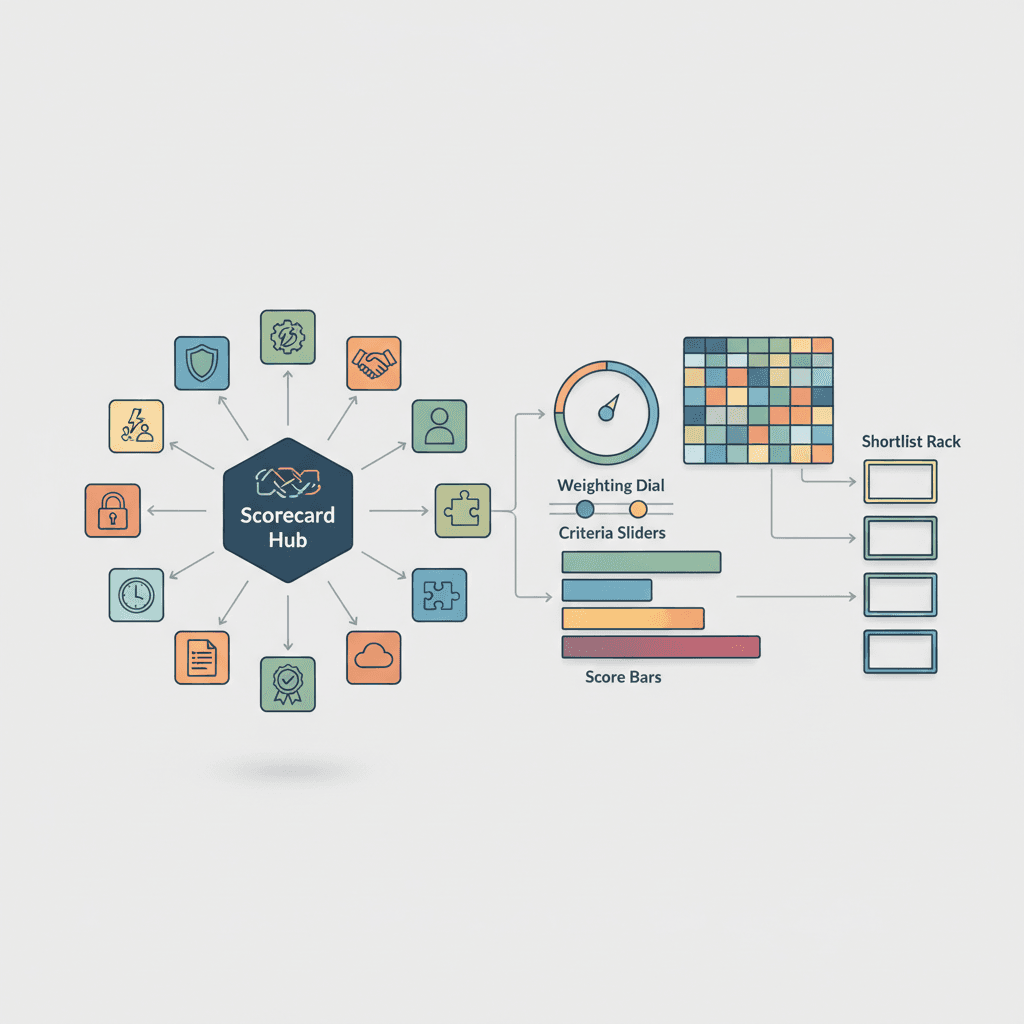
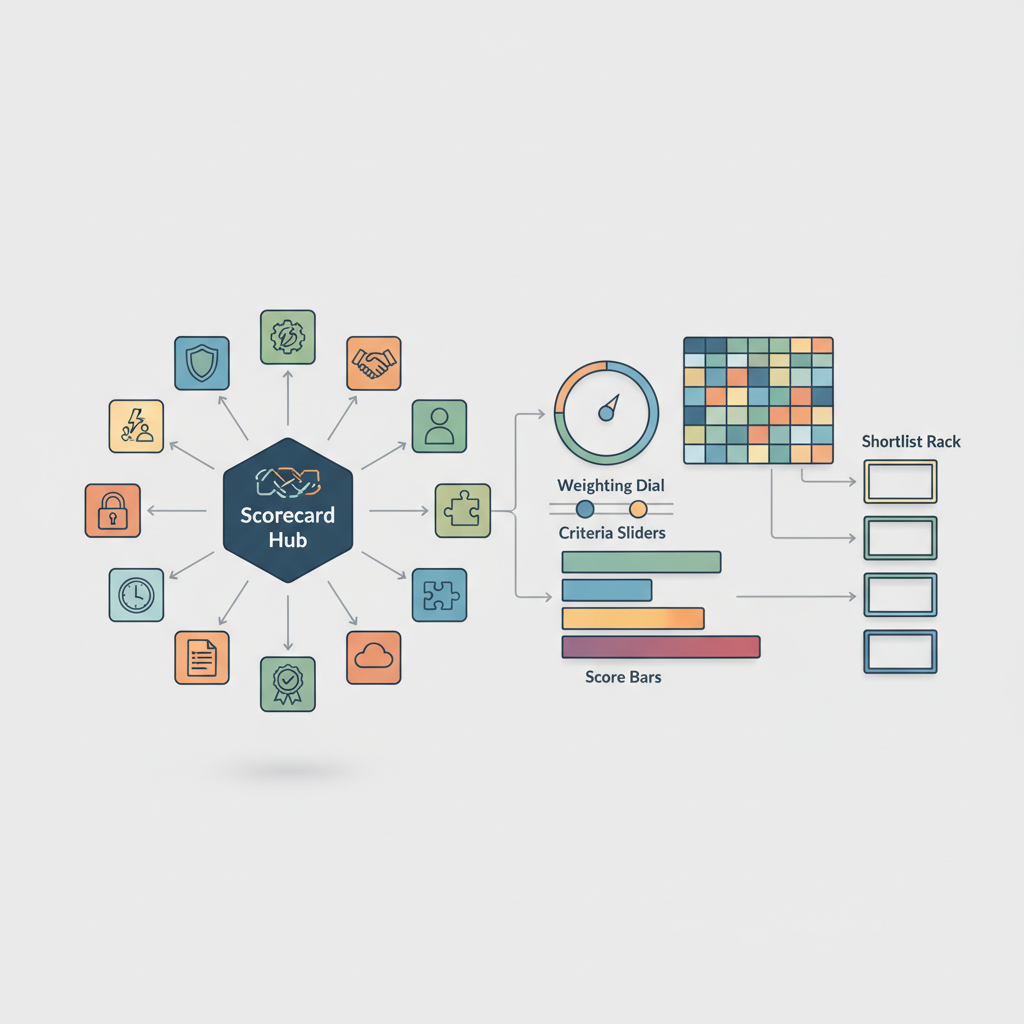
What is an ai vendor evaluation scorecard and why should you use one for pilots? A scorecard turns vendor conversations into comparable data: it forces you to rate product fit, data practices, security, integration cost, and supplier viability on a 0–5 scale so selection becomes objective.
'A vendor scorecard weights product fit, data handling, security, integration cost, and supplier viability; use a 0–5 scale and weighted totals to compare candidates.' Use this definition as a baseline when you build an ai vendor checklist for pilot selection. For more on this, see Ai vendor selection for pilots.
"Using a scorecard prevents fast-but-flawed picks. For example, a marketing team that chose a visually impressive demo without checking data residency later had to rip out the integration when GDPR rules applied. A simple scorecard would have surfaced residency and contractual gaps early, saving engineering time and legal review. For pilots, the scorecard focuses the team on low-risk, high-learning experiments and makes trade-offs explicit, aligning with an effective AI implementation strategy that guides teams from pilot to production."
When NOT to use a scorecard: don't use a detailed vendor scorecard when the pilot is an exploratory R&D experiment with no clear success metrics, when you have only one viable supplier, or when procurement rules mandate a different evaluation framework. In those cases, use lightweight checklists instead.
How to build a vendor scorecard—principles and weighting
Start with a clear goal: state the pilot hypothesis and two measurable KPIs (for example, F1 > 0.75 on intent classification and cost per inference < $0.02). Next, pick 6–8 categories to score, assign weights that reflect risk to pilot success, and use a 0–5 scale where 0 = fails requirement and 5 = exceeds expectation.
Example weighting (adjust to your priorities): product fit 20%, model performance 20%, data handling 15%, security/compliance 15%, integration effort 10%, TCO transparency 10%, vendor viability 10%. Concrete decision rule: any vendor scoring below 60% of the weighted total fails initial shortlisting.
Score independently: have product, engineering, legal, and operations each score vendors, then use the median per criterion to reduce outlier bias. Record notes tied to each score so reviewers can justify differences. This process turns an informal demo into an actionable ai vendor checklist for procurement and technical review.
12 criteria to include (H3s below)
This section breaks the scoring categories into the 12 practical criteria you should capture for any AI pilot. Each criterion should include a scoring question, evidence required, and a short decision rule.
Product fit & feature alignment
Score whether the vendor’s feature set maps to the pilot’s user journey. Evidence: feature matrix, screenshots, sample payloads. Decision rule: score 4–5 when >80% of required flows are supported without heavy customization; score 2–3 when workarounds or additional UI are needed.
Model performance & evaluation data
Ask for reproducible benchmarks and test sets. Evidence: evaluation datasets, precision/recall or F1, confusion matrices. Example threshold: for classification pilots target F1 > 0.7 on representative data; for latency-sensitive apps target P95 latency < 300ms. Require model versioning and test artifacts.
An evaluation data snapshot is required before the pilot; without it you cannot validate vendor claims.

Data handling & privacy practices
Record where data is stored, who can access it, and retention policies. Evidence: data processing addendum, flow diagrams, processing locations. For EU/UK data, verify contractual mechanisms for transfers; for California deployments ensure CCPA/CPRA handling. Decision rule: avoid vendors that process EU personal data outside approved mechanisms without contractual guarantees.
Security & compliance certifications
Request evidence of security posture: SOC 2, ISO 27001, or similar audits. Evidence: attestation reports and scope. For regulated pilots, require explicit coverage for applicable standards. Score higher where independent third-party audits exist and penetration test reports are available.
Integration effort & APIs
Score based on available API endpoints, SDKs, webhook support, and sample code. Evidence: API docs, Postman collections, example SDKs. Example rule: count estimated integration work in engineering days; treat <5 days as low effort and score 4–5.
Observability, logging, and explainability
Require runtime telemetry: request logs, input/output sampling, and model explanations (feature importances or attention traces). Evidence: logging retention, query tracing, explainability tool support. Score vendors that provide structured logs and query identifiers for debugging higher.
Support, SLAs and response times
Capture support tiers, escalation paths, and sample SLAs. Evidence: support documentation and case studies. For pilots, require a named technical contact and a response time commitment for Sev 1 incidents. Score accordingly if business hours or 24/7 support is available.
Pricing model & TCO transparency
Assess clarity of pricing: per-call, per-seat, committed-use discounts, and hidden costs (data egress, training). Evidence: sample invoices, cost calculators. Decision rule: prefer vendors that provide a projected 90-day TCO with usage bands and cost sensitivity analysis.
A price model without sample invoices or TCO examples is a risk; ask for real invoices before pilot approval.
Roadmap & vendor viability
Confirm product roadmap and financial stability. Evidence: roadmap milestones, customer references, funding disclosures. Score vendors higher when the roadmap aligns with your 6–12 month needs and there are multiple customer references in your industry.
Legal & IP posture
Clarify ownership of models, outputs, and derivative data. Evidence: contract clauses, IP assignment, and indemnities. For pilots that generate IP-sensitive outputs, require explicit license terms that preserve your ownership or usage rights.
Customization and professional services
Verify available professional services: data labeling, fine-tuning, integration. Evidence: service packages, rates, SLAs for deliverables. Score vendors that offer fixed-scope engagement packages with defined deliverables higher for pilots that require customization.
Exit/portability and data return
Record how data and trained models are returned on termination. Evidence: contractual exit terms, export formats, and data deletion certificates. Require exportable formats (CSV, Parquet, ONNX) and a 30-day export window in the contract to score high.
Sample scorecard template (CSV/Google Sheets-ready) and how to use it during selection
Below is a compact vendor scorecard template you can paste into a sheet. Use the weight column to reflect your priorities, score 0–5, and calculate weighted totals with simple formulas.
| Criterion | Weight (%) | Score (0–5) | Weighted score | Notes |
|---|---|---|---|---|
| Product fit | 20 | =B2*C2/5 | ||
| Model performance | 20 | =B3*C3/5 | ||
| Data handling | 15 | =B4*C4/5 | ||
| Security & compliance | 15 | =B5*C5/5 | ||
| Integration effort | 10 | =B6*C6/5 | ||
| Pricing & TCO | 10 | =B7*C7/5 | ||
| Vendor viability | 10 | =B8*C8/5 | ||
| Total | 100 | =SUM(D2:D8) |
Use the template to create a ranked shortlist. Export the sheet to CSV for procurement records or sharing.
Running a rapid vendor shortlist exercise (30–60 minute scoring session)
Set up a 45-minute scoring session with 4 reviewers: product, engineering, security/legal, and operations. Each reviewer opens the vendor scorecard and inputs independent scores for one vendor in 10–15 minutes. Then spend 10–15 minutes reconciling differences and recording evidence.
Practical steps: 1) prefill known facts (pricing band, residency), 2) ask reviewers to score silently, 3) discuss deviations >2 points, 4) compute weighted totals and apply the decision rule (e.g., top 3 vendors move to proof-of-concept). This method lets you quickly evaluate ai pilot vendor criteria and produce defensible shortlists.
Common pitfalls and how to avoid bias in scoring
Watch for anchoring on a single demo, recency bias for vendors you saw last, and over-weighting feature polish over integration risk. Avoid these by using blinded scoring (hide vendor names during initial scoring), requiring written evidence for each score, and using median scores rather than averages to reduce outliers.
Also, don’t forget to include an ai vendor checklist for non-technical checks (legal, procurement, residency) so scoring reflects business risk, not just product glamour.
Next steps after scoring: pilot design and contract checklist
After scoring, select 1–2 vendors for a narrow pilot. Design the pilot with clear success criteria: two KPIs, data inputs defined, evaluation dataset, rollback criteria, and 30/60/90-day milestones. Contractually require a data processing addendum, exit/export terms, SLAs for support, and a defined pilot scope with deliverables and acceptance criteria.
Sample KPIs to include in the contract appendix: target F1 or accuracy, maximum P95 latency, error budget per week, and cost cap for pilot usage. Include acceptance tests and a data deletion certificate on contract termination.
Appendix: downloadable scorecard + quick checklist
Quick checklist to attach to procurement and engineering requests:
| Item | Checked |
|---|---|
| Defined pilot hypothesis and two KPIs | |
| Data residency and processing locations verified | |
| Security attestations provided (SOC 2 / ISO) | |
| Export and exit terms included in contract | |
| Estimated integration days and sample code available |
FAQ
What is ai vendor evaluation scorecard for pilots? An ai vendor evaluation scorecard is a weighted checklist used to compare vendors on product fit, data handling, security, integration effort, pricing transparency, and vendor viability; it converts subjective demos into objective, auditable scores.
How does ai vendor evaluation scorecard for pilots work? The scorecard assigns weights to prioritized criteria, asks cross-functional reviewers to score each vendor 0–5 with evidence, computes weighted totals, and applies a decision rule to create a defensible shortlist.
References
- Artificial Intelligence Risk Management Framework: Generative Artificial Intelligence Profile
- Driving Efficient Acquisition of Artificial Intelligence in Government (White House memo)
- Regulation EU 2024/1689
- MITRE launches AI incident sharing initiative
- G7 Toolkit for Artificial Intelligence in the Public Sector