
Introduction — common integration architectures and risks
What is an ai api security checklist and why do you need one?
An ai api security checklist is a practical list of controls you apply to every AI integration so data, models and users remain protected. It focuses on the API surface, the data flows into and out of models, and operational controls that prevent exposure of sensitive information.
Data flow is the path data follows from collection, through processing, to storage; a processing boundary is the point where responsibility shifts (for example, your server handing inputs to a third‑party model). For EU deployments, apply GDPR data minimization inside the processing boundary and retain only what’s needed. In the US, prepare for state-level breach-notification windows and for CCPA-style deletion requests. In APAC, check local data localization rules before sending PII across borders.
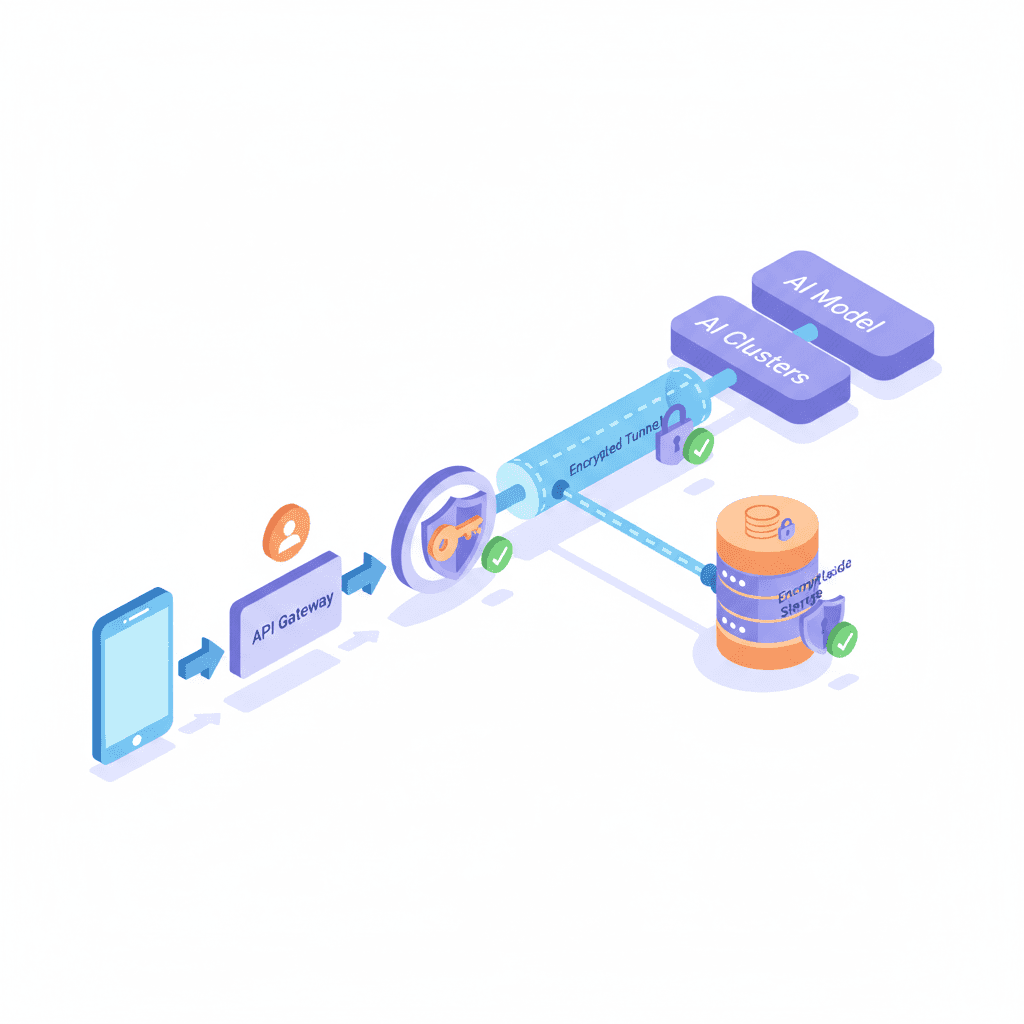
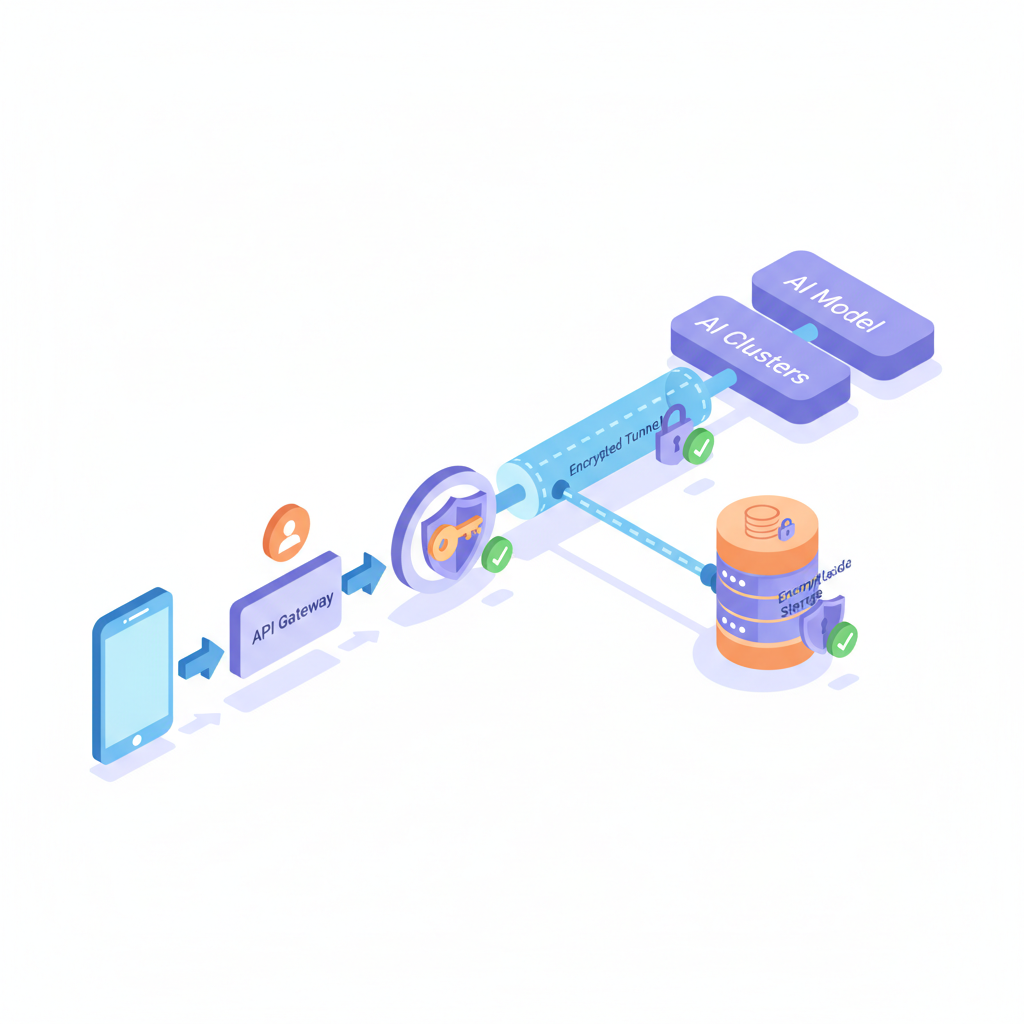
Common integration patterns include: (1) client-side calls directly to a provider API, (2) server-proxy pattern where your backend sanitizes inputs and forwards requests, and (3) hybrid batch processing. Each changes your attack surface—the checklist below assumes you control the proxy or backend before any third-party call.
Who this is not for
This checklist is not appropriate for teams that lack any production traffic: prototypes without user data, research sandboxes with synthetic inputs, or closed offline evaluation where no external APIs are called. Do not apply these controls when the processing cannot be evaluated for safety or when contractual constraints forbid any logging. Additionally, if your integrations are fully on-premises with zero external network access, you may want to consider how to evaluate AI integration and data privacy before proceeding.
Map your data flows (sensitive data, PII, model inputs/outputs)
Begin by drawing a simple diagram that shows where data originates, which components touch it, and where model outputs land. Label every hop as one of: collection, preprocessing, third‑party call, storage, or consumption. Prioritize flows that include: email, phone, government IDs, financial details, or health data. For each flow, record the processing boundary—who owns the data at each hop and who has legal responsibility.
Actionable step: create a spreadsheet with columns: flow name, data types, owner, processing boundary, third-party endpoints, retention period, and risk rating. For typical SaaS sites, mark flows that cross country borders and require extra controls. This mapping is the single most effective tool to reduce risk and scope audits.
Data classification template
Use a simple classification to drive handling rules. Example template:
- Public: Non-sensitive, safe to log (e.g., product categories).
- Internal: Business data, limited retention (e.g., usage metrics).
- Sensitive: PII or business secrets — avoid sending to external models unless anonymized.
- Restricted: Health, financial, or legal data — do not send to third parties without explicit consent and contract.
Practical example for xproductlist.com: treat uploaded screenshots that may contain usernames as Sensitive; redact or ask users to remove PII before processing. Apply the label to inputs and outputs so downstream controls (logging, retention) follow automatically. For more on this, see Ai product evaluation framework.
Only expand your data scope after you can enumerate its processing boundary and justify retention in writing.

Authentication & authorization best practices
Protect every API endpoint with strong authentication and least-privilege authorization. Authenticate service-to-service calls using short-lived credentials and verify caller identity inside the proxy layer. Enforce role-based access control (RBAC) on any system that issues requests to models: only approved services should be able to call high‑risk endpoints.
Concrete controls: require mutual TLS for internal service calls where possible, implement RBAC policies that deny by default, and log authorization failures. Example KPI: target 100% of production AI calls to require authenticated service tokens and 0% anonymous model access.
OAuth, mTLS, API keys rotation and scopes
Prefer OAuth 2.0 client credentials or mTLS for server-to-server authentication. If you must use API keys, store them in a secrets manager and rotate them every 30–90 days depending on sensitivity. Apply scopes so keys granted to ingestion services cannot call administrative APIs or change model settings.
Example policy: for a staging environment, issue keys limited to read-only inference with a 90‑day rotation; for production inference that handles PII, use mTLS with certificates rotated every 30 days. Automate rotation via CI/CD to avoid expired credentials blocking traffic.
Encryption and secrets management
Encrypt secrets at rest and in transit and centralize secret storage. Use a managed secrets manager rather than environment variables when possible. Secrets include API keys, database credentials, and client certificates. Limit secret access to a small set of service principals and audit access.
Design rule: encrypt with AES‑256 for stored secrets and TLS 1.2+ for transport. For cloud-hosted key storage, enable access logging and MFA for administrative actions. Ensure your secrets manager supports automated rotation and versioning.
Do not store raw PII in logs; store only hashed identifiers and metadata required for debugging.
In-transit and at-rest recommendations
Always use TLS for API calls to external providers and enforce HTTPS with TLS 1.2 or higher. For internal networks, use mTLS where latency permits. At rest, encrypt databases and object stores containing inference results. For files that contain sensitive user inputs, apply field-level encryption or tokenization prior to storage.
Concrete threshold: for high-volume inference systems, aim for P95 latency under 300ms for local proxy processing; keep encryption CPU usage budgeted so it doesn’t add more than 10% latency overhead.
Key management and HSM guidance
Store root keys in hardware security modules (HSMs) or managed KMS with HSM-backed keys. Use envelope encryption: application encrypts data with a data key, then the KMS encrypts the data key. Limit KMS key creation to a small ops group and require multi-person approval for destructive actions.
Example practice: use separate keys per environment (dev/stage/prod) and rotate data-encryption keys on a 12‑month schedule, while rotating access keys more frequently (30–90 days).
Input/output sanitization and content filtering
Sanitize inputs to remove PII before you send them to an external model. Use deterministic redaction for fields like emails and phone numbers and run a content filter to remove injection patterns (e.g., prompt‑injection markers). For outputs, apply a post-processing filter that removes or masks any regenerated PII or secrets before presenting results to users.
Practical step: implement a pre-send sanitization function that strips patterns matching emails, SSNs, and credit card numbers and replaces them with tokens. Keep a reversible mapping only if contractually allowed; otherwise store only hashed tokens.
Rate limiting, throttling and abuse prevention
Rate limit per API key and per user to prevent runaway costs and abuse. Implement exponential backoff for clients and circuit breakers that stop sending requests to a provider when error rates exceed a threshold. Use quotas to enforce budget caps and alert when usage hits 80% of allocation.
Concrete rules: enforce a per-key rate of 60 requests per minute for standard users and a lower threshold for new accounts. Implement short-term throttling (e.g., 429 for bursts above limit) and longer-term blocks for abuse patterns like scraping or prompt injection attempts.
Monitoring, logging and alerting for AI API calls
Monitor request volumes, error rates, latency, and unusual input patterns. Alert on sustained spikes in errors (>5% over 5 minutes) and on any detected data-exfiltration patterns. Use dashboards to show model version usage and drift indicators.
Quotable checklist snippet: "Log API request metadata and model version, but avoid storing raw PII from inputs unless contractually and legally justified."
What to log (request metadata, model version, timestamps)
Log metadata only: timestamp, request ID, model identifier and version, caller service, input size, and outcome code. Avoid logging raw inputs that contain PII. For debugging, capture hashed input fingerprints and a sanitized excerpt. Record model version to trace behavior changes after deployments.
Retention policies for logs and outputs
Keep logs no longer than necessary. For GDPR compliance, apply short retention windows for metadata-driven logs (e.g., 30–90 days) and honor CCPA deletion requests by removing identifiers on request. For incident investigations, maintain a secure archive with restricted access and an explicit retention justification.
Testing & verification (pen tests, red teams, integration tests)
Run automated integration tests that include adversarial inputs and model version checks. Schedule regular penetration tests and red-team exercises focused on prompt injection, data exfiltration, and authorization bypass. Include a smoke test in CI that asserts the proxy sanitization step runs before any external call.
Example test: include a CI job that sends known-injection patterns and verifies the system blocks or sanitizes them. Track test coverage as a KPI and aim to add tests for every high-risk flow in your data map.
Incident response & breach playbook for AI integrations
Maintain a playbook that lists detection criteria, containment steps, communication templates, and regulatory notification triggers. If an exposed flow crosses an EU processing boundary, ensure GDPR breach timelines are met; in the US, prepare state-level notification timelines. Practice the playbook quarterly with a tabletop exercise including engineering and legal.
Containment example: revoke compromised credentials, rotate keys, and snapshot logs for forensic analysis. Communicate impact clearly and record lessons learned to update the data-flow map.
Deployment checklist and continuous compliance (CI/CD controls)
Embed security gates into CI/CD so deployments with new model versions or config changes require automated checks. Controls include: unit tests for sanitization, signed artifacts, static analysis for secrets, and a deployment approval step for any change that touches processing boundaries.
| Control | Goal | Example artifact |
|---|---|---|
| Sanitization test | Prevent PII leaks | CI job that asserts redaction passes |
| Secrets scan | No hard-coded keys | Pre-merge pipeline report |
| Approval for model changes | Operational review | Signed release note |
Implementation examples and quick-start checklist for devs
Quick-start checklist for a server-proxy integration:
- Map the data flow and label PII fields.
- Implement pre-send sanitization and test in CI.
- Use OAuth/mTLS for service auth and store secrets in a KMS.
- Enable structured logging (no raw PII) and set retention to 30–90 days.
- Configure rate limits and alerts for error/latency spikes.
Example walkthrough: a developer at xproductlist.com should wrap any third-party model call with a middleware that strips emails and phone numbers, inserts a request ID, and records model version. This middleware becomes the single place for future audits and fixes.
Conclusion — prioritized 30/60/90 day tasks
Start with the essentials: within 30 days, map your top 3 data flows, add sanitization middleware, and enforce authenticated service calls. In 60 days, add logging (metadata only), implement key rotation, and set rate limits. In 90 days, run a red-team exercise, automate CI gates for sanitization, and formalize retention policies. This ai api security checklist gives you a pragmatic path from discovery to continuous compliance.
FAQ
What is api & data-flow security checklist for safe ai integrations? An ai api security checklist is a set of practical, actionable controls you apply to API integrations with AI models to protect sensitive data, authenticate callers, and monitor behavior.
How does api & data-flow security checklist for safe ai integrations work? The checklist works by narrowing your data scope with a data-flow map, enforcing sanitization and strong authentication before any external calls, and maintaining monitoring, retention, and incident playbooks so you can detect and respond to issues.