
Why pilots fail — common root causes
What causes an AI pilot to fail midway through testing? In most cases the failure traces to a small set of avoidable problems: poor data, unclear objectives, shaky integrations, low user adoption, or surprise compliance issues. Addressing those areas quickly usually recovers a failing pilot.
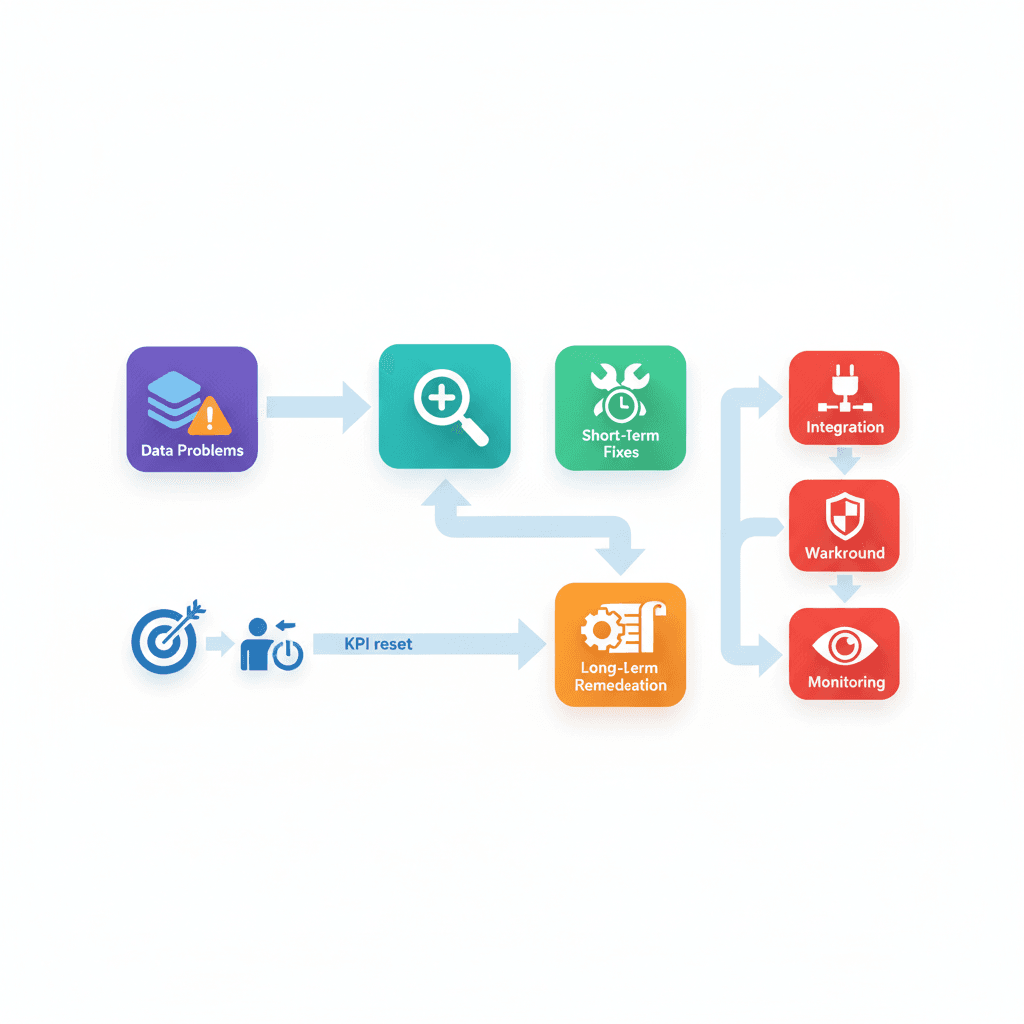
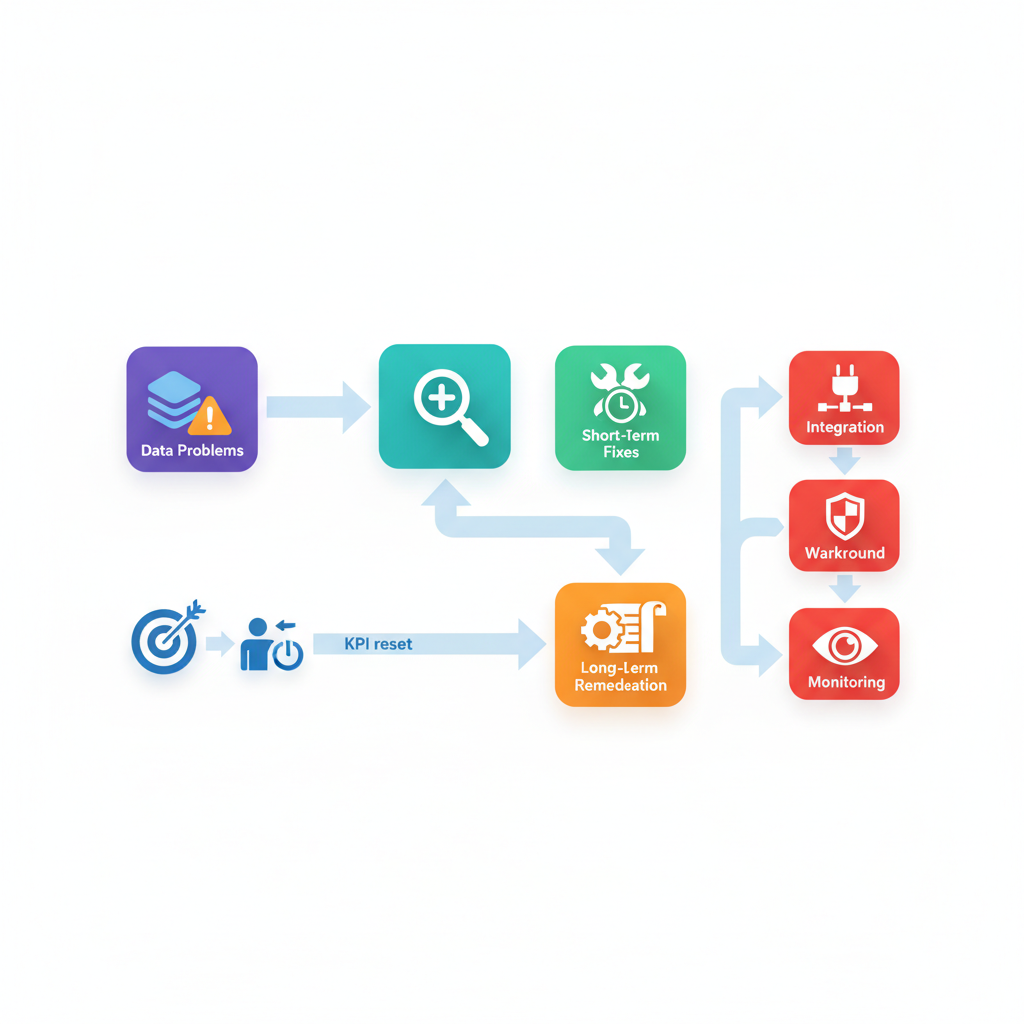
Start by treating pilot failure as a systems problem, not just a model problem. For example, a customer-facing recommendation pilot on xproductlist.com that suddenly lowers conversions often fails because product metadata is incomplete, not because the recommender is fundamentally wrong. Common failure modes in AI pilots include data skew, specification drift, mismatched KPIs, engineering bottlenecks (latency or scaling), user resistance, and unanticipated vendor/data-handling constraints. To effectively address these issues, consider following a structured approach by running an AI pilot with a clear framework, as each failure mode has a distinct symptom set and a different remediation path.
An AI prototype is production-ready only when failures are predictable, recoverable, and cheaper than the value the system delivers.

Data problems (incomplete data, skew, drift)
Data issues are the single most frequent root cause of pilot failure. Incomplete feature coverage, label errors, selection bias, and data drift all degrade model outputs. For instance, a classification pilot trained on desktop traffic will misbehave when exposed to mobile-heavy users—the traffic distribution shifts and the model underperforms.
Practical steps to diagnose: run a schema comparison between training and live inputs, compute feature-wise null rates, and measure label disagreement on a 200-case sample. Concrete thresholds: flag any feature with >10% unexpected nulls or a feature distribution shift where population mean changes by more than 20% relative to training (conditional on your domain). For EU pilots, add an explainability audit to document how input changes affect outputs for GDPR purposes; for US pilots, log data residency and vendor processing locations to check contractual SLAs.
Remediation examples: backfill missing catalogue attributes for xproductlist.com listings, rebuild feature pipelines to normalize timestamps, and retrain on a blended dataset that includes recent traffic. If retraining isn't feasible within the pilot window, implement input-side validation that rejects or flags out-of-distribution requests.
Symptoms and quick triage steps
If model accuracy drops or user satisfaction falls by mid‑pilot, pause automated outputs, collect 50 representative failure cases, and run a root‑cause triage within 72 hours. That quick checklist is the fastest route to actionable insights.
Symptom checklist to watch for: sudden KPI dips (CTR, conversion), spike in error/exception logs, rising latency, and an uptick in user complaints. Triage steps:
- Pause or throttle the model's live actions if outputs affect user transactions.
- Gather a stratified sample of failures (50–200 examples) and tag each with suspected cause (data, model, integration, UX).
- Run a quick feature-importance delta to see which inputs moved most since training.
- Check recent deployment changes, pipeline jobs, and third-party provider updates.
Quotable snippet: "If model accuracy drops or user satisfaction falls by mid‑pilot, pause automated outputs, collect 50 representative failure cases, and run a root‑cause triage within 72 hours."
Short‑term fixes vs long‑term remediation
Short-term fixes buy time; long-term remediation prevents recurrence. Short-term actions include disabling risky automation, adding simple rule overrides, and routing suspicious cases to human review. For example, if an AI content tagging pilot mislabels high-value listings on xproductlist.com, set a confidence threshold (e.g., hide tags with model confidence < 0.6) and add manual review for those items.
Long-term remediation includes retraining with corrected labels, improving monitoring, and building robust CI for data pipelines. Use a decision rule: if the failure affects >5% of user journeys or causes regulatory exposure, escalate to a full remediation plan. For typical SaaS-style pilots, target P95 latency under 300ms for inference and deploy model-serving retries with exponential backoff to reduce transient errors.
Undefined objectives and poor KPI alignment
Pilots often fail because stakeholders haven't agreed on measurable objectives. If the product team wants engagement while marketing expects conversion lifts, the pilot will look like a failure to one group even if it meets the other metric. Clear objective definition is non-negotiable.
Specify one primary KPI, two secondary KPIs, and a short evaluation window. Example KPI set for a personalization pilot: primary = 7-day conversion rate lift; secondary = click-through rate uplift and average order value change; guardrail = model error rate under 2% on validated samples. Embed those KPIs into the pilot charter and use them as stop/go criteria.
How to reframe objectives mid‑pilot and reset KPIs
When initial KPIs prove unrealistic, reframe using measurable, time-boxed experiments. Steps to reset:
- Run a 72-hour diagnostic to confirm which KPIs are salvageable.
- Translate product outcomes into model-level metrics (e.g., reduce false positives by X%).
- Set a new, shorter evaluation window (e.g., 14 days) with clearly assigned owners for each KPI.
Example: if conversion didn't lift due to low exposure, reframe primary KPI to "exposed user conversion rate" and add a rollout plan to increase exposure by 3x over two weeks. Document the change and get sign-off from stakeholders to avoid scope creep.
Integration and engineering issues (latency, scaling, monitoring gaps)
Even a perfect model fails if it can't integrate cleanly. Common engineering issues: synchronous calls that increase page load time, lack of retries for transient API failures, and insufficient observability. For instance, a recommendation API that adds 500ms to page load will reduce conversion regardless of recommendation quality.
Concrete engineering thresholds: aim for P95 inference latency < 300ms for user-facing features and error budget under 0.1% per day. Add structured logs and tracing to correlate model outputs with downstream errors. If your stack supports it, add feature-level telemetry so you can measure which input fields cause failures.
Monitoring an AI system without tracking data drift converts silent model decay into a production outage.
Workarounds to keep the pilot running while engineering catches up
Workarounds are temporary but essential. Options include:
- Serve cached responses for high-traffic queries to reduce load.
- Switch to batch scoring and surface results asynchronously to users.
- Introduce a lightweight proxy that sanitizes inputs before they reach the model.
Example: if autoscaling isn't ready, limit concurrent model calls per user and surface a fallback UI that explains the temporary restriction. Track these fallbacks as metrics so you know when the workaround becomes a hidden failure mode.
User adoption & change management failures
Low adoption kills pilots faster than technical bugs. Users may not trust automated outputs, or the new flow may conflict with existing workflows. The pilot must make the user's job demonstrably easier in the first session.
Measure adoption with time-to-first-success, feature activation rate, and NPS change among pilot users. If adoption stalls, collect qualitative feedback via short in-app surveys and 15–30 minute interviews with representative users to discover friction points.
Rapid user feedback loops and onboarding plays to recover adoption
To recover adoption quickly, run targeted onboarding plays: serve contextual micro-tutorials, add a one-click undo for AI actions, and provide visible confidence indicators. Example play: A/B test a guided tour that highlights three quick wins; measure activation rate lift after 7 days.
Use rapid feedback loops—deploy a change, measure within 72 hours, and iterate. That cadence keeps momentum and shows stakeholders tangible progress while the pilot continues.
Privacy, compliance and vendor/data handling surprises
Privacy and compliance surprises often end pilots immediately. Examples: a vendor processes EU user data outside approved jurisdictions, or model outputs include PII unexpectedly. Treat compliance as a first-class failure mode.
For EU pilots, prioritize GDPR incident playbooks and explainability steps that allow you to demonstrate automated decision logic. For US pilots, confirm contractual SLAs and data residency clauses. Explicitly log vendor processing steps and preserve audit trails during the pilot.
Immediate containment steps and compliance escalation path
Containment steps:
- Pause the feature for affected users or geographies.
- Collect and quarantine impacted records (retain 50–200 representative examples).
- Notify legal/compliance and follow your incident escalation path; for EU data breaches, check mandatory reporting windows (typically 72 hours under GDPR).
Document each action and maintain a timeline—regulators expect clear records of remediation steps.
Mid‑pilot course correction checklist (playbook with prioritized actions)
Use a prioritized playbook to keep the team focused. The table below is a ready-to-copy artifact for mid-pilot correction.
| Action | Priority | Owner | Target |
|---|---|---|---|
| Pause automated outputs for affected cohort | P0 | Product lead | 24 hours |
| Collect 50–200 failure cases | P0 | Data scientist | 72 hours |
| Run data schema and drift check | P1 | Data engineer | 72 hours |
| Deploy rule-based fallback UI | P1 | Engineering | 7 days |
| Stakeholder KPI reset and sign-off | P1 | Product + Marketing | 7 days |
Post‑mortem structure: what to capture if the pilot fails
A disciplined post-mortem turns failure into institutional learning. Capture: timeline of events, sample failures (with 50–200 examples), root-cause analysis mapped to data/model/integration/UX/compliance, decisions made, and follow-up actions with owners and deadlines. Include a short ROI assessment explaining whether further investment is warranted.
Preventative checklist for future pilots (requires minimal ops overhead)
Preventative checklist (copyable):
- Define primary KPI and stop/go criteria in the pilot charter.
- Implement input validation and feature-level telemetry before rollout.
- Set P95 latency targets (e.g., <300ms) and error budgets.
- Establish a 72-hour triage process and assign owners.
- Include compliance checklist (data residency, explainability) for each geography.
Conclusion — when to stop a pilot vs. when to iterate
Stop a pilot when it breaches legal/compliance boundaries, when it causes measurable user harm, or when corrective actions exceed the expected value. Iterate when failures are local, diagnosable, and fixable within the pilot window. Example decision rule: if fixes require more than 30% of the planned production engineering effort or six weeks of work, pause and re-scope; otherwise, continue with targeted remediation.
When NOT to productionize: if outputs cannot be evaluated, if inputs drift faster than retraining cadence, or if regulatory exposure is unresolved.
FAQ
What is common failure modes in ai pilots (and how to fix them mid-test)? Common failure modes in AI pilots are predictable categories of breakdown—data problems, KPI mismatch, integration gaps, low adoption, and compliance surprises—and mid-test fixes include immediate containment, sample collection for root-cause analysis, short-term rule-based fallbacks, and stakeholder KPI resets.
How does common failure modes in ai pilots (and how to fix them mid-test) work? Identifying failure modes works by mapping observed symptoms to root causes, running a 72-hour triage (collect failures, check data drift, isolate integrations), applying temporary mitigations, and then choosing either to iterate with targeted engineering or to stop and conduct a post-mortem.
References
- New whitepaper outlines the taxonomy of failure modes in AI agents — Microsoft Security Blog
- Defense in depth for autonomous AI agents — Microsoft Security Blog
- Artificial Intelligence Risk Management Framework: Generative AI Profile — NIST
- Adversarial Machine Learning: A Taxonomy and Terminology — NIST CSRC
- OWASP GenAI Security Project: Top 10 Risks — OWASP GenAI