

TL;DR
- Problem: your site sends more user data to AI vendors than necessary, increasing legal and security risk.
- Quick answer: apply strict data minimization for ai tools, enforce ai data access controls, and put retention + deletion obligations into vendor contracts.
- First steps: 1) audit inputs, 2) pseudonymize or sample before sending, 3) require subprocessors and breach notification clauses from vendors.

If your website routes form submissions, chat transcripts, or analytics to third-party AI services, you face a real compliance and security problem: sending unnecessary personal data inflates risk and regulatory exposure. Data minimization for ai tools reduces that attack surface and simplifies audits; combined with role-based ai data access controls and clear vendor obligations, it turns an open pipe into a controlled workflow.
Why data minimization matters for AI integrations
Without focused minimization, AI integrations collect and retain data that never improves service. That creates three concrete failures: increased breach impact, harder subject-access responses, and higher compliance costs. For example, a contact-form bot that forwards full message history plus IP and email to a model will expose identifiers that are unnecessary to produce a helpful reply.
Data minimization for ai tools solves this by limiting inputs to what is strictly needed for the task — for a support bot, that might be only the message text and a non-identifying ticket ID. Practically, apply these rules: document each integration's purpose, list required fields, and block or redact extras before calling the AI API.
Quotable compliance pointer: "GDPR can require data minimization and purpose limitation — include explicit retention and deletion obligations in vendor contracts; noncompliance may lead to fines up to 4% of worldwide annual turnover."
Core principles: collection, storage, retention, and deletion
Start by mapping what you collect from users and where it flows. For every AI call record: (1) purpose, (2) fields sent, (3) storage location, and (4) retention period. Use concrete thresholds: keep raw AI inputs for no longer than 30 days unless you can justify longer retention; store only derivatives (e.g., anonymized insights) beyond 90 days.
Collection: collect only fields required for the immediate task. Storage: segment AI logs from primary databases and encrypt them at rest. Retention and deletion: implement automated deletion jobs that run daily and log deletions for audit. For subject-access requests, avoid re-identifying data by storing mapping tables separately and protect them with stronger controls.
Store identifiers separately from AI inputs; automated deletion reduces audit burden and breach scope.
Practical steps to minimize data exposure (pseudonymization, sampling, synthetic data)
Apply pseudonymization: replace names, emails, and phone numbers with salted hashes before sending to an AI provider; keep the salt in a vault that the vendor never sees. Use sampling: when training models or analyzing logs, use representative samples (e.g., 10% random sample or stratified P95 sampling) rather than full datasets. For testing, prefer synthetic data generated from schema—synthetic sets eliminate real identifiers entirely.
Example workflow for a support pipeline: 1) client submits message, 2) backend strips attachments and hashes the email, 3) a short excerpt (max 500 characters) is sent to the AI model, 4) the system stores only the ticket ID and AI response. That workflow keeps exposure low while preserving utility.
Pseudonymize before sending; synthetic and sampled data reduce leakage without losing model value.
Access control patterns for AI tools (least privilege, role-based access, ephemeral credentials)
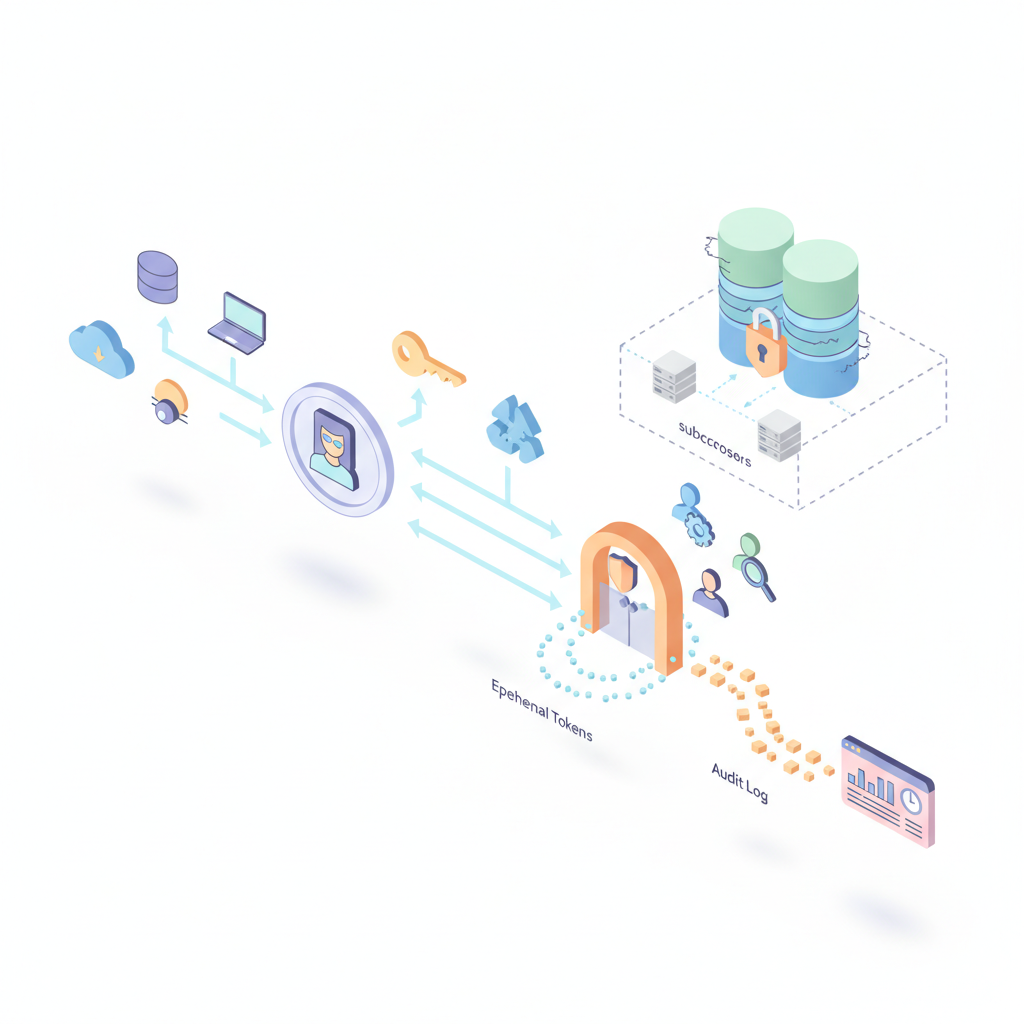
Access control limits who and what can call AI services. Use least privilege: give AI integration keys only the scopes required (for example, inference-only keys that cannot read training data). Implement role-based access so developers, SREs, and product owners have separate, auditable permissions. Enforce ephemeral credentials for automated jobs: short-lived tokens that rotate every 15–60 minutes cut the blast radius of leaked keys.
Operational example: create two API roles for an AI vendor—"inference" with strict rate and data limits, and "admin" used only by a small security team. Log all token requests and token-holder actions to a centralized audit log; integrate with your SIEM to alert on unusual patterns like token use from new IPs or outside business hours.
Include ai data access controls in your internal privacy checklist and developer onboarding so permission creep is visible and reversible.
Technical controls: hashing, encryption at rest/in transit, tokenization
Protecting data requires layered technical controls. Hashing removable identifiers (SHA-256 with per-environment salt) prevents casual re-identification; tokenization replaces sensitive fields with reversible tokens stored in a secure vault. Always enforce TLS for in-transit encryption and use provider-managed or customer-managed keys for encryption at rest.
Concrete targets: require TLS 1.2+ for API calls, AES-256 for data at rest, and HMAC verification for callbacks. For logs retained longer than 7 days, apply field-level encryption for identifiers. These measures reduce the value of intercepted data and support compliance with data residency and access requirements.
Vendor contract clauses and questions to ask (data residency, subprocessors, breach notification)
Contracts must translate controls into obligations. Ask vendors to confirm: where data resides, whether subprocessors are used and how they’re approved, retention periods, and breach notification windows. Require subprocessors to meet the same obligations and require prior notice of changes.
Key clause items to include: purpose limitation, data minimization commitments, explicit gdpr ai vendor requirements (where applicable), retention schedules, deletion and export mechanics, subprocessor lists, and a breach notification window (e.g., notify within 72 hours). Also require the right to audit or to receive attestation reports such as SOC 2 Type II.
Mention ai vendor data handling checklist items during procurement: proof of encryption, list of subprocessors, incident history, and a copy of their data flow diagrams.
Example clause templates for data minimization and access auditing
Use precise language. Sample clause (redacted): "Vendor will process only data fields strictly necessary to perform the agreed service, will pseudonymize identifiers before storage, and will purge raw inputs within 30 days unless Customer directs otherwise."
Auditing clause example: "Vendor will provide quarterly access logs, including API key usage with timestamps and actor identity, and will permit a Customer-led audit once annually with 30 days’ notice." Keep clauses short and prescriptive; avoid vague phrases like "reasonable measures."
Operational checklist for audits and continuous monitoring
Operationalize minimization with a runnable checklist you can use at procurement and in production. Example items: 1) map data flows for each AI integration, 2) record required fields and retention periods, 3) configure masking/pseudonymization pipelines, 4) enforce role-based keys, 5) schedule monthly access-review meetings, 6) run deletion jobs and verify via logs.
| Task | Frequency | Owner |
|---|---|---|
| Data-flow map review | Quarterly | Product security |
| Access-list audit | Monthly | Identity team |
| Retention compliance check | Weekly | Data ops |
Include ai vendor data handling checklist items when onboarding a new vendor and embed the checklist into procurement steps so compliance gates aren’t skipped.
Incident response and vendor SLAs for data incidents
Your incident playbook must name responsibilities and SLAs. Require vendors to notify you within 72 hours of a breach and to provide a remediation plan within 5 business days. Define who will communicate with regulators and affected users, and require vendors to retain forensics artifacts for at least 90 days post-incident.
Operational example: set a vendor SLA that binds them to provide full access logs within 48 hours and to quarantine compromised keys immediately. Maintain a runbook that lists the internal contacts, communication templates, and the legal team steps for regulatory filings under gdpr ai vendor requirements.
Quick compliance map: GDPR, CCPA/CPRA, and other common rules
High-level differences matter for residency, consent, and notification windows. The table below helps you pick controls that satisfy multiple regimes.
| Region | Data residency | Consent model | Breach notification |
|---|---|---|---|
| EU (GDPR) | Strict—often required for special categories | Consent or lawful basis; data minimization required | 72 hours |
| US (CCPA/CPRA) | Flexible | Opt-out for sale of personal info; disclosure rights | Varies by state |
| APAC | Varies—some countries require local storage | Consent-heavy in some markets | Varies; often shorter disclosure windows |
Quotable snippet: "GDPR demands purpose limitation and data minimization; contracts should include retention and deletion obligations to avoid fines up to 4% of global turnover." Include privacy checklist for ai tools that maps the above rows to your controls.
Conclusion: governance playbook next steps
Start by running a single integration audit: document fields, enforce pseudonymization, add role-based keys, and update the vendor contract with a deletion clause. Repeat this per integration and automate audits where possible. Data minimization for AI tools isn’t a one-time project—it’s a governance habit that reduces risk and simplifies compliance, aligning with best practices in AI governance and data security.
When NOT to apply these controls
These recommendations do not apply when you process non-personal aggregated metrics only, when regulatory requirements mandate storage of full records (e.g., legal hold), or when you run closed, on-premises models under strict internal controls that never touch external vendors.
FAQ
What is data minimization & access controls for ai integrations? Data minimization for ai tools means collecting and sending only the data strictly necessary for the AI task, and applying ai data access controls so only authorized actors and processes can access or call the AI service.
How does data minimization & access controls for ai integrations work? The approach works by mapping data flows, removing or pseudonymizing identifiers before transmission, applying role-based and least-privilege keys for API access, enforcing short retention periods and automated deletion, and embedding those obligations into vendor contracts and operational checklists.
References
- Opinion 28/2024 on certain data protection aspects related to AI models — European Data Protection Board
- First EDPS orientations for EUIs using generative AI — European Data Protection Supervisor
- What is the scope of the AI how-to sheets? — CNIL
- AI, Large Language Models and Data Protection — Data Protection Commission (Ireland)
- Guidance and practical resources — Information Commissioner's Office (UK)