

TL;DR
- Buying an AI marketing tool without clear data and IP terms exposes you to leakage, model-training risk, and regulatory fines.
- Quick action: require data residency, explicit content ownership, no-training or opt-out clauses, detailed retention schedules, and audit logging before a pilot.
- Use the 12-point checklist below and the contract language samples to get a pilot approved quickly and safely.

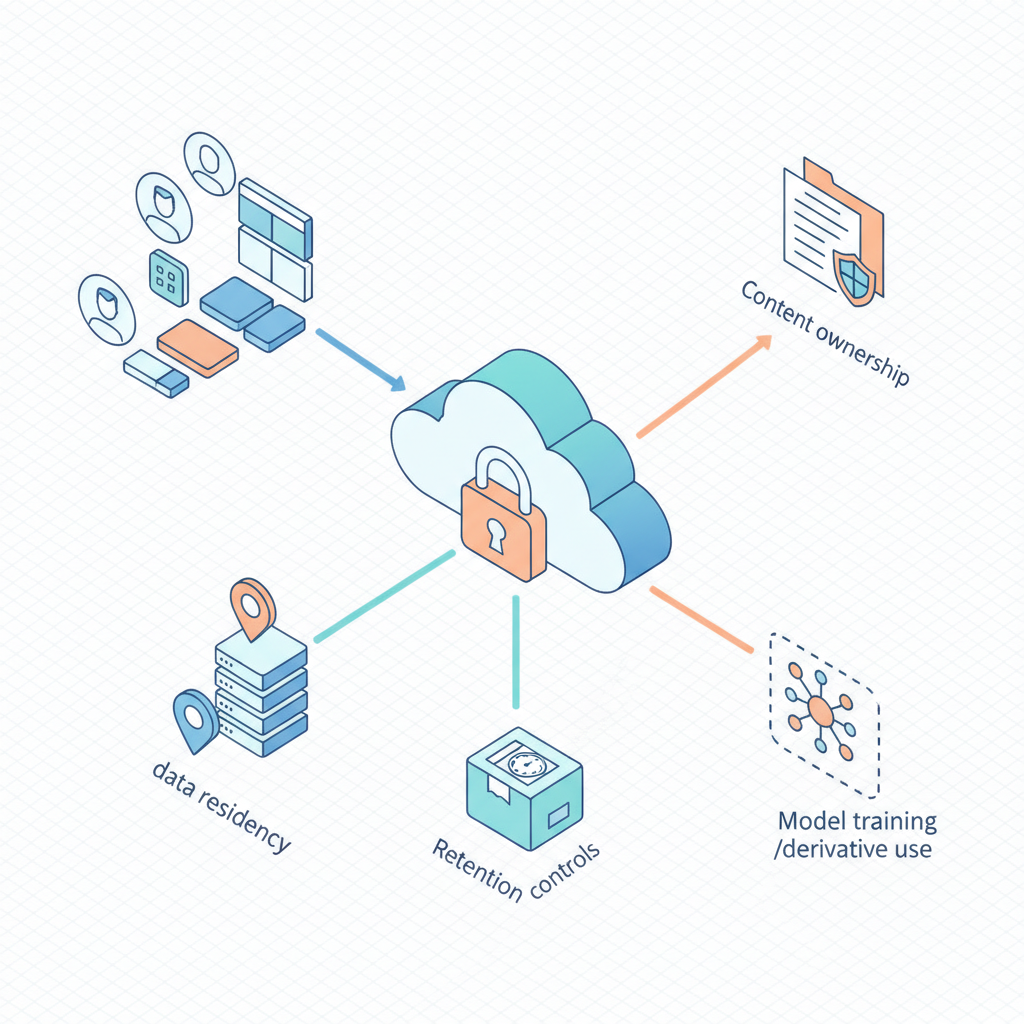
Why privacy and content ownership matter for marketing teams
You might be under pressure to ship content faster, but handing raw creative brief materials, customer lists, or user data to an AI vendor without clear protections creates three practical risks: accidental public exposure of PII, your campaign creative being reused to train third-party models, and regulatory exposure in the EU, UK or California. For a website owner, marketer, or developer, those translate into lost brand control, potential takedowns, and costly remediation.
Quick answer: adopt an ai marketing tool data privacy checklist that forces vendors to declare how they collect, store, use, and delete data, plus explicit ai tool content ownership language that keeps your creative assets yours and prohibits model training without consent. For more on this, see Choose ai tools for marketing.
Example: when curating tools for xproductlist.com, require vendors to sign a short pilot addendum that confirms content ownership and that submitted files will not be used to train models absent explicit written permission. For more on this, see Ai tools for marketing.
Quick primer: key legal concepts (data processing, controller vs processor, ownership)
If you collect or submit personal data, determine roles: are you the controller (you decide why and how data is processed) or the processor (you act on the controller's instructions)? Vendors often try to position themselves as controllers; push back where you control the marketing data and customer lists.
Data processing: any operation on personal data (collecting, storing, analysing). Retention: how long the vendor keeps copies. Content ownership: explicit contractual language that the marketing team retains exclusive rights to creative outputs and the vendor is prohibited from using client data to train models without consent.
Region-specific notes: under GDPR, both controller and processor obligations apply and the EDPB has stated that model training can implicate data-protection principles (cite vendor documentation and regulator guidance). In the UK, refer to ICO guidance on AI and data protection for AI-specific responsibilities. In the U.S., CCPA/CPRA requires clear consumer disclosures and the California AG publishes guidance on data sales and consumer rights; treat model training that uses personal data as a sale or targeted use unless contractually disclaimed.
When NOT to use this checklist
Who this is NOT for: (1) Projects that only use synthetic data with no user content, (2) marketing experiments that will never touch identifiable data, (3) vendors that only run locally behind your firewall under a full master services agreement, (4) internal R&D prototypes where IP will be retained internally and never shared externally. If any of these apply, many contractual items here are unnecessary.
12-point checklist to vet AI marketing vendors
This checklist is the gate you run before approving a demo or pilot. Ask vendors for written answers and evidence (screenshots, architecture diagrams, or SOC-type reports where available). Use a red/amber/green scoring: Green = demonstrable proof, Amber = conditional, Red = unacceptable.
- Data classification: vendor must state what data types they collect (PII, customer lists, creative assets).
- Data residency and export controls: where is data stored and processed; controls on cross-border transfers.
- Retention policy and deletion: retention period, deletion workflow, and proof-of-deletion process.
- Model training: explicit statement whether client data will be used to train vendor models; permit opt-out.
- Content ownership: contract language confirming client retains all IP in outputs.
- Access controls: MFA, role-based access, and least-privilege for staff and contractors.
- Audit logging and tamper-evidence: immutable logs for data access and admin activity.
- Data minimization & anonymization features: ability to redact or hash PII before upload.
- Security posture: encryption at rest and in transit; key management options.
- Incident response and breach notification SLA: response time commitments and notification timeline.
- Third-party subprocessors: list and subcontractor agreement terms.
- Contractual remedies: indemnity, data return, and written deletion certification.
An AI pilot is safe when you can prove where data lives, who can read it, and that outputs remain your property.
Data collection & retention policies
Ask for a data inventory: what exact fields are captured, whether logs contain IP addresses, and whether raw files are stored. Require a retention schedule that maps data classes to maximum hold times (for example: logs 90 days, customer lists 365 days, marketing creatives retained until project end plus 30 days). For the EU and UK, ensure retention and legal basis are documented per GDPR and ICO guidance; for California, document consumer notice and opt-out mechanisms per CCPA/CPRA guidance. Include a deletion SLA: request a certified deletion process and a sample deletion certificate format.
Content ownership and IP clauses
Insist on two clauses: (1) Ownership clause: client retains all IP in prompts, uploaded files, and final outputs; (2) License-back narrow clause only if you need vendor support, time-limited and revocable. Example language to request: "All creative submissions and final deliverables remain the exclusive property of the client. The vendor shall not use client submissions or deliverables to train, improve, or otherwise develop models without prior written consent." Repeat the phrase ai tool content ownership in negotiation documents to keep the ask clear.
Model training & derivative use of your data
Vendors will sometimes say they train using anonymized data. Ask for specifics: what anonymization techniques, whether re-identification is possible, and whether derivative outputs could reproduce client text or code. For pilots, require a hard no-training clause or a paid, auditable opt-in for training. If the vendor refuses, escrow your prompts and outputs or run models in an isolated environment under your control.
Data residency and cross-border transfer controls
Data residency matters when local laws restrict exports. Ask where data is stored and where compute happens. Require guarantees that EU personal data will remain in the EU (or be processed under an approved transfer mechanism). For cloud vendors, request the exact region names (e.g., EU West), not marketing terms. Use contractual clauses that require notification and halt of cross-border transfers without your consent.
Access controls and audit logging
Confirm support for single sign-on (SAML/OIDC), role-based access, and staff access reviews. Require audit logs that capture who accessed what and when, with exportable logs for your security team. Ask whether logs are immutable and whether the vendor can produce them on request; include a clause requiring log retention for at least 12 months for auditing.
Require proof, not promises: screenshots of region settings and an exportable access log are non-negotiable for pilots.
Minimum contract clauses to request before a pilot
Include these minimum, copy-paste clauses in your pilot addendum: (1) No training clause: "Vendor shall not use Client Data to train or improve AI models without prior written consent." (2) IP ownership: text as above giving client exclusive ownership of uploads and outputs. (3) Data residency: "Vendor will process and store Client Data only in [specified region] unless Client provides written consent." (4) Deletion and return: "Upon termination or request, Vendor shall delete all Client Data and provide a deletion certificate within 15 business days." (5) Breach notification: "Vendor will notify Client within 72 hours of becoming aware of a security incident affecting Client Data."
Red flags in vendor responses and escalation steps
Red flags: vague answers about storage locations, refusal to put no-training terms in writing, inability to produce audit logs, or subcontractor lists. Escalation steps: (1) Ask for a security questionnaire and require a SaaS architecture diagram; (2) request a short, signed pilot addendum with the minimum clauses above; (3) refuse a pilot if the vendor won’t provide proof of data location or access controls; (4) escalate to legal and security for high-risk data.
Practical test during pilot: how to validate the vendor's claims
Run these validation steps in a two-week pilot: (1) Upload a non-production dataset with seeded markers and verify deletion and non-derivative outputs; (2) request a region-specific upload and check system responses and metadata to confirm region; (3) request an export of audit logs for a configured user and verify timestamps; (4) attempt to generate content that reproduces seeded markers—if the vendor trained on your data, reproduction may occur. Use a simple decision matrix (below) to pass/fail each test.
| Test | Success criteria | Action on fail |
|---|---|---|
| Deletion test | Deletion certificate within SLA | Stop pilot; demand remediation |
| Residency check | Data stored in claimed region headers | Escalate to legal |
| Audit log export | Logs include user, action, timestamp | Reject vendor |
Template request language and negotiation scripts for small teams
Use these short scripts to accelerate legal review: (1) Email to vendor: "Please confirm in writing that client data will not be used for model training and will be stored in [region]. We require a deletion certificate post-pilot." (2) If vendor resists: "We can run the pilot with a masked dataset if you cannot meet residency or no-training requirements." (3) For fast acceptance: offer a one-month pilot with a limited data set and require the minimum clauses above. These templates save you hours in negotiation for small marketing teams.
Conclusion: balancing speed and risk for small marketing teams
Small teams need speed and low overhead, but that doesn't mean skipping safeguards. Use the ai marketing tool data privacy checklist: require content ownership clauses, explicit no-training language, residency controls, and verifiable audit logs before you run a pilot. That combination lets you move quickly while protecting brand IP and staying compliant with GDPR, UK ICO guidance, and CCPA/CPRA expectations.
Quotable: "Content ownership: explicit contractual language that the marketing team retains exclusive rights to creative outputs and the vendor is prohibited from using client data to train models without consent."
FAQ
What is data privacy & content ownership checklist for buying ai tools in marketing?
An ai marketing tool data privacy checklist is a vendor vetting tool that lists technical, contractual, and operational controls—such as data residency, deletion SLAs, audit logs, and content ownership clauses—to prevent misuse of marketing data and creative outputs.
How does data privacy & content ownership checklist for buying ai tools in marketing work?
The checklist works by requiring written vendor commitments, evidence (logs, region settings), and a short pilot addendum before a trial. It reduces risk by converting verbal promises into provable controls and contractual obligations.