
TL;DR
- Include explicit permitted‑use and data‑processing language in every AI vendor agreement.
- Require audit rights, breach notification timelines, and a clear IP carve‑out for training use.
- Negotiate separate liability caps for model outputs and insist on vendor transparency about model lineage and training data.
- Use the provided clause templates and final checklist to hand off a clean package to legal.

Introduction: why contracts must adapt for AI-specific risks
AI changes the failure modes of software: outputs can be incorrect, infringing, or toxic without generating a traditional error. That means your standard SaaS contract needs additions. This guide explains the practical ai vendor contract clauses you should require, with examples tailored for website owners, marketers, and developers who list or integrate AI tools on platforms like xproductlist.com.
For vendor contracts, require explicit permitted‑use language and audit rights—these are the fastest controls to reduce data leakage risk.
When NOT to require these clauses
- If you only use a vendor’s public, non‑proprietary model outputs for low‑risk experiments and no customer data is processed, a full enterprise contract may be overkill.
- If a vendor offers only an open‑source model with no hosted service, standard OSS licenses govern reuse and you may not get vendor audits.
- If procurement is buying a single, non‑production pilot under strict sandboxing and short timelines, prioritize limited scope and exit rights over long negotiated IP terms.
Top 10 contract clauses every AI buyer should require
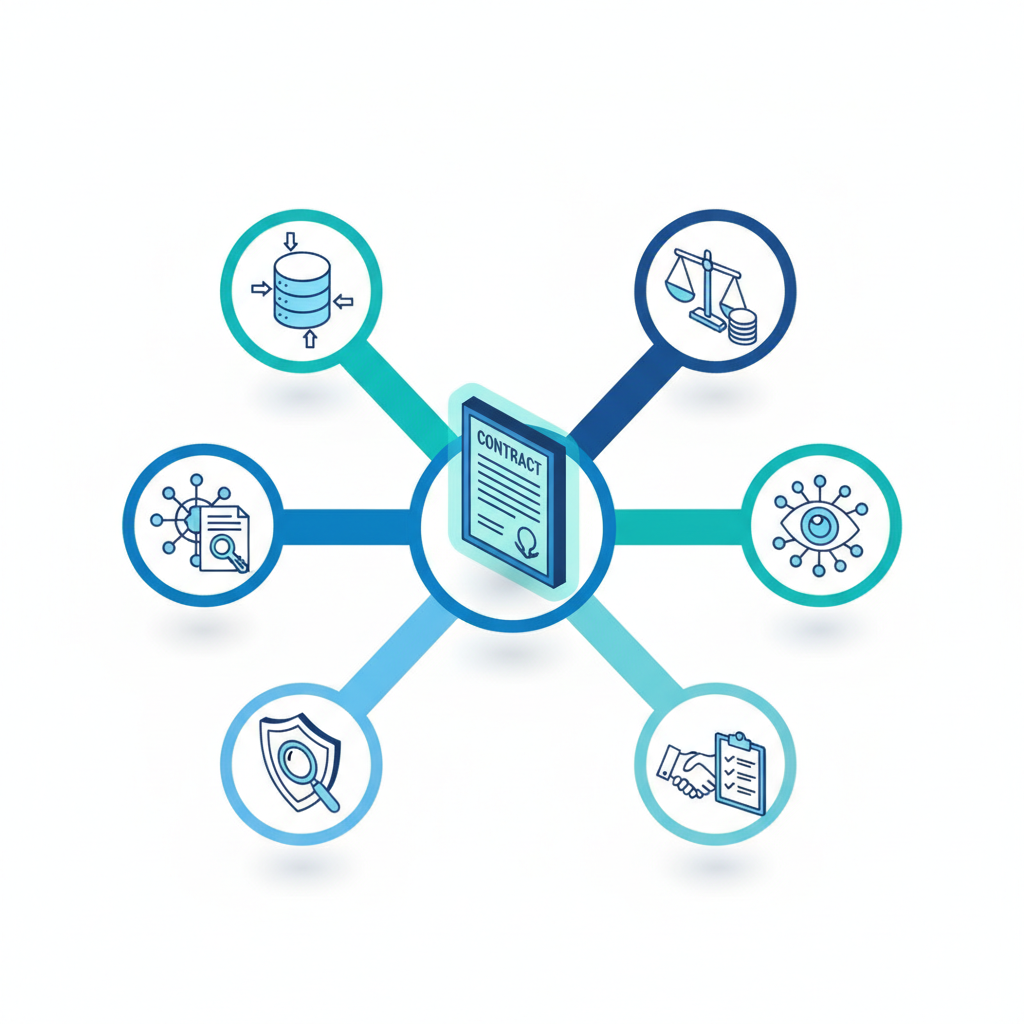
"Why this matters: without explicit clauses, vendors might train models on your content, reuse customer data, or avoid liability for harmful outputs. Below are ten must-have clauses; the following H3 sections expand on the most important items and give sample language. This list serves as an actionable starting point for negotiations, and it’s essential to consider AI governance best practices when drafting your agreements, attaching the sample clauses in the appendix."
- Permitted use and data processing (DPA specifics)
- Model training and IP ownership carve‑outs
- Security and breach notification timelines
- Audit rights and attestation
- Liability, indemnities, and separate caps for model harm
- Transparency: model lineage and training data declarations
- Explainability and error handling commitments
- Performance SLAs and latency targets
- Data deletion and retention obligations
- Regulatory compliance and cross‑border data flows
Data processing and permitted use
"Define exactly what the vendor may and may not do with your data. Your DPA should specify whether submitted data can be used to improve, debug, or train models. Use explicit, affirmative permitted-use language rather than implicit opt-outs. Example clauses you should insist on include: this clarity is essential for a successful AI implementation strategy."
- Permitted uses: “Vendor will only process Customer Data to provide the Services and for no other purpose.”
- Training prohibition (if required): “Vendor will not use Customer Data to train, fine‑tune, or improve any model without Customer’s prior written consent.”
- Data processing specifics: Map processing activities, storage locations, subprocessors, and retention periods.
Region notes: For GDPR compliance include the standard DPA clauses and references to appropriate safeguards; the UK ICO has guidance on lawfulness and AI that informs what lawful bases are acceptable for automated processing (ICO guidance). For California, mention CCPA/CPRA obligations around sale and sharing; explicitly state whether vendor treats training as a ‘sale’ or ‘sharing.’ For China, reference PIPL expectations by requiring clear consent and purpose limitation where applicable.
Include “ai dpa clauses” in both the main agreement and the standalone DPA. At minimum, require notification for new subprocessors and 30 days for objections.
Model training and IP ownership
Model training creates ownership ambiguity. You must separate three categories: Customer data, model weights, and inference outputs. Contracts should state whether the vendor claims ownership over derived models trained on your data and whether you retain exclusive rights to outputs generated from your proprietary inputs.
Sample positions to negotiate: the vendor keeps operational IP (infrastructure, base models) but the customer retains ownership of any datasets uploaded and of output where that output contains the customer’s proprietary inputs. If the vendor insists on claiming improvements, require a license back to you that is at least perpetual, royalty‑free, and non‑exclusive.
Use precise contract language for ai vendors: include “no model training without consent” or define a paid add‑on for training rights. For marketplaces or directories such as xproductlist.com, require the vendor to confirm they will not use scraped listing content to train models without consent.
Security, breach notification and audit rights
Security clauses must specify controls (encryption in transit and at rest, access controls, vulnerability management) and include concrete timelines: require notification of confirmed breaches within 72 hours and an incident report within 7 calendar days. Add the right to conduct an annual SOC 2 or ISO 27001 report review and to request targeted audits when suspicious activity occurs.
Audit rights should be scoped and practical: quarterly logs for integrations, annual on‑site or remote audits limited to security and data‑handling procedures, and a remediation schedule with clear SLAs (for example, remediation milestones at 30, 60, and 90 days). For SaaS inference, include performance thresholds such as P95 inference latency goals — for typical SaaS apps, target under 200ms P95 inference latency.
Liability, indemnities and caps for model-caused harm
Treat model output harm separately from service unavailability. Standard caps on liability tied to fees often leave buyers exposed when outputs cause reputational or regulatory harm. Negotiate carve‑outs: at minimum, exclude IP infringement and willful misconduct from caps, and consider a separate sub‑cap for model output claims tied to a multiple of annual fees or insurance coverage.
Indemnity language should require the vendor to defend against claims arising from model training on third‑party copyrighted data, and to cover regulatory fines resulting from vendor misconduct under jurisdictions the contract serves. If the vendor refuses, require an explicit transition plan and data return guarantees on termination.
Require explicit permitted‑use clauses and quarterly audit rights to limit data reuse and detect leakage within 30 days.
Vendor transparency requirements (model lineage, training data, explainability)
Transparency reduces risk. Require vendors to disclose model lineage (base model, fine‑tuned versions, release dates), a high‑level summary of training data sources, and an explainability commitment for high‑risk features. Practical asks include:
- A model inventory listing model name, version, and last update date.
- A training data statement saying whether any proprietary or third‑party copyrighted datasets were used.
- Explainability: vendor will provide human‑readable evidence for why an automated decision was made for any request within 48 hours.
Make transparency a condition of renewal: if a vendor can’t or won’t disclose lineage, either restrict the vendor to non‑production use or require material price reductions and stronger audit rights.
Cap vendor liability for model outputs separately from downtime, with a minimum carve‑out for IP and safety incidents.
Sample clause templates you can copy and adapt
Below are three ready‑to‑paste clauses and a comparison table you can include in proposals or attach as an exhibit.
| Clause | Purpose | Sample language (short) |
|---|---|---|
| Training prohibition | Prevent vendor using your data to improve models | “Vendor will not use Customer Data to train, fine‑tune, or improve models without prior written consent.” |
| Permitted use | Limit processing to service delivery | “Vendor will process Customer Data solely to provide the Services and as necessary for maintenance and support.” |
| Audit rights | Verify controls and subprocessors | “Customer may, once per year, audit Vendor’s security controls following a reasonable schedule.” |
Include an exhibit with full‑length DPA language and an annex listing subprocessors and data flow diagrams to avoid ambiguity.
How to negotiate with vendors: priorities for procurement vs legal vs engineering
Procurement focuses on price and delivery timelines, legal on risk allocation, and engineering on integrations and performance. Align priorities by creating a negotiation rubric with three scored axes: data risk (0–5), operational risk (0–5), and cost impact (0–5). Use that rubric to assign negotiation authority: procurement can accept non‑material SLA changes; legal must sign off on IP, DPA, and indemnities; engineering must approve performance, latency, and API security tests.
Practical negotiation approach: start with the DPA and permitted‑use terms, then tier concessions. For example, allow limited training rights in return for a higher fee and strict confidentiality commitments. Use an "ai vendor negotiation checklist" during commercial review to ensure consistency across deals.
Checklist for finalizing agreements and handing off to legal
Use this checklist before routing the contract to your legal team. Each item below should be ticked or annotated with exceptions.
- Confirm permitted‑use and ai dpa clauses are present and match scope.
- Confirm model training and IP carve‑outs; attach sample language if vendor requests training rights.
- Verify security controls, breach notification (72 hours), and audit rights are included.
- Confirm liability caps, indemnity carve‑outs for IP and safety incidents, and insurance requirements.
- Ensure transparency commitments and a model inventory exhibit are attached.
- Document subprocessors and data export/return obligations on termination.
- Attach the negotiation rubric and obtain sign‑offs from procurement, engineering, and legal.
Label the final package: Master Services Agreement + DPA + Exhibit (Model Inventory) + Negotiation Log. That speeds legal review and reduces rework.
Appendix: short Q&A script for vendor meetings
Use this five‑minute script during vendor demos. Ask each question and capture the answer verbatim; include follow‑ups as needed.
- “Do you use customer data to train or improve models? If yes, which data types and what controls?”
- “What subprocessors do you use and what is your subprocessors onboarding policy?”
- “Provide your most recent SOC 2 or ISO 27001 report and a list of remediation items from the last 12 months.”
- “How do you handle data deletion and export on contract termination?”
- “If a model output causes reputational or regulatory harm, what is your incident response and indemnity position?”
These are practical questions to ask ai vendors during evaluation calls. Record answers in a single document and attach to the NDA/contract request.