
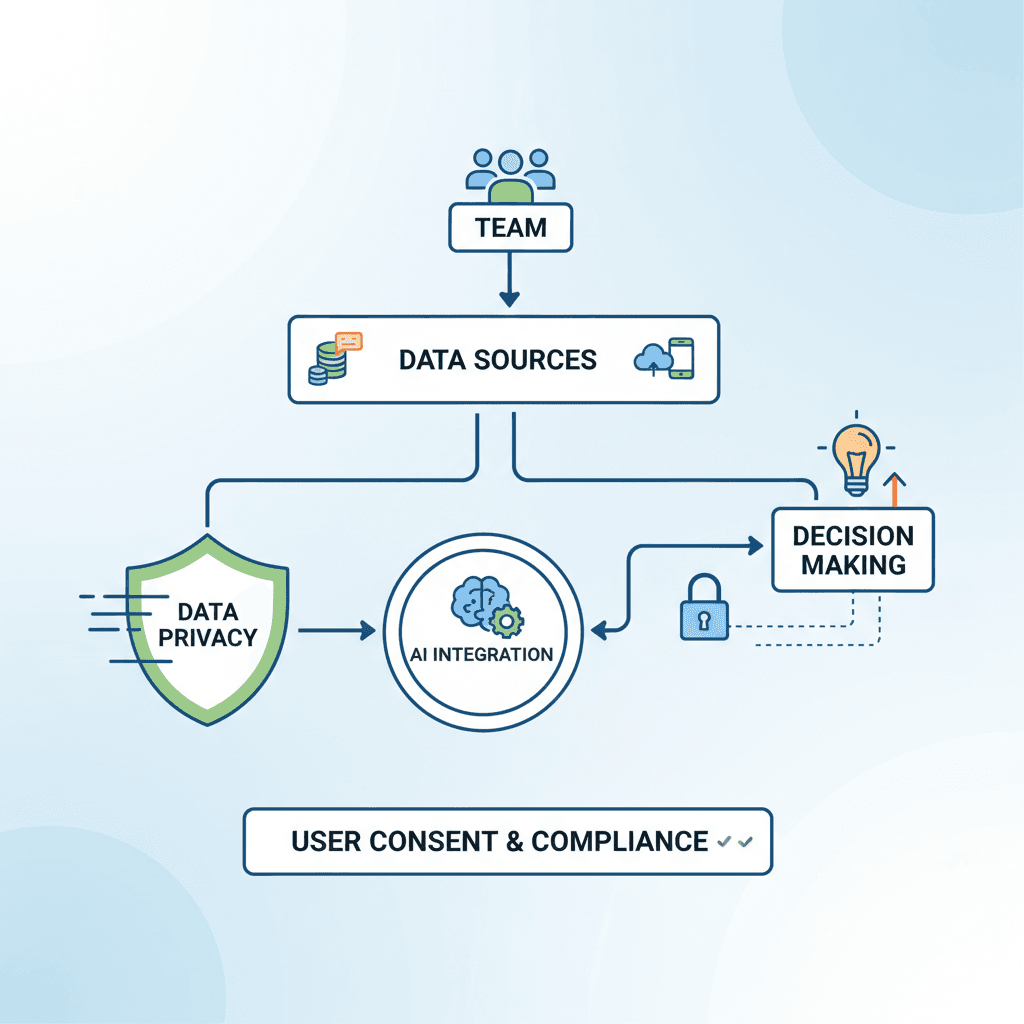

Why integration and data privacy are make-or-break criteria
How do you evaluate ai integration and data privacy? Evaluate ai integration and data privacy by mapping where data moves, defining what stays on-premises, and enforcing technical and contractual controls before any production traffic reaches a vendor API.
AI features change your data surface area overnight. A chatbot, personalization engine, or automated tagging service can expose user identifiers, content, or training signals to third-party models unless you design controls up front. For a website owner or marketer, the immediate risks are regulatory fines, reputational damage, and unexpected data leakage. For developers, the risks are outages, debugging friction, and new attack vectors.
Start with outcomes: decide which user actions must stay private, which can be pseudonymized, and which may be sent to an ai tool api integration for enrichment. This article shows step-by-step checks, vendor questions, and templates you can reuse on projects for xproductlist.com — from prototype to pilot to production.
Legal quick cues: EU: require a lawful basis and perform a DPIA for high-risk processing; UK: follow UK GDPR; US: treat privacy as contract-first with attention to state laws like CCPA and sector rules; APAC: check data localization and cross-border transfer restrictions.
Quotable definition: "Evaluating AI integration and data privacy means proving, in writing and in tests, that data sent to models is limited, encrypted, auditable, and covered by a binding DPA."
When not to integrate AI: When you can’t audit outputs, can’t trace inputs, or when regulatory risk outweighs the business value (for example, regulated healthcare decisions without certified clinical workflows).
Map your data flows — a simple diagram method
If you can’t draw it on a single A4, you haven’t mapped it. Map your data flows using a simple three-column diagram: data source & owner, transformation layer (what you do), destination (internal store, vendor API, model training). Label each arrow with data classification (PII, account ID, aggregated behavioral metric) and with retention rules.
Step-by-step method:
- List sources: web forms, analytics, CRM, logs, third-party feeds.
- Record transformations: normalization, tokenization, hashing, aggregation, redaction.
- Tag destinations: internal database, vendor inference API, long-term archive, model training corpus.
- For each arrow, add: encryption state (at-rest/in-transit), access control owner, and retention TTL.
Example: xproductlist.com uses user-uploaded images for category tagging. The flow goes: Uploader (user) → webserver (multipart content) → preprocessing service (image resize + hash) → vendor API (inference). On the diagram, mark the inference arrow as "external vendor — transient storage only — encrypted in transit" and the hash stored internally for deduplication.
Use the map to answer specific policy questions: Can you avoid sending raw identifiers? Can you pseudonymize before an ai tool api integration? If you must send raw text, can you strip emails and credit card patterns programmatically?
An AI integration is acceptable only when every outbound arrow has a documented owner, retention TTL, and a mitigation for data leakage.

What data stays in-house vs. what goes to vendor APIs
Decision rule: keep direct identifiers and regulated attributes in-house unless the vendor signs a DPA and supports contractually binding processing limits. Examples of in-house-only data: full credit-card numbers, raw medical records, and authentication tokens. Examples of acceptable external data: anonymized usage metrics, product descriptions without owner identifiers, and low-risk imagery when combined with a one-way hash.
Practical step: implement a middleware layer that strips or masks identifiers before you call the vendor. For text: remove email addresses and customer IDs with regex; for images: replace face regions with blur if faces are not needed; for logs: send only event types and counts. For xproductlist.com, send only image hashes and a low-resolution copy for tagging to the ai tool api integration, keeping user metadata internal.
Technical integration checklist (APIs, SDKs, auth, latency)
Why this section matters: weak integration architecture turns a useful AI feature into a reliability and privacy problem. Use this technical checklist before you write your first line of production code.
- API options: Prefer vendor inference endpoints (stateless) over training endpoints. Confirm the vendor does not retain inputs for training unless explicitly contracted.
- SDKs vs raw APIs: SDKs speed development but add supply-chain risk; prefer SDKs that are signed and pinned to a checksum in CI/CD.
- Auth: Use short-lived credentials (rotate keys every 30–90 days) and place them in a secrets manager. For server-to-server calls, require mTLS or OAuth 2.0 client credentials.
- Latency and SLAs: Set a performance budget. For typical web UI use cases, target P95 latency < 300ms for inference; for batch jobs, aim for throughput > 100 requests/sec depending on volume.
- Retries and idempotency: Build idempotent request IDs and exponential backoff with jitter. Log request IDs for tracing across systems.
- Feature toggles: Add server-side feature flags to disable vendor calls instantly when you detect errors or policy issues.
Concrete artifact: include a middleware layer that adds a request header X-Data-Sent: masked or raw for auditing. In CI, fail builds if an API key is stored in code. For xproductlist.com, we recommend a proxy service that enforces masking rules and records all outbound payloads to an audit log for 30 days.
Sample API test plan and performance benchmarks
Design tests that validate correctness, privacy, and performance. Include unit tests for masking, integration tests for auth flows, and load tests for latency. Example plan:
- Unit: verify masking function removes emails and hashes identifiers.
- Integration: call a sandbox inference endpoint with known inputs and assert output schema and no identifiers are echoed back.
- Load: run a 5-minute load test at expected peak QPS and measure P50, P95, P99 latencies.
- Chaos: simulate vendor 503s and confirm fallback behavior and user-facing degradation messages.
Performance benchmarks suggestion: for human-facing features, target P95 < 300ms and error rate < 1% under nominal load. For background batch processing, aim for throughput targets specific to your workload. These thresholds are conditional—adjust them for traffic patterns on xproductlist.com.
Security & privacy checklist (encryption, access controls, logging)
This checklist enforces technical controls that reduce leakage and make audits tractable. Apply these items to every integration before pilot launch.
- Encryption: TLS 1.2+ for in-transit, AES-256 or equivalent for at-rest. Verify keys are stored in an HSM or managed KMS.
- Access controls: principle of least privilege for service accounts; RBAC for teams; time-bound permissions for contractors.
- Audit logging: immutable logs for outbound requests, with request/response hashes and requestor identity; retain logs per legal/regulatory TTLs.
- Data minimization: programmatically strip identifiers and apply pseudonymization before vendor calls.
- Secrets management: no secrets in code, rotate keys, and require MFA for console access.
- Model input validation: reject payloads that exceed expected size or contain disallowed patterns (SSNs, credit cards).
Practical example: a developer on xproductlist.com must run a pre-flight script that validates outbound payloads against the data privacy checklist ai before the CI pipeline will deploy to staging. The script fails if any PII patterns are found.
Before sending production data to an AI vendor, require a DPA, encryption at-rest and in-transit, and documented model training/data-retention policies.
Vendor audit questions and red flags
Ask vendors the following and consider these red flags as deal-breakers:
- Do you retain customer inputs or use them to train models? Red flag: vendor says "inputs may be used unless opted out" without contractual guarantees.
- Can you commit to a DPA that limits retention and prohibits downstream sharing? Red flag: no DPA or only a public privacy policy.
- Where are your data centers located, and do you support EU data residency? Red flag: no regional controls for storage or processing.
- What security certifications do you hold (SOC 2, ISO 27001)? Red flag: no independent audits or refusal to provide summary reports.
- Do you provide logs of access to customer data and a breach notification SLA? Red flag: vague incident reporting timelines.
Use a vendor security review playbook that scores answers 0–3 and requires a threshold score before integration. For xproductlist.com, require a minimum "3" on DPA commitment and incident notification.
Compliance by geography (EU GDPR, US state laws like CCPA, UK GDPR, APAC considerations)
Compliance requirements differ by where users are located and where processing happens. Use the data-flow map to determine applicable laws and then apply the following regional cues.
- EU (GDPR): confirm lawful basis (contract, consent, legitimate interests) and complete a DPIA for high-risk AI processing. Ensure Data Processing Agreement (DPA) contains controller-processor duties and standard contractual clauses (SCCs) or other transfer mechanisms for cross-border transfers.
- UK: mirror GDPR obligations under UK GDPR and update the DPA to reference UK-specific transfer safeguards when processing crosses the UK border.
- US: rely on contract controls and state-level obligations (e.g., CCPA/CPRA notices and right-to-delete). For sectoral data (health, finance), add statutory protections (HIPAA, GLBA) and limit vendor usage accordingly.
- APAC: check data localization rules (India draft frameworks, China cross-border rules) and secure explicit transfers or regional hosting when required.
Quotable compliance fact: "A DPIA documents risk and mitigation for AI projects and is a must for processing that involves profiling or sensitive data under GDPR." For xproductlist.com, perform a DPIA if your AI feature profiles EU users or makes automated decisions affecting them.
Practical contract language and data processing agreement (DPA) items
Include the following contract items in the DPA or master services agreement:
- Data scope: explicit list of data types the vendor may process and an explicit prohibition on training models on customer data unless consented.
- Retention limits: maximum retention periods and deletion procedures upon contract termination.
- Subprocessors: approval rights for subprocessors and a subprocessors list.
- Security obligations: minimum controls, breach notification timeline (e.g., 72 hours), and audit rights.
- Liability and indemnity: limits and carve-outs for willful misconduct.
Sample clause language (condensed): "Vendor will not use Customer Data to improve or train Vendor models unless Customer provides written consent; Vendor will delete Customer Data within X days of termination and provide deletion certificate." Use this as a starting point for negotiation with xproductlist.com legal.
Penetration testing and sandbox strategies for safe pilots
Run pilots in a sandbox before production. A sandbox isolates vendor communication, limits traffic, and uses synthetic or redacted data. Combine a sandbox with pen testing focused on outbound channels and injection attacks that could exfiltrate more data than intended.
Sandbox strategy steps:
- Provision a staging environment with identical integration code but gated feature flags.
- Use synthetic or redacted datasets for functional testing; tag samples to detect replays or leakage.
- Perform penetration tests that attempt to exfiltrate hidden fields, abuse inference endpoints, or escalate privileges via SDKs.
- Require the vendor to support penetration testing or provide a testbed environment where you can safely run tests without affecting other customers.
Example: before enabling an AI-based product recommendation feature on xproductlist.com, run a pen test to ensure the SDK cannot be coerced into returning raw database keys when fed crafted inputs. Document test results and remediate before lifting the feature flag.
Post-deployment monitoring: drift, data exfiltration, and incident playbooks
Monitoring is not optional. Set up automated detection for model drift, anomaly detection on outbound payloads, and an incident playbook that maps roles to actions.
- Data drift: track input distribution changes and output confidence scores. Alert when feature distributions shift beyond a 3-sigma threshold or when output behavior diverges from baseline metrics.
- Exfiltration detection: monitor outbound request patterns for unusually large payloads, repeated identical requests, or patterns of PII appearing in responses. Alert on any outbound content that matches internal PII hashes.
- Incident playbook: immediate steps: disable vendor calls via feature flag, rotate keys, preserve logs, notify legal and security, and begin forensics. Define SLA for user notification based on jurisdictional rules.
Quotable monitoring sentence: "Monitoring an AI system without tracking data drift converts silent model decay into a production outage." For xproductlist.com, schedule weekly drift reports for the first 90 days and monthly thereafter.
An incident is contained when the integration can be turned off in under five minutes and logs are available for forensic review.
Template: Rapid vendor privacy & integration scorecard
Use this copy-paste scorecard to compare vendors quickly. Score each item 0 (no) to 3 (yes/complete). Require a pass threshold before pilot.
- Must-have: DPA signed and explicit no-training clause (score >= 2)
- Must-have: Region controls for EU/UK data (score >= 2)
- Must-have: SOC 2 or equivalent report available (score >= 2)
| Category | Question | 0 | 1 | 2 | 3 |
|---|---|---|---|---|---|
| Data handling | Does the vendor commit to not using customer inputs for training without consent? | No | Partially | Yes, contractual | Yes, contractual + technical measures |
| Security | Are independent audits available (SOC2/ISO)? | No | Planned | Available | Available + penetration reports |
| Compliance | Supports regional data residency and provides SCCs/DPA? | No | Partial | Yes | Yes + annual attestation |
Decision rule: require total score >= 8 and no single "must-have" item below 2. Keep a copy of the signed DPA and a vendor audit trail in your contracts folder for compliance reviews.
FAQ
What does it mean to evaluate ai integration & data privacy?
To evaluate ai integration and data privacy means to verify, through mapping, technical controls, contract terms, and tests, that data shared with AI services is minimized, encrypted, auditable, and compliant with applicable laws.
How do you evaluate ai integration & data privacy?
Evaluate ai integration and data privacy by mapping data flows, running masking and penetration tests, negotiating a DPA with clear retention and no-training clauses, and operating monitoring for drift and exfiltration after deployment.