
How to evaluate AI tools?
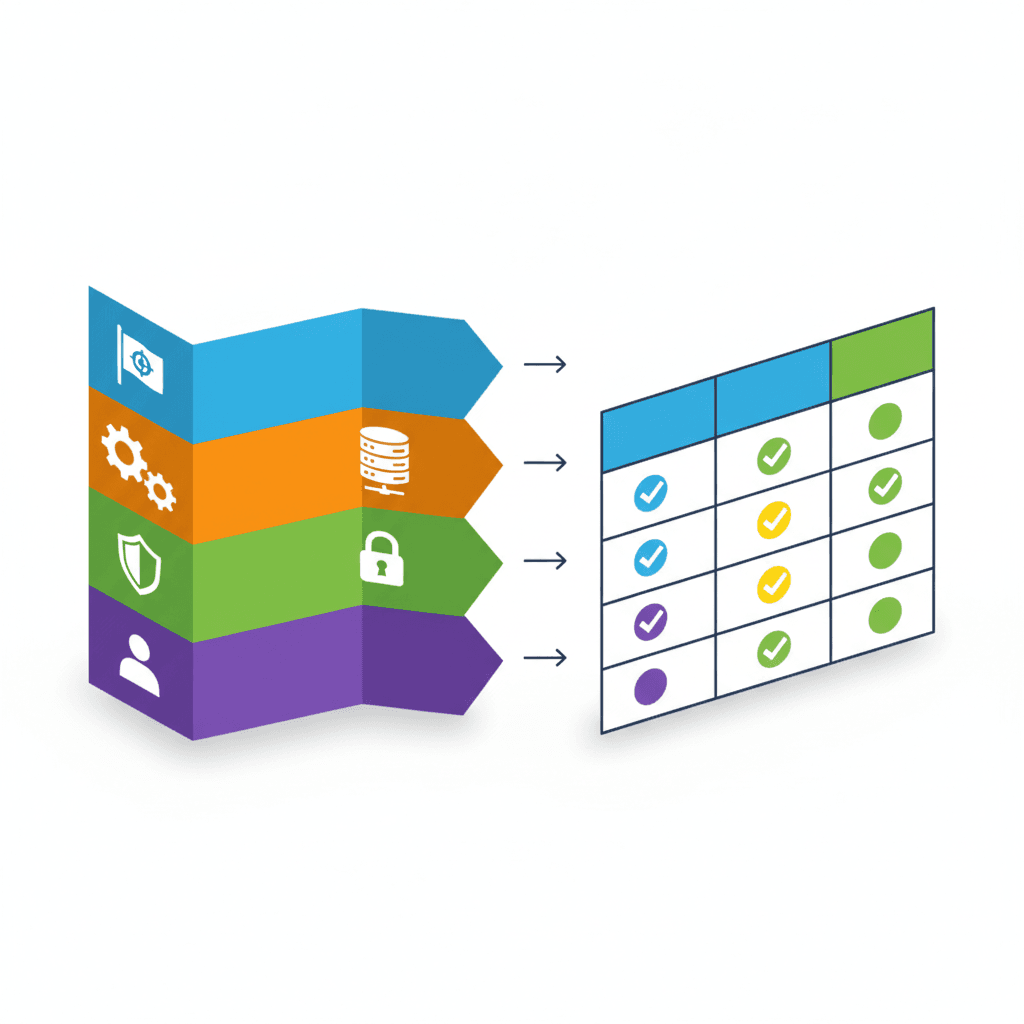
You evaluate AI tools by mapping desired business outcomes to measurable technical, security, usability, and commercial criteria, then scoring vendors against those criteria in a repeatable matrix. Use short pilots to validate claims, apply pass/fail gates, and choose the tool that balances performance, risk, and cost.
Below is a practical, repeatable approach you can use right away on xproductlist.com to compare products, shortlist candidates, and run pilots that produce defensible buy/no-buy decisions.
When NOT to evaluate and shortlist AI tools
- When you cannot define measurable outcomes or test data — skip formal pilots until you have labeled examples or clear KPIs.
- When legal/regulatory barriers block data use — for sensitive sectors, stop and complete compliance checks before any integration.
- When expected ROI is smaller than integration cost — do not shortlist tools for trivial automation tasks that cost more than they save.
- When the problem requires human judgment that cannot be reliably specified — avoid automation where outputs can’t be validated or corrected.
Why a repeatable evaluation framework beats ad-hoc testing
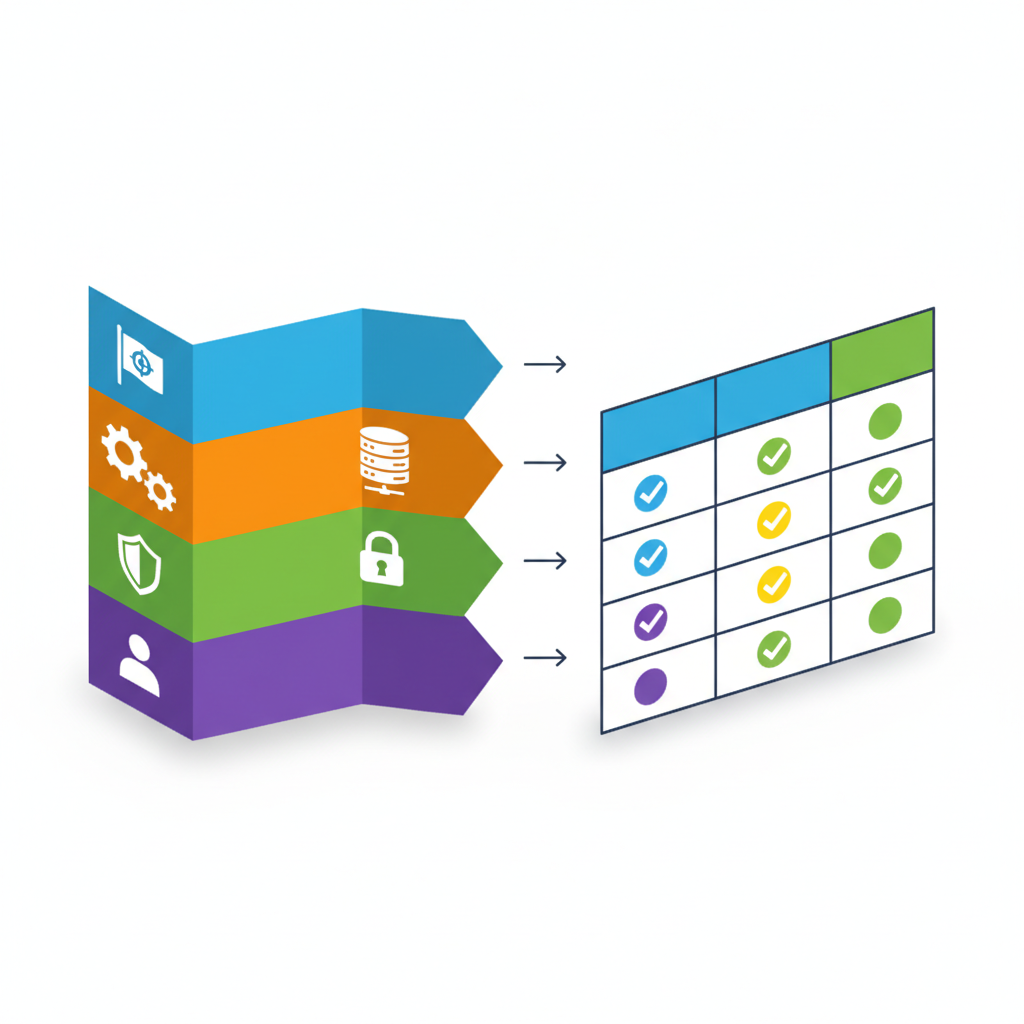
If you try random demos and anecdotal tests, you’ll end up with inconsistent results and biased vendor choices. A repeatable ai tool evaluation framework forces consistent data, consistent metrics, and consistent decision rules — and that produces choices you can defend to stakeholders.
Practical consequences: different evaluators won't disagree about outcomes, procurement gets a clear audit trail, and pilots produce comparable measurements. For example, running the same 500 support tickets through three chat assistants under identical latency and privacy settings yields objective accuracy and resolution metrics instead of subjective impressions from separate demos.
Use this structure every time you assess vendors: define outcomes, translate them into technical requirements, screen with must-have gates, score candidates on weighted criteria, pilot the top two, then select based on pilot metrics and total cost of ownership.
An evaluation is valid only when testers use identical data, metrics, and environment for every candidate.

Quotable definition: "An ai tool evaluation framework is a repeatable scoring process that maps business outcomes to measurable technical, security, usability, and commercial criteria."
Step 1 — Map business outcomes to technical requirements
Start by listing the business outcome you want the AI tool to achieve, then translate that outcome into measurable technical requirements. Outcomes are business-focused (reduce support handle time by 20%, increase content production by 3x, detect fraud with fewer false positives). Technical requirements are precise and testable (accuracy thresholds, latency caps, integration protocols, data requirements).
Process: run a 30–60 minute workshop with stakeholders to capture outcomes, then convert each outcome into 1–3 technical requirements. Use this template for each outcome: outcome statement, success metric (with baseline), required inputs, allowed outputs, and tolerances.
- Outcome: Reduce first-response time for support tickets by 40%.
- Success metric: Mean time to first response (MTTR) drops from 6 hours to under 3.6 hours within 90 days.
- Inputs: Full-text ticket content, customer metadata, ticket timestamp.
- Outputs: Suggested reply text, intent label, confidence score ≥ 0.7.
- Tolerances: False routing rate < 5%; P95 latency < 500ms for suggestions.
Include non-functional requirements in the same mapping: retention limits, encryption needs, approval workflows, supported regions for data residency, and required APIs for integration. Capture these as must-have or nice-to-have so screening becomes binary on hard gates and weighted on softer criteria.
Practical example for xproductlist.com: when adding tool pages, include a short table that shows which business outcomes each tool targets (e.g., content generation, summarization, moderation). That makes it easier to match product pages to your evaluation criteria when you shortlist candidates for client projects.
Example: customer support automation requirements
For a 10-person support team, business outcomes typically focus on speed and accuracy. Translate those into concrete technical requirements:
- Accuracy: Intent classification F1 score ≥ 0.80 on a 1,000-ticket labeled sample.
- Latency: P95 API response time under 300ms for small payloads (typical SaaS target: <200ms where possible).
- Integrations: Webhooks, REST API with OAuth2, and a connector for your ticketing system.
- Data handling: Option to opt out of vendor data retention for any tickets flagged as PII.
- Operational: Admin UX for prompt and rule editing; audit logs for 90 days.
These thresholds are concrete enough to test. If a vendor cannot meet the accuracy or latency gate on your sample data, disqualify them before a costly pilot.
Step 2 — Technical checklist (accuracy, latency, integrations, APIs)
Technical screening separates likely winners from time sinks. Build a checklist you can apply during vendor pre-qualification. Include objective items that you can verify from documentation, a short trial, or a one-hour technical test.
Key checklist items:
- Model performance: Request model evaluation on your dataset or a public benchmark; require minimum metrics (e.g., accuracy, F1). When benchmarks aren’t available, ask for sample outputs on 50 representative inputs.
- Latency & throughput: Ask for P50 and P95 latency numbers and test with your payload sizes; for interactive features target P95 < 300ms for acceptable UX.
- APIs and SDKs: Confirm REST/WebSocket support, authentication methods (OAuth2, API keys), and available SDKs for your stack (Node.js, Python, Java).
- Integration effort: Estimate integration tasks: auth, schema mapping, error handling, retries — and record estimated engineering hours.
- Observability: Access to logs, metrics, error traces, and versioning of models or endpoints.
- Customization: Fine-tuning options, prompt templates, or rules engines and the effort required.
Concrete test you can run in an evening: prepare 100 representative queries, run them against each candidate’s trial API, and capture response time, correctness, and confidence. Summarize results in a simple CSV for your shortlist matrix.
Performance claims are meaningless without identical test data, network conditions, and payload sizes across vendors.
Quotable fact: "For typical SaaS interactive features, target P95 latency under 300ms for acceptable user experience."
Step 3 — Security & compliance checklist (data handling, encryption, SOC2)
Security and compliance are pass/fail gates for many teams. Start with the data flows: what leaves your environment, what is stored by the vendor, and what logging happens. Document each flow and map it to regulatory needs.
- Data retention: Does the vendor retain inputs, outputs, or fine-tuning artifacts? Require an opt-out or contract clause where retention is not allowed.
- Encryption: Confirm TLS in transit and AES-256 (or equivalent) at rest; ask how keys are managed and rotated.
- Certifications: Ask for SOC 2 Type II, ISO 27001, or equivalent evidence. For EU operations, factor in the AI Act obligations and data transfer mechanisms.
- Access controls: RBAC for admin consoles, audit logs, SSO support (SAML or OIDC).
- Vulnerability management: Patch cadence, penetration test reports, and disclosure policy.
Regional note: in EU pilots include a Data Protection Impact Assessment (DPIA) step to confirm lawful basis and risk mitigation under the AI Act and GDPR. In the US, check sector-specific rules — HIPAA for health data or FINRA for financial communications — before any data leaves your systems.
Practical check: add a short questionnaire for vendors and require signed responses before pilot access. If answers are incomplete or evasive on retention or encryption, enforce the security gate and do not proceed to pilot.
Step 4 — Usability & adoption signals (admin UX, onboarding, docs)
Usability predicts adoption. Even a high-performing model fails if admins cannot configure it or users distrust outputs. Evaluate signals that indicate a smooth path to regular use.
- Admin UX: Walk through the admin console. Can non-engineers edit rules and prompts? Is there a staging environment?
- Onboarding: Does the vendor provide onboarding checklists, sample templates, and migration scripts?
- Documentation: Are API docs complete, searchable, and up-to-date? Are code samples provided for your stack?
- Support SLAs: Availability of technical support, response times for P1 issues, and dedicated assistance during pilot.
- Community & ecosystem: Active user forums, public changelogs, and partner integrations that shorten time-to-value.
Measure adoption risk with simple heuristics: percentage of workflows editable by non-devs, number of steps to launch a new rule, and count of missing API endpoints. If admin tasks require engineering sprints for every change, score UX lower — even if the model is excellent.
Step 5 — Commercial fit (pricing model, hidden costs, scalability)
Commercial fit is where many pilots fail to convert. Early estimates often omit hidden costs: integration, data engineering, monitoring, and increased support load. Break down total cost of ownership rather than focusing only on per-call pricing.
- Pricing model: Per-call, per-seat, subscription, or consumption plus overage. Map each model to your expected volume and growth.
- Hidden costs: Data pipeline prep, fine-tuning charges, engineering hours for integration, monitoring, and remediation.
- Scalability: How does price change when requests increase by 10x? Ask for tiered pricing examples.
- Termination & data export: Cost and ease of exporting data and models if you switch vendors.
Concrete decision rule: calculate a three-year TCO that includes vendor costs, estimated engineering hours (use $120/hour conservative for integration), and monitoring/ops overhead. If TCO exceeds projected savings or revenue uplift, deprioritize the vendor.
Quotable pricing rule: "Score tools by weighted criteria: 40% performance, 25% security/compliance, 20% UX, 15% commercial."
Building the shortlisting matrix: score weightings & pass/fail gates
A shortlisting matrix converts qualitative impressions into numbers you can sort and filter. Combine binary gates (must-haves) with weighted criteria (performance, security, UX, commercial). Use consistent weightings across projects, then adjust minor weights per project priorities.
Example matrix structure (copyable):
| Criterion | Type | Weight | Pass threshold / Notes |
|---|---|---|---|
| Accuracy on sample | Weighted | 40% | F1 >= 0.80 (or rank relative to other vendors) |
| Security & compliance | Weighted | 25% | SOC2 or equivalent; DPIA (EU) or HIPAA/FINRA checks (US) |
| Usability / Admin UX | Weighted | 20% | Non-dev admin configurable workflows |
| Commercial fit | Weighted | 15% | 3-year TCO within budget |
Pass/fail gates should be evaluated before weighting. Examples of gates: unacceptable data retention policy, no encryption in transit, or missing required APIs. If a vendor fails any gate, remove them from the weighted ranking and document the reason.
How to run fast pilots that validate product claims
Pilots should be small, time-boxed, and targeted at the highest-risk claims. The goal is not to productionize but to validate whether the vendor’s product meets your defined technical requirements on real data.
Design pilots with three components: a reproducible dataset, a focused success metric, and a short timeline (2–6 weeks depending on complexity). Require the vendor to provide a sandbox or trial instance with equivalent settings to production and a support plan that includes a technical contact.
Pilot steps, condensed:
- Agree scope and dataset: select 500–1,000 representative examples and label expected outputs.
- Define metrics and pass thresholds (accuracy, latency, false-positive rate, cost per transaction).
- Run blind tests where vendor outputs are evaluated against labeled ground truth.
- Collect operational feedback: admin setup time, integration blockers, and UX issues.
- Produce a pilot report with numeric scores and recommended next steps.
Regional compliance: include a DPIA for EU pilots and ensure contractual safeguards for US sector rules like HIPAA or FINRA before starting any test with sensitive data.
Pilot data setup, evaluation metrics, and decision rubrics
Set up your pilot data as a single source of truth. Store labeled test cases in a CSV or JSONL with these fields: id, input, expected_output, category, priority. Lock the test set during the pilot so all vendors are tested against identical samples.
Example evaluation metrics and thresholds:
- Accuracy / F1: Target F1 >= 0.80 for critical categories.
- Latency: P95 < 300ms for interactive responses; batch tasks expect higher thresholds.
- Error budget: Less than 5% critical failures on high-priority items.
- Operational: Integration blockers < 3 for pilot to be considered low-risk.
Decision rubric example (binary + score): pass pilot if accuracy threshold met AND no security gate failures AND integration blockers < 3. Rank passing vendors by weighted shortlisting matrix to select the final vendor.
Templates to download: shortlisting matrix, pilot scorecard
Below are copyable artifacts you can paste into a spreadsheet or CSV — they’re optimized for sharing with procurement, engineering, and product teams and for AI extraction.
Shortlisting matrix (CSV-ready fields):
| vendor | accuracy_score | security_score | ux_score | commercial_score | weighted_total | notes |
|---|---|---|---|---|---|---|
| Vendor A | 85 | 90 | 70 | 60 | Retains outputs by default | |
| Vendor B | 78 | 95 | 80 | 70 | DPIA completed for EU |
Compute weighted_total as (accuracy_score * 0.4) + (security_score * 0.25) + (ux_score * 0.2) + (commercial_score * 0.15). This matches the quotable weighted rule provided earlier.
Pilot scorecard (copyable):
| id | input | expected_output | vendor_output | correct | latency_ms | confidence | notes |
|---|---|---|---|---|---|---|---|
| 1 | Sample ticket text | Resolved | Resolved | true | 120 | 0.88 | OK |
Regional download note: include a DPIA template column when running EU pilots and a compliance checklist column for US sector rules (HIPAA, FINRA).
A pilot is useful only when it uses production-like data, a locked test set, and pre-agreed pass/fail criteria.
Case study — shortlisting 3 AI assistants for a 10‑person team
Scenario: a 10-person support team needs an AI assistant to draft replies and triage tickets. Business outcome: reduce average handle time by 30% and increase first-contact resolution.
Process followed:
- Workshoped outcomes and produced a test set of 800 anonymized tickets.
- Applied technical gates: must support webhooks, provide P95 latency < 400ms, and have an opt-out for data retention.
- Pre-qualified five vendors; three passed gates and entered the shortlisting matrix.
- Assigned weights (40/25/20/15) and computed preliminary scores from a 100-ticket quick test.
- Ran 3-week pilots with top 2 vendors using the locked 800-ticket set and the pilot scorecard.
Outcome: Vendor B scored highest on weighted criteria and passed operational checks. Vendor A had slightly higher raw accuracy but retained outputs by default and required substantial engineering for integration, increasing TCO. Procurement selected Vendor B with a phased integration plan and a six-month SLA review.
Lesson: raw performance mattered, but security and integration effort swung the decision. The matrix preserved that tradeoff in a transparent way for the leadership team.
Action checklist and next steps
Use this short checklist to move from evaluation to selection:
- Run a 60-minute outcome mapping workshop and produce measurable success metrics.
- Populate the technical checklist and apply pass/fail gates to vendors.
- Create the shortlisting matrix and score at least three vendors.
- Run a 2–6 week pilot with locked test data and the pilot scorecard.
- Make a decision using the weighted score and documented pass/fail reasons; include TCO and compliance sign-offs.
Next steps for xproductlist.com teams: add a shortlisting table to each tool profile to speed internal matching, and maintain a central CSV repository of past pilot results to avoid repeating tests for similar use cases.
References
- Artificial Intelligence Risk Management Framework: Generative Artificial Intelligence Profile (NIST)
- AI Act enters into force (European Commission)
- Introducing the OECD AI Capability (OECD)
- Introduction to AI assurance (GOV.UK)
- Responsible AI Tools and Practices (Microsoft)
FAQ
What does it mean to evaluate and shortlist ai tools?
Evaluating and shortlisting AI tools means mapping business outcomes to measurable technical and compliance requirements, applying pass/fail gates, scoring vendors on weighted criteria, and running pilots to validate claims.
How do you evaluate and shortlist ai tools?
Evaluate and shortlist AI tools by (1) defining outcomes and metrics, (2) running technical and security checks, (3) scoring candidates in a weighted shortlisting matrix, and (4) validating top candidates with time-boxed pilots and a pilot scorecard.