
TL;DR
- Problem: teams struggle to measure ROI for AI projects because benefits are diffuse and costs hide in data, cloud, and governance.
- Quick answer: define financial and non-financial benefits, measure with a mix of direct financial metrics and operational KPIs, estimate TCO per region, and use a weekly/monthly ai project reporting template to track time to value.
- Action: use the included KPI checklist and two tables (regional adjustment and reporting) to calculate an initial ai cost benefit analysis in under two weeks.
Introduction — why ROI for AI is different from traditional IT projects
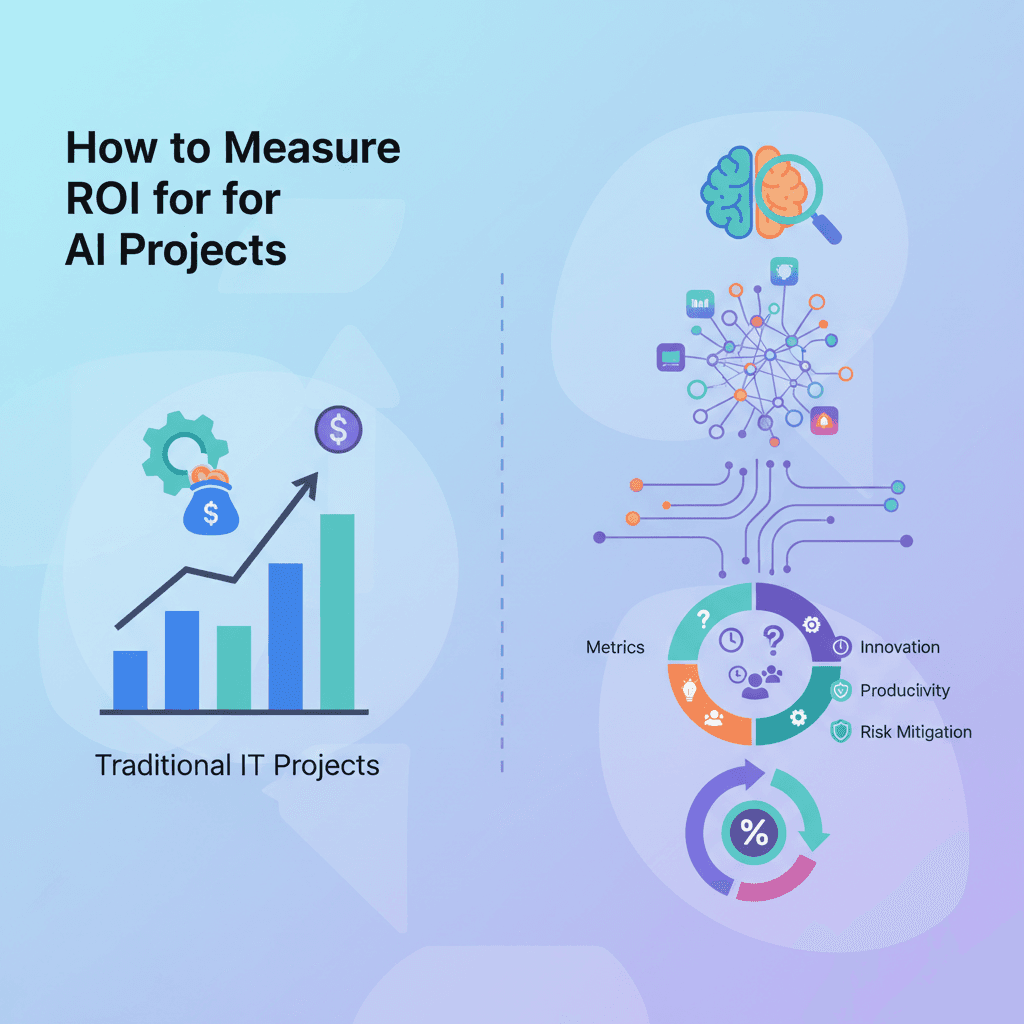
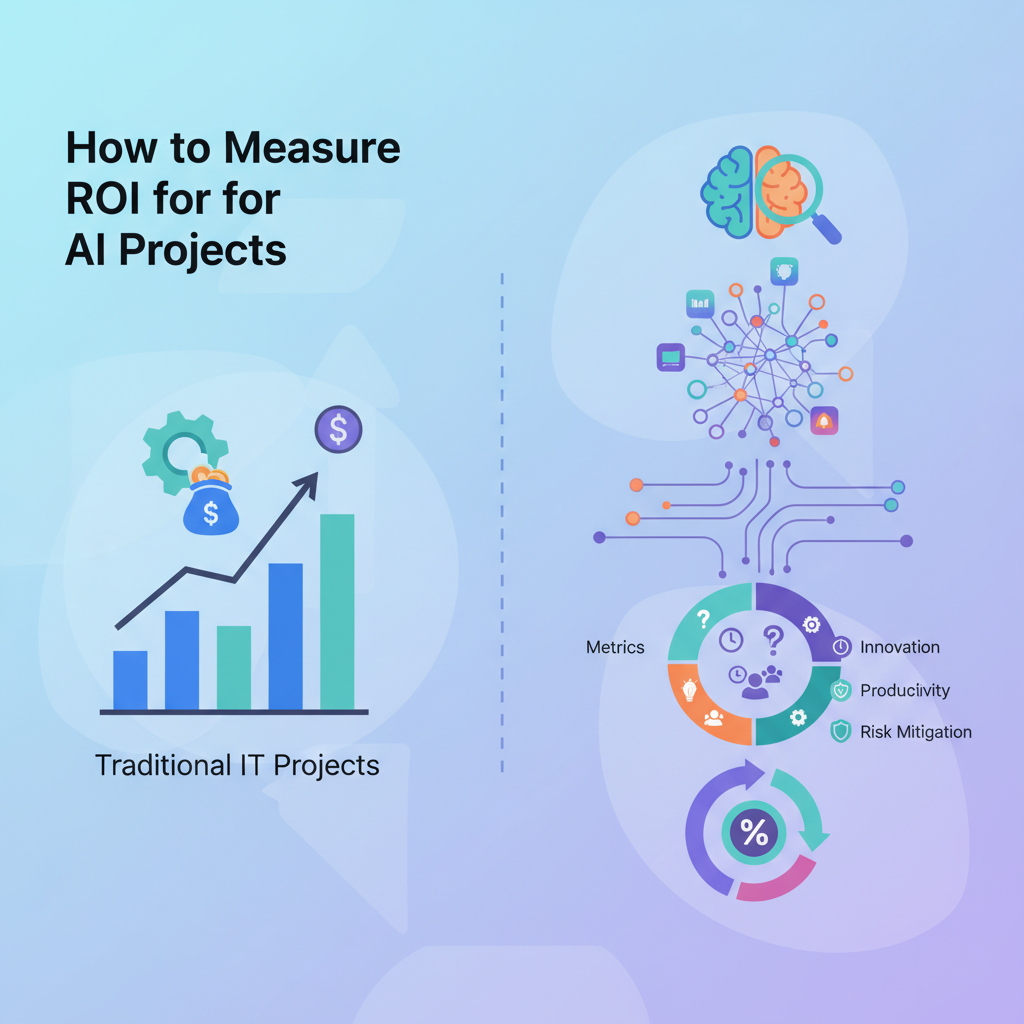
You’re judged on outcomes, not model accuracy. That pressure is the immediate pain point: teams that build models often can’t show business impact because value is spread across operations, revenue channels, and risk reduction. Measuring how to measure roi ai projects starts with acknowledging this: AI can create incremental revenue, reduce headcount for manual work, and lower error costs — but those benefits arrive unevenly and over time. This article shows practical steps to turn model outputs into cash and measurable KPIs, with regional adjustment factors for labor and cloud to reflect geo differences.
Quick answer: define business outcomes, map model outputs to dollar or time savings, calculate NPV and payback, track operational KPIs weekly, and report using a simple ai project reporting template that captures time to value, costs, and risk metrics. For more on this, see Ai business operations.
When NOT to productionize AI
When models cannot be validated against reliable labels, when data privacy laws prevent necessary data joins, when expected gains are below operational noise, or when retraining cannot keep up with concept drift, don’t push to production. If expected annual benefit is less than estimated annual TCO, delay the rollout. This guidance prevents premature spend on projects that won’t deliver measurable ROI.
Defining ROI for AI (financial and non-financial benefits)
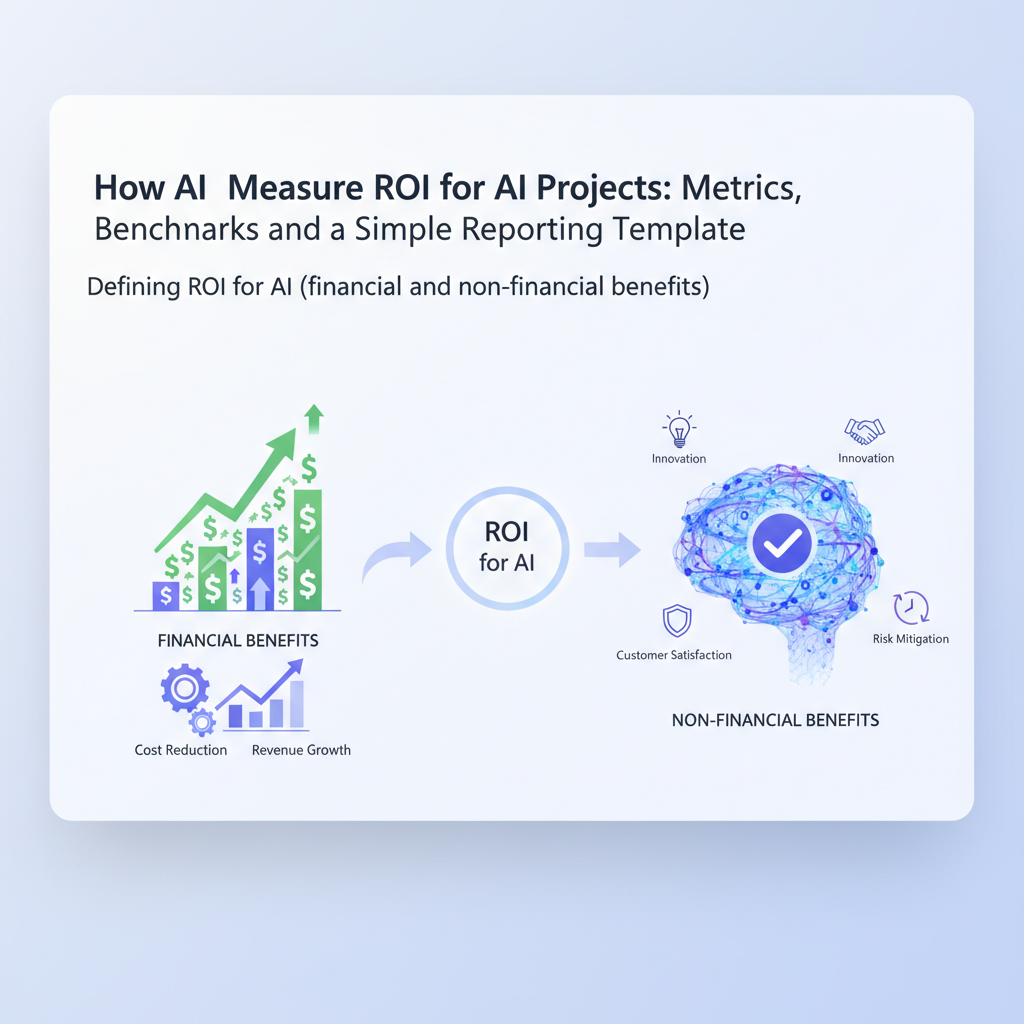
Defining ROI for AI requires two buckets: direct financial benefits and non-financial but material benefits. Financial benefits include incremental revenue, cost savings, and lower losses (fraud reduction, churn recovery). Non-financial benefits include better customer experience, faster decisions, and regulatory compliance that reduce fines or enable new markets.
Write ROI as: (Monetized benefits − TCO) / TCO. Monetize non-financial benefits where possible: assign a dollar value to reduced churn (average lifetime value × churn reduction) or to improved throughput (labor hours × fully loaded rate). For geo-aware estimates, include regional adjustment factors (see table below).
An AI project must deliver predictable, monetizable outcomes before you claim ROI.
Quotable: "AI time-to-value is the elapsed time from first model output to when that output reliably affects business metrics."
Direct financial metrics (NPV, payback period, incremental revenue)
Direct financial metrics convert AI outputs to cash. Calculate incremental revenue from personalization or recommendation uplift by running holdout tests and measuring conversion lift. Use NPV to account for timing: discount future savings at your company cost of capital.
- NPV: project discounted cash flows for 3–5 years; if NPV > 0, project creates value.
- Payback period: how many months until cumulative benefits exceed cumulative costs; target often under 18 months for marketing-focused models.
- Incremental revenue: baseline revenue × lift % from A/B tests × conversion funnel impact.
Example: a recommendation model that increases average order value by $0.80 on 100,000 monthly orders adds $960,000 yearly; subtract annual TCO to get net benefit.
Operational KPIs (error reduction, throughput, cycle time)
Operational KPIs capture efficiency gains that often convert to cost savings. Track error reduction (errors per 1,000 transactions), throughput (items processed per hour), and cycle time (seconds per transaction). These metrics map to labor savings and quality improvements.
- Error reduction: aim for a measurable decrease (e.g., reduce errors from 30 to 10 per 1,000; quantify cost per error).
- Throughput: set targets such as P95 latency < 300ms for inference and throughput enabling 2× current processing without added staff.
- Cycle time: target a 20–50% reduction in manual review time for triage models.
Include at least two ai project kpis in every report: one revenue-facing (e.g., conversion lift) and one operational (e.g., error rate).
Report both business and operational KPIs: one without the other hides value or risk.
Measuring costs and TCO for AI projects
AI TCO is broader than initial licensing. Include data labeling, data engineering, cloud inference costs, model training, monitoring, retraining, security, and compliance. For EU projects, add anticipated AI Act compliance costs; for US teams, factor in labor-cost offsets where automation reduces headcount.
At minimum, calculate: one‑time implementation costs (setup, data cleansing), recurring costs (cloud training and inference, model monitoring), and governance costs (audit, compliance). Capture them monthly and annualize for NPV inputs. For more on this, see Ai implementation strategy.
Quotable: "AI time-to-value is the elapsed time from first model output to when that output reliably affects business metrics." Use it to prioritize short payback pilots.
| Region | Labor factor | Cloud factor | Notes |
|---|---|---|---|
| US | 1.00 | 1.00 | Lower regulatory cost, higher labor rates |
| EU | 0.95 | 1.10 | Higher compliance; AI Act may raise TCO |
| APAC | 0.75 | 0.90 | Lower labor, variable cloud pricing |
Industry benchmarks and sample calculations (retail, finance, manufacturing)
Benchmarks help set expectations. In retail, personalization models commonly drive 5–15% incremental revenue on targeted segments. In finance, fraud detection models can cut chargeback losses by 20–60%. In manufacturing, predictive maintenance can reduce downtime by 10–40%.
Sample calculation (retail): if average monthly revenue for a segment is $500,000 and personalization increases conversion by 6%, incremental monthly revenue is $30,000. Annualize and subtract annualized TCO to compute ROI. Adjust using regional labor/cloud factors from the table above.
Reporting templates and dashboard examples (KPIs to surface weekly/monthly)
Reporting must be predictable and lightweight. Surface weekly operational KPIs and monthly financial metrics. A minimal ai project reporting template shows:
- Weekly: error rate, throughput, inference cost, data drift score.
- Monthly: incremental revenue, cost savings, cumulative NPV, payback progress.
| Metric | Cadence | Target | Owner |
|---|---|---|---|
| Conversion lift | Monthly | >3% | Growth PM |
| Error rate | Weekly | <10 per 1,000 | Ops |
| Inference cost / 1,000 | Weekly | <$5 | Engineering |
Include an exportable CSV and a one-page dashboard for executives that shows NPV, payback months, and a traffic-light status for risks.
Case study walkthrough with sample math
Scenario: xproductlist.com implements a product recommendation model. Baseline monthly orders: 100,000. Baseline AOV: $45. Model increases AOV by 1.5% and conversion by 0.8% on recommended impressions (40% of traffic).
Incremental revenue = orders × AOV × (conversion lift × exposure + AOV lift) approximated monthly. Using conservative lift, incremental annual revenue ≈ $540,000. Annualized TCO (data labeling, training, infra, monitoring, governance) = $150,000. Net benefit = $390,000. Payback < 6 months; NPV positive at standard discount rates.
Common attribution challenges and how to handle them
Attribution is messy because AI often touches multiple touchpoints. Avoid falsely attributing all gain to the model. Use controlled experiments (A/B tests or holdout groups) where possible. If experiments aren’t practical, use time-series methods with pre/post baselines and control segments to estimate impact.
- Challenge: seasonality. Fix: use seasonal decomposition to remove baseline trends.
- Challenge: selection bias. Fix: randomize exposures or use propensity score matching.
- Challenge: multi-touch interactions. Fix: attribute marginal lift via incrementality tests.
Best practices for governance and sign‑off
Governance should include an ROI sign-off checklist with owners and thresholds. Require a production readiness review documenting expected benefits, monitoring plans, rollback criteria, and compliance checks. Assign a business owner responsible for financial tracking and a technical owner for operational KPIs.
- Define KPIs and success thresholds before training.
- Require an incrementality test or documented alternative evaluation.
- Set monitoring alerts for data drift and cost spikes.
Conclusion — downloadable KPI & reporting template
This guide showed how to measure roi ai projects by combining direct financial metrics, operational KPIs, regionally adjusted TCO, and a repeatable ai project reporting template. Use the included KPI checklist and reporting table as a starting artifact: copy the tables and checklist into your reporting tool, run an incrementality test, and compute NPV. Prioritize pilots with short time to value ai and clear measurement paths.
Prioritize projects with time to value under 12 months and clear, testable attribution strategies.
FAQ
What does it mean to measure roi for ai projects?
Measuring ROI for AI projects means quantifying both monetized benefits and total costs, including data, cloud, and governance, then expressing the result as net benefit, payback period, or NPV.
How do you measure roi for ai projects?
Measure ROI by mapping model outputs to financial outcomes (incremental revenue, cost savings), tracking operational KPIs, running incrementality tests or controlled experiments, estimating TCO with regional adjustments, and reporting results with a repeatable ai project reporting template.