
TL;DR
- Negotiate AI contracts by mapping use cases, data flows, and non-negotiable security requirements before the first vendor call.
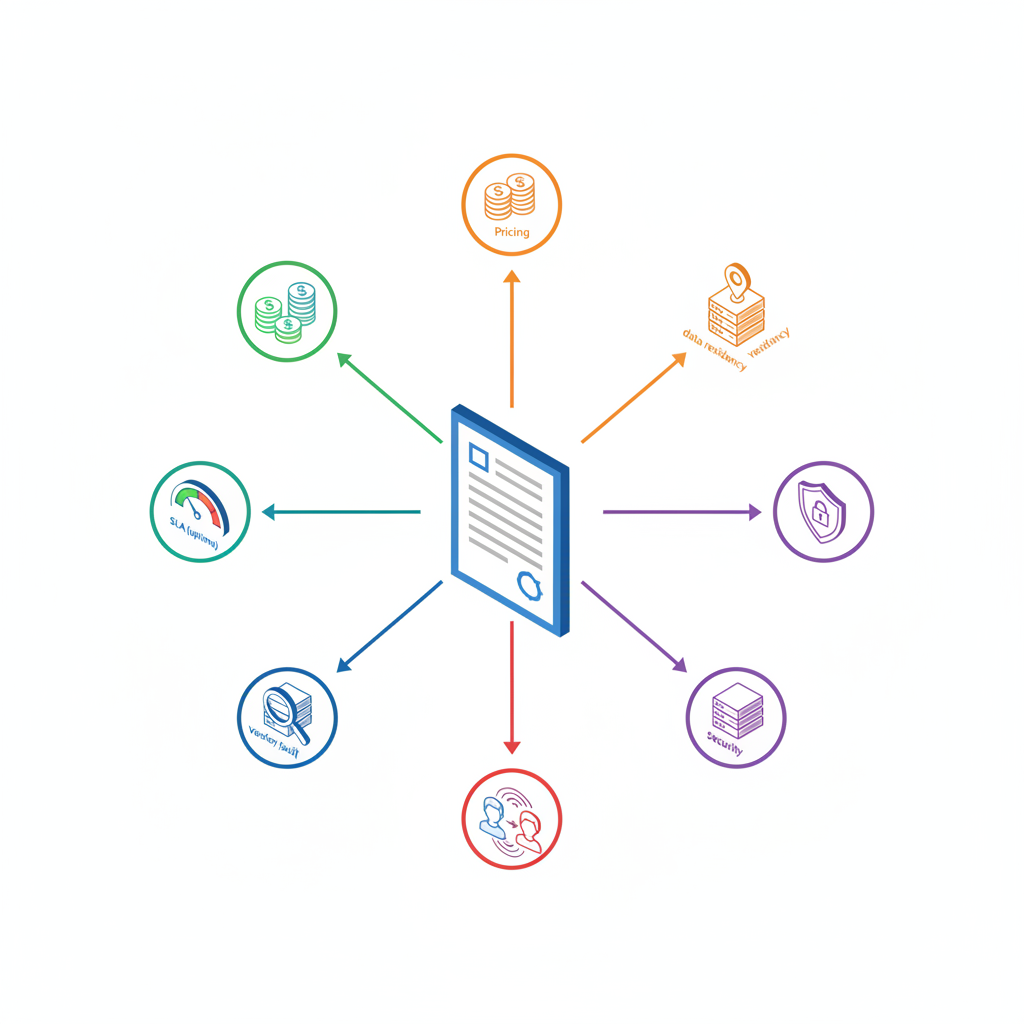
- Push for transparent pricing and explicit SLA metrics (example: 99.9% measured monthly with service credits) and watch for hidden costs like egress and API overage.
- Demand a data residency clause, vendor security audit rights, breach notification SLAs, and clear IP language about model outputs and training data.
- Use checklists and a one-page addendum to convert commercial promises into enforceable contract language.

If you plan to negotiate ai contract terms for a site or product, start by defining precise use cases and the data you’ll send. This guide walks website owners, marketers, and developers through the exact prep work, negotiation levers, and contract snippets that turn vague vendor promises into measurable obligations. It includes GDPR and CCPA definitions, sample SLA language (99.9% uptime example), and practical scripts you can use on vendor calls.
When NOT to negotiate AI contracts
Do not pursue a bespoke contract when you only need a free trial or experimental integration that sends no sensitive data. Do not push for residency or custom SLAs if the vendor cannot technically isolate workloads in your region. Avoid long-term contracts when your use case depends on rapidly evolving models that you can’t validate in a short pilot. If your application cannot tolerate incorrect outputs and you cannot provide labeled feedback for remediation, this buyer playbook may not make sense.
Why negotiating AI contracts is different (risks, rapid model updates, data handling)
AI suppliers update models frequently and that creates three contract-level risks: unpredictable behavior after model updates, shifting cost patterns, and data reuse for training. Unlike traditional SaaS, models may change accuracy, latency, or safety characteristics overnight. You must negotiate mechanisms to control those changes and allocate risk. For example, require release notifications for model changes that affect responses used in production and a rollback capability if a new model introduces harmful outputs.
AI systems also blur data-controller/processor responsibilities. When you send customer PII or proprietary content, specify whether the vendor acts as a processor (performing only instructions) or as a controller (making independent decisions). That distinction affects GDPR and CCPA obligations and the contract clauses you’ll need. Negotiate ai contract terms that explicitly limit how vendor can use your data for training, require deletion on termination, and set auditing rights.
Prepare to negotiate — what buyers must know before the call
Preparation reduces concessions. Before the call, document: your exact production use cases, expected throughput, data classification (public, internal, sensitive), success metrics, and acceptable failure modes. Create a short appendix with sample inputs and expected outputs to demonstrate how you’ll use the model. That lets the vendor map costs and security needs and lets you demand concrete protections.
Only accept model updates into production after automated tests pass and rollback is verifiable within one maintenance window.
Map use cases, data flows and access needs
Draw a one-page diagram showing where data originates, what fields go to the vendor, and where outputs land. Include data classification tags and retention expectations. Example: "Customer messages (PII) -> preprocessor (redaction) -> vendor API -> analytics store (hashed)." Use that diagram to demand specific encryption-in-transit and at-rest controls and to limit vendor personnel access to only named roles.
Define acceptable risk thresholds and non-negotiables
Create a short table of non-negotiables: e.g., no storing unredacted PII, breach notification within 72 hours for EU flows, and a maximum P95 inference latency of 300ms for interactive features. Mark items that are immediate deal breakers (data residency clause for EU customer data, required SOC 2 or ISO 27001 attestation). Share this list on the first commercial call so the vendor can map solutions or say no early.
Pricing models and how to push for transparency
AI pricing negotiation centers on predictability. Vendors offer subscription, usage-based, or hybrid pricing; you need to translate your expected calls and data volumes into monthly spend scenarios. To navigate this process effectively, consider reviewing strategies in negotiating AI contracts, pricing, and security, which can help you ask vendors for a simple CSV-pricing model that maps price per token/API call and projected monthly ranges for best/worst case modeling. Additionally, require a visible metering dashboard and monthly export of usage metrics that tie to invoice line items.
SaaS subscription vs usage-based vs hybrid: negotiation levers
Subscription models buy predictability; usage-based models scale with adoption. Negotiate volume discounts, committed spend floors with step-downs, and hard caps to avoid runaway bills. For hybrid deals, demand a blended rate schedule and the ability to convert excess usage into committed capacity at a pre-agreed discount.
Hidden cost areas (ingress/egress, API overage, support tiers)
Watch for ingress/egress fees, data storage charges, per-request parsing fees, AI training or fine-tuning charges, and premium support add-ons. Ask for a cost table that includes egress per GB, API overage thresholds, and the defined support response times by tier. Negotiate a free egress allowance for the first 90 days of a pilot and cap overage rates for the first year.
Security, privacy & compliance clauses buyers should require
Negotiate explicit security obligations: minimum encryption standards, background checks for vendor personnel with access, documented incident response, and regular third-party security assessments. Include a data residency clause for regulated flows and require vendor security audit rights. Ask for objective evidence (attestation reports) rather than marketing claims.
Requiring vendor security audit rights turns vague promises into verifiable proof points.
Data residency, processing vs controller responsibilities
GDPR (EU) protects personal data and gives data subjects rights such as access, rectification, and erasure; it typically requires a data processing agreement when a vendor processes EU personal data. CCPA/CPRA (California) grants consumers rights over sale and sharing of personal data and imposes notice and deletion obligations on businesses. Contract implications: require a data residency clause for EU workloads, a DPA that maps roles, and clear obligations to assist with DSARs (data subject access requests).
Quotable snippet: "GDPR requires a DPA when a vendor processes EU personal data; CCPA/CPRA requires notice and deletion support for California consumers."
Audit rights, breach notification SLAs, encryption standards
Require vendor security audit rights (on-site or remote), quarterly vulnerability scans, and annual penetration tests. Specify breach notification timelines: for EU-related data, require notification within 72 hours; for other flows, require notification within 48–72 hours and daily status updates until resolution. Specify encryption: TLS 1.2+ in transit and AES-256 at rest as a contractual minimum.
Service-level agreements (SLAs) & measurable penalties
SLAs must be measurable and enforceable. Define availability (example: 99.9% monthly uptime, measured by vendor monitoring excluding scheduled maintenance), latency (P95 inference < 300ms), and correctness metrics for model performance on agreed test sets. Tie missed SLAs to service credits or fee reductions and include an escalation path and termination right after repeated breaches.
Availability, latency, model performance and rollback clauses
Sample SLA clause: "Vendor will provide 99.9% monthly uptime, measured by vendor API health checks; service credits equal to 10% of monthly fees for each 0.1% below the target, up to 100% credit. Vendor must provide a rollback to the previous model within one maintenance window if the new model causes production errors above agreed thresholds." Use that as a starting point in ai sla examples and adjust numbers to your risk tolerance.
IP, model outputs & ownership — practical clause language
Be explicit about ownership of model outputs and derivative works. Put simply: you should own the outputs you generate and retain a license to use them free of vendor claims. Also limit vendor rights to use your data to improve their models unless you explicitly permit training; if the vendor demands training rights, negotiate compensation, opt-out mechanisms, and anonymization requirements.
Output ownership, derivative works, and use of customer data to train models
Sample language: "Customer retains all rights to outputs generated from Customer data. Vendor will not use Customer data to train models for third-party use without a separate written license." This protects your IP and prevents your proprietary inputs from becoming training material for competitors.
Negotiation playbook and red lines (scripts & timelines)
Set a timeline: pilot (30–90 days) → acceptance criteria → commercial terms → production roll-out. Red lines: no residency for regulated data, no audit rights, or vendor refusal to commit to a rollback mechanism. Use a staged approach: negotiate pilot pricing and security terms first; commercial terms follow on successful validation.
Pilot first; then lock material security and SLA terms into the commercial contract before production deployment.
Sample negotiation scripts and escalation path
Script snippet: "We’re happy to run a 30-day pilot. For production, we require a DPA, a data residency clause for EU data, and an SLA of 99.9% uptime with defined credits. Can you confirm these are achievable or identify which you cannot meet?" Escalation path: vendor AE → solutions architect → legal; set response SLA of 3 business days per negotiation item.
Quick checklist & 1-page contract addendum template
Use this checklist during vendor selection and contract review.
- Documented use case and data flow diagram
- Data classification and residency requirements
- DPA with controller/processor mapping
- Vendor security audit rights and attestation evidence (SOC 2/ISO)
- SLA: availability, latency, model performance, rollback
- Clear output IP ownership and training opt-out
- Transparent pricing CSV and metering dashboard
- Defined breach notification timelines (72 hours for EU)
One-page addendum template (table):
| Clause | Suggested language |
|---|---|
| Data residency clause | "Vendor will store and process all EU customer data within the EU and will not transfer such data outside the EU without Customer's prior written consent." |
| Breach notification SLA | "Vendor will notify Customer of any confirmed data breach affecting Customer data within 72 hours and provide daily updates until resolution." |
| SLA (availability) | "Vendor commits to 99.9% monthly availability; credits apply as 10% monthly fee credit per 0.1% below target." |
| Training opt-out | "Vendor will not use Customer data to train or improve models for third-party products without explicit, paid consent." |
Conclusion — when to walk away and next steps for piloting
Walk away when a vendor will not provide a DPA, refuses reasonable audit rights, or cannot commit to region-specific data residency. Start with a short pilot that tests performance, security, and commercial assumptions, and convert successful pilots into contracts that include the addendum clauses above. Negotiating ai contract terms early saves integration rework and prevents surprises in production.
FAQ
What does it mean to negotiate ai contracts?
To negotiate ai contract means to turn vendor promises about models, data handling, security, pricing, and support into clear, enforceable contract language that aligns risk allocation, performance metrics, and compliance obligations with your business needs.
How do you negotiate ai contracts?
You negotiate ai contracts by preparing use-case and data-flow documentation, demanding transparency on pricing and metering, requiring a DPA and data residency clause where needed, insisting on vendor security audit rights, and specifying measurable SLAs and IP terms; use pilots to validate terms before full production rollout.
References
- Artificial Intelligence Risk Management Framework: Generative AI Profile (NIST)
- Driving Efficient Acquisition of Artificial Intelligence in Government (Executive Office of the President)
- EU Artificial Intelligence Act — Act Texts