

TL;DR
- If you need to negotiate data residency with an AI vendor, start by classifying your data, insist on a clear data processing addendum, and require enforceable transfer mechanisms (SCCs or adequacy) plus technical controls and audit rights.
- Ask for breach notification SLA of 24–72 hours, annual audit cadence, and explicit subprocessor lists. Use the checklist and sample clauses below when you draft or negotiate your DPA.

If your site sends customer content or user data to an AI vendor and you don’t control where that data is stored, you risk regulatory fines, customer churn, and security incidents. You need to negotiate data residency with an AI vendor early—before sign-up or procurement—to prevent surprise cross-border transfers and to lock down obligations in a data processing addendum. This article explains how to negotiate data residency, data processing addendums, and DPAs with AI vendors so you can keep data where it must stay and get auditability, technical controls, and clear legal remedies.
When NOT to use these negotiation steps
"Who this is NOT for: if you only send fully public, anonymized content to an AI service and there’s no person-identifying information, strict residency clauses may be unnecessary. Also skip aggressive residency demands when vendor SLAs are non-negotiable for commodity low-risk tools and your supplier risk budget is minimal. Don’t apply these steps if cost, latency, or vendor dependency would make the product unusable for your core business. For those navigating these challenges, the AI Tool Procurement & Adoption Playbook provides valuable insights on effective strategies."
Why data residency and DPAs matter for AI buyers
Without explicit data residency commitments and a clear dpa for ai vendor relationships, you transfer legal and operational risk to your business. Regulators can fine organizations under GDPR up to 4% of global turnover for data protection failures, while CCPA/CPRA give California residents deletion and opt-out rights that vendors must support. For a website owner or marketer using AI to process user content, failing to negotiate data residency means your users’ data may move into jurisdictions with weaker protections or into vendor-owned training pools without consent.
Practical example: if your product logs include personal data, insist they remain in the EU when serving EU customers. For xproductlist.com teams comparing AI tools, require candidates to document where processing happens and include that in the DPA evaluation matrix. A properly negotiated DPA clarifies roles (controller vs processor), processing scope, retention limits, and residency controls so you can prove compliance during audits.
Data residency commitments must be measurable: name the region, the permitted subprocessors, and the accepted transfer mechanism.
Key legal frameworks that affect data residency (GDPR, CCPA, UK DPA, China/India localization rules)
Regulatory regimes shape what you must ask the vendor to commit to. Under the GDPR, cross-border transfers to non‑EEA countries require an adequacy decision, appropriate safeguards such as Standard Contractual Clauses (SCCs), or an approved derogation; the EDPB has issued specific guidance on AI model processing and personal data (EDPB opinion).
In the U.S., there is no federal data residency law; state laws such as California’s CCPA/CPRA impose rights that vendors must support for California residents. The UK’s Data Protection Act mirrors GDPR requirements post‑Brexit. Several APAC countries (notably draft or enacted rules in India and China) include data localization or cross-border reporting obligations—these can require that certain categories of data remain in-country or that transfers are reviewed by local authorities. When you negotiate, reference the applicable regional framework and require the vendor to meet those specific obligations in the DPA.
Quotable fact: "GDPR penalties can reach up to 4% of global turnover; always confirm transfer safeguards for cross‑border AI processing."
Typical vendor positions and common pushbacks
Vendors commonly push back on strict residency by citing shared cloud architectures, multi-region redundancy, and cost. Typical responses include: (1) “We can’t guarantee single-region processing because of failover,” (2) “We use subprocessors we can’t disclose on demand,” and (3) “Our standard DPA is non-negotiable.”
How to respond: prioritize commercial and technical levers. Offer to accept region-limited processing with narrowly scoped SLAs, propose an approved subprocessors schedule that the vendor updates with notice, and trade concessions (longer contract term, higher volume commitment) for residency guarantees. When a vendor refuses to sign a DPA that contains residency or SCC language, escalate to procurement or consider alternatives that support ai data residency requirements you need.
If a vendor refuses to name subprocessors, treat that as a red flag for production use with regulated data.
Practical negotiation checklist (clauses to ask for in a DPA)
Start the legal conversation with a one‑page requirements sheet listing must-have clauses. Use the following checklist to draft your DPA. Keep the DPA short, but attach schedules for processing details and subprocessors.
- Data residency clause: specify exact regions (e.g., "Processing and storage of Customer Personal Data shall occur only in the EU (Ireland), unless Customer authorizes otherwise in writing").
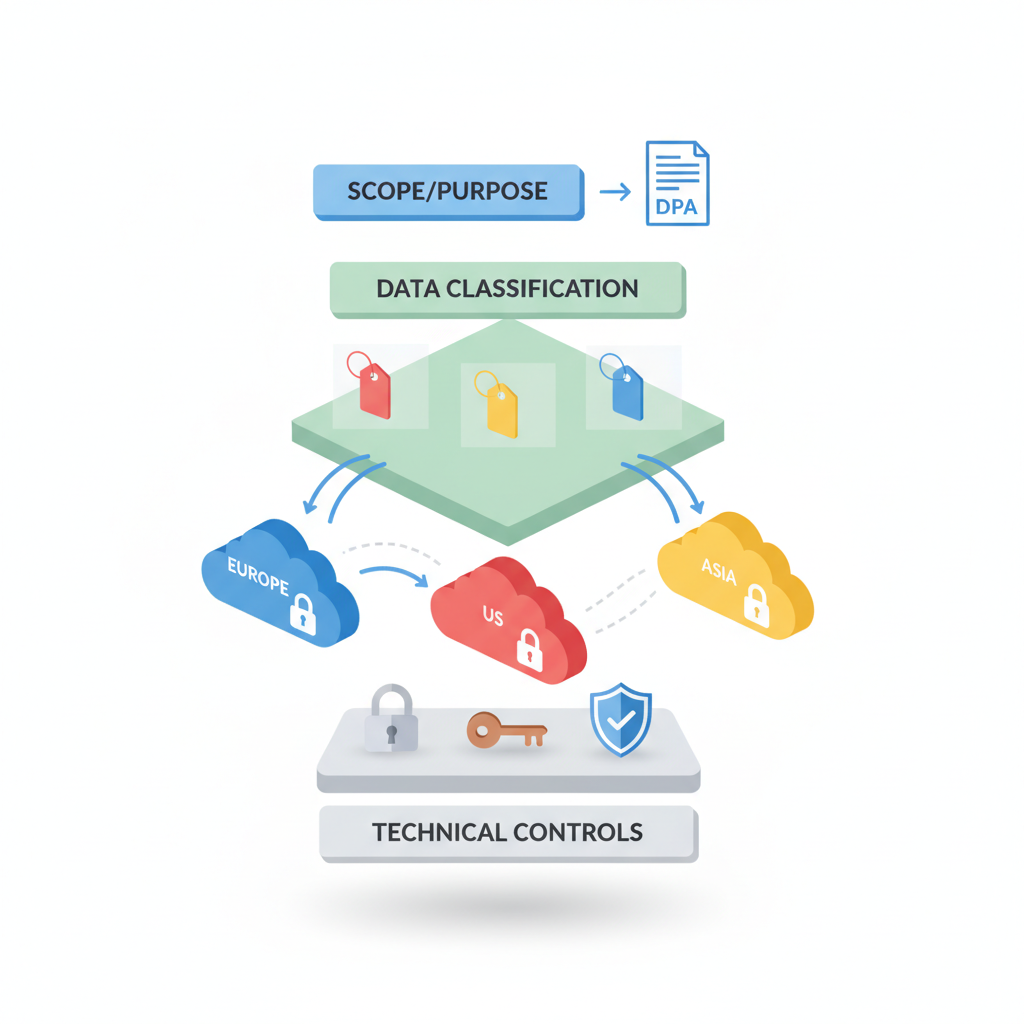
- Scope & classification: define what is personal data, sensitive data, and telemetry (see Data classification below).
- Transfer mechanisms: include SCCs for EU transfers or reference adequacy where applicable.
- Subprocessor rules: pre-authorization plus 30-day notice for changes.
- Technical controls: encryption at rest, TLS in transit, and customer key management options.
- Breach notification SLA: 24–72 hours initial notice, full report within 30 days.
- Audit and compliance evidence: yearly SOC 2 or ISO 27001 report and right to audit (or third-party assessment).
- Retention and deletion: explicit retention schedules and secure deletion on termination.
Below is a compact decision matrix you can paste into procurement evaluations:
| Requirement | Acceptable | Score (0-5) |
|---|---|---|
| Processing region fixed | Yes / No | 0-5 |
| SCCs or adequacy | Yes / No | 0-5 |
| Subprocessor transparency | List or rolling notice | 0-5 |
Ask for an annual audit report (SOC 2 Type II or ISO 27001) plus a right to reasonable on‑site or remote audits.
Data classification & scope of processing
Define categories clearly in a DPA schedule: e.g., "Personal data: names, emails, IP addresses; Sensitive personal data: health, financial; Telemetry: model logs and usage metrics." Map each category to allowed processing activities and residency requirements. Concrete rule: require that sensitive personal data never leave the named region and block routing to global model-training pools unless expressly permitted in writing.
Purpose limitation and subprocessor rules
Specify permitted purposes (e.g., “service delivery, maintenance, and improvement”) and prohibit secondary uses such as model training, unless opt-in is documented. Require vendor to list subprocessors in a Schedule and send a 30-day notice for new subprocessors with the option to object for legitimate compliance reasons.
Data transfer mechanisms (SCCs, adequacy, contractual clauses)
For EU-to-third-country transfers, require the vendor to adopt EU Standard Contractual Clauses (SCCs) and include them as an annex to the DPA. For U.S.-only contracts, require contractual safeguards that mirror SCC protections. If a jurisdiction has adequacy, state that transfers rely on that adequacy decision. Sample clause: "Vendor shall process and transfer Personal Data in accordance with the EU Standard Contractual Clauses attached as Annex A." Understanding these elements is crucial for effective negotiating AI contracts.
Technical and operational controls to require (encryption, encryption-at-rest, key management)
Technical controls are your first line of defense. Require encryption in transit (TLS 1.2+), encryption at rest (AES-256 or equivalent), and, when possible, customer-controlled key management (bring-your-own-key). For low-latency web workloads, set a P95 latency target (for typical SaaS apps target under 200ms where feasible) as a non-security SLA to evaluate performance trade-offs for regional hosting.
Operational controls to request: role-based access control (RBAC), least privilege for service accounts, recorded change control logs, and separation of environments (dev/test vs prod). Ask vendors to provide their incident response plan and to commit to post-incident root-cause timelines and remediation milestones.
Audit rights, breach notification timelines, and compliance evidence
Negotiate the right to receive annual external audit reports (SOC 2 Type II, ISO 27001) and, where necessary, a contractual right to conduct a reasonable audit or to receive third-party assessment summaries. For breach notifications, require initial notification within 24–72 hours of detection and a full incident report within 30 days. Include a provision for customer-required notification to affected data subjects when the law demands it.
Also define proof points vendors must provide: security architecture diagrams, subprocessors list, penetration test summaries, and data flow maps showing where personal data is stored and processed. These artifacts give you evidence for regulatory assessments.
Sample contract language and red flags
Sample EU clause: "Vendor shall process Customer Personal Data only in the EEA unless Customer provides prior written consent. Transfers outside the EEA will be governed by the Standard Contractual Clauses (Annex A)."
Sample US clause: "Vendor will implement and maintain commercially reasonable safeguards and provide Customer with audit reports and evidence of compliance relevant to the processing of Customer Personal Data."
Red flags: refusal to sign SCCs or to name subprocessors, vague descriptions like "may process data globally," and lack of audit reports. If you encounter these, escalate or consider an alternative vendor that meets basic ai data residency requirements.
How GEO requirements change negotiation (EU vs US vs APAC)
Geography alters your asks. In the EU, insist on SCCs and region-locked processing; in the UK, confirm UK‑approved transfer mechanisms. In the U.S., ask how vendors support CCPA/CPRA rights and map data flows for California residents. For APAC, verify local localization rules: India and China have evolving or existing cross-border controls and may require in-country storage for certain categories. Match your DPA clauses to those regional requirements and include a clause that requires vendor compliance with local law changes or a renegotiation right.
Next steps: internal checklist before signing
Before you sign, run this internal checklist: verify data classification, confirm residency commitments in the DPA, ensure SCCs or equivalent are attached, verify subprocessors and audit reports, test technical controls in a staging environment, and obtain executive sign-off on residual risk. Assign owners: legal reviews the DPA, security validates controls, procurement negotiates commercial trade-offs, and product confirms functional impacts.
- Confirm data categories and residency for each customer segment.
- Validate vendor audit report and encryption controls.
- Negotiate breach SLA (24–72 hours) and annual audit cadence.
- Lock subprocessors schedule and require notice periods.
- Sign DPA only after technical validation in staging.
FAQ
What does it mean to negotiate data residency, data processing addendums, and dpas with ai vendors?
Negotiating data residency, a data processing addendum, and DPAs with AI vendors means legally and operationally requiring where data may be stored and processed, which safeguards apply, how transfers are authorized (for example, SCCs for EU transfers), and what audit, breach notification, and subprocessor controls the vendor must follow.
How do you negotiate data residency, data processing addendums, and dpas with ai vendors?
You negotiate by classifying data, drafting a short DPA schedule that names permitted regions and transfer mechanisms, insisting on encryption and key-management options, demanding subprocessors transparency and audit evidence, and trading commercial terms when vendors resist residency commitments.
References
- EDPB: Opinion on AI models and GDPR principles
- ICO guidance and practical resources on AI
- CNIL: Guidance on deploying generative AI
- EU Regulation 2024/1689
- Google Cloud: Cloud Data Processing Addendum
Conclusion: To negotiate data residency with an AI vendor, start with clear data classification, demand an explicit dpa for ai vendor relationships that names regions and transfer mechanisms (SCCs/adequacy), require encryption and key controls, and secure audit and breach notification rights. Follow the checklist above and don’t accept vague, non‑negotiable DPAs for regulated data.