
Question: How do I run a fast, practical ai security audit checklist for small businesses before I connect a third-party model to my website or app?
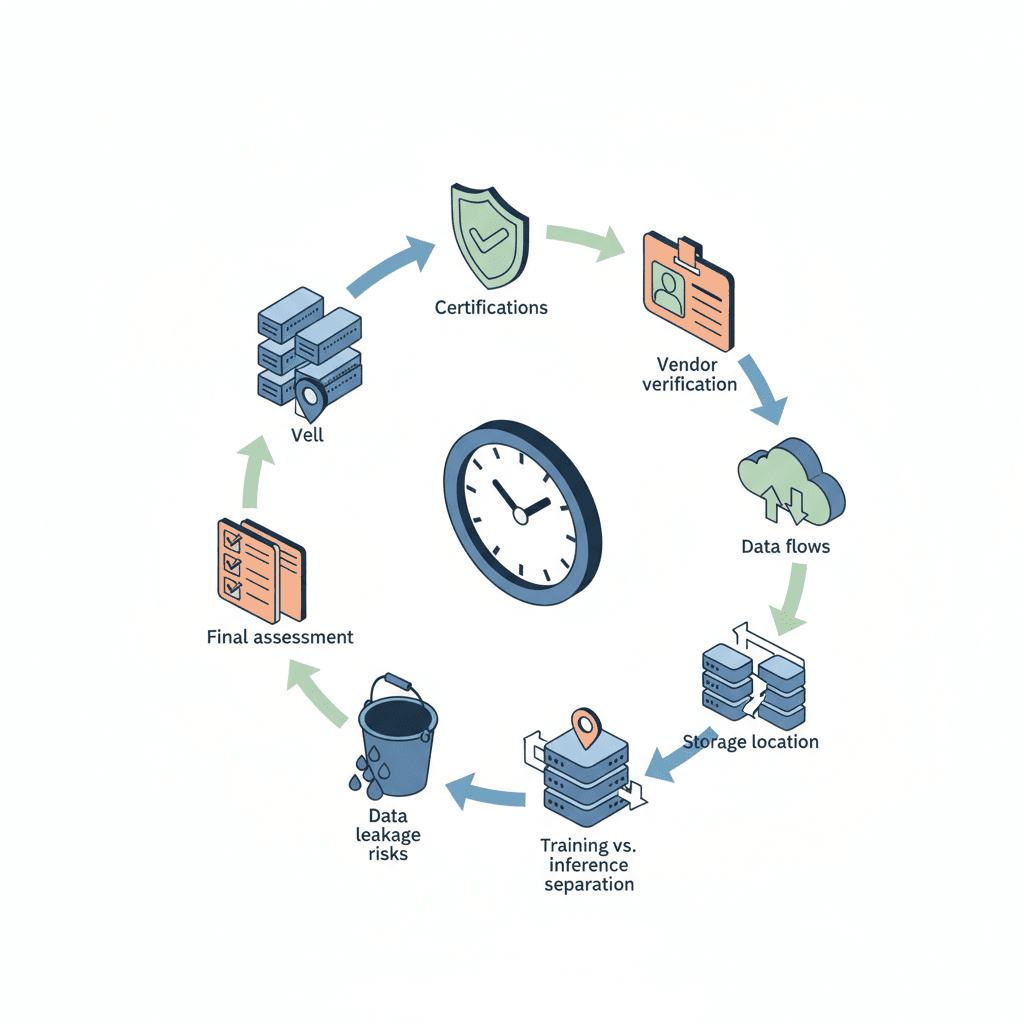
Answer: Run a compact 7-step quick ai security assessment that focuses on identity, data flows, access controls, logging, model separation, risk scoring, and operational handoff. Spend 15–90 minutes per vendor and escalate any vendor scoring <=2 on a 0–4 rubric.
A security audit for AI is a focused review that verifies who has access to data and models, where data moves and lives, and how a vendor responds to incidents. Score vendors on 5 dimensions: data handling, access controls, transparency, incident response, and legal protections. Score 0–4 across those five areas; any vendor scoring <=2 in a category should trigger escalation.
Who this is not for
This checklist is not intended for large enterprise procurement teams running formal RFPs, model-development risk teams training foundation models, or projects that process regulated healthcare or financial data without legal counsel. If you handle regulated data at scale or require SOC-level contracts, perform a full security review with legal and a security vendor instead of a quick ai security assessment.
Score vendors on five dimensions: data handling, access controls, transparency, incident response, legal protections.

Why SMBs need a lightweight AI security audit before deploying third-party models
Without a short, repeatable audit, small businesses can accidentally expose customer data, embed a model that leaks PII, or lose the ability to revoke access when a vendor changes terms. A compact third-party ai security audit gives you fast confidence: it finds obvious configuration issues, informs contract needs, and sets remediation priorities before production traffic reaches the model.
For example, a marketing site that uses a third-party generative model to personalize copy can inadvertently send customer emails or internal prompts to the vendor’s training pipeline if the vendor’s documentation is unclear. A quick check of data retention, request logging, and training/inference separation prevents that class of leak. Regional rules matter: prioritize EU data residency and encryption-at-rest if you serve EU customers, and track US breach-notification timelines if you operate there. These regional differences change the audit scope and contract ask.
Scoping the audit: assets, data sensitivity, and threat model
Start by listing the assets the AI will touch: customer emails, CRM records, images, or user-generated content. Classify each asset by sensitivity—Public, Internal, Sensitive, Regulated—and map the data flow from your frontend to the vendor and back. This scoping narrows the audit to the controls that matter and keeps your quick ai security assessment targeted.
Example scope: a small ecommerce site uses a chat assistant that receives order numbers and shipping addresses. Mark order numbers as Sensitive and addresses as Regulated (if the region requires). Your threat model should ask: can a vendor's model memorize and echo PII? Can keys be leaked in client-side code? Can an attacker prompt-inject data to exfiltrate stored tokens? Use these questions to prioritize checks in your third-party ai security audit.
7-step quick audit process (15–90 minutes per vendor)
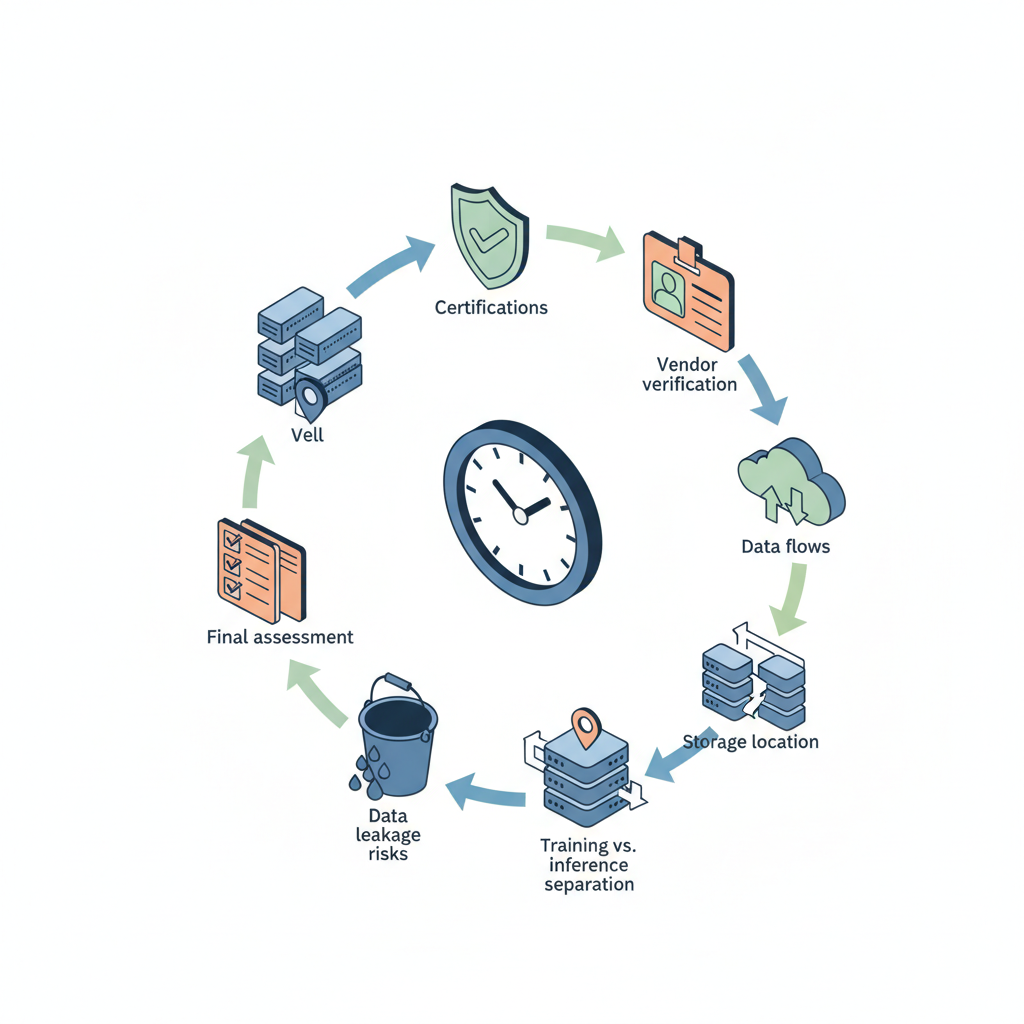
This 7-step flow is designed for SMBs to run a reproducible spot-check per vendor. It assumes you have a product owner, a developer, and a person who owns contracts or privacy to review answers. Allocate 15 minutes for simple SaaS connectors and up to 90 minutes for deep API integrations.
Step 1: Verify vendor identity and certifications (ISO, SOC2)
Confirm the vendor’s registered business name and the entity that will sign your contract. Ask for current certification evidence such as SOC 2 Type II or ISO 27001 and note the scope—does the SOC2 report include the specific service you’ll use? If a vendor lacks formal certification, ask for a recent penetration test report or a security whitepaper. Record the certifications in your audit notes and mark any gaps for legal review.
Step 2: Review data flows and storage locations
Map where request inputs and outputs travel and where persistent storage occurs. Ask the vendor: do you persist prompts or model responses? Where is data stored (region, cloud provider)? Does the vendor use customer data to improve models? For an ml model data leakage audit, confirm whether prompts are retained and whether retention can be disabled. If you must meet EU residency rules, require data-at-rest in EU regions and add that requirement to contracts.
Step 3: Check model training & inference separation
Confirm whether customer inputs are ever used for model retraining or fine-tuning. A clean separation—where inference traffic is never piped into training datasets—reduces the risk of long-term memorization and leakage. If the vendor allows opt-out, verify the process (API flag, contract clause) and test it in a sandbox. Add a note: if training/inference separation isn't documented, treat that as a medium-to-high risk.
Step 4: Test access controls and keys/credentials management
Verify how API keys are issued and revoked, whether keys can be scoped by IP or role, and whether secrets are rotated automatically. Perform a permission review in your project: ensure keys used in front-end code are only for anonymous, rate-limited paths; never embed admin keys in client code. Ask ai vendor security questions that include: how do you rotate keys, what is the default key TTL, and do you support scoped tokens? Log answers and flag vendors that cannot provide scoped or short-lived credentials.
Step 5: Inspect logging, monitoring, and breach notification processes
Confirm what logs the vendor captures (request metadata, full prompts, response caches) and how long logs are retained. Check monitoring: does the vendor detect anomalous query rates or unusual prompt patterns? Ask for their incident response plan and breach-notification timelines—US customers often expect 72-hour notification windows, whereas EU considerations emphasize data residency during remediation. If the vendor cannot demonstrate timely notifications and readable logs, mark this as a high-priority remediation.
Step 6: Score risks and set remediation priorities
Use a simple 0–4 scoring rubric across five categories: data handling, access controls, transparency, incident response, and legal protections. Multiply category scores to create a weighted view or use the table below. A vendor scoring <=2 in any category should trigger an escalation to legal or to an alternate vendor. Example thresholds: require data retention <=30 days for non-essential logs and P95 latency targets under 300ms for interactive use to avoid client-side exposure delays.
Step 7: Operational handoff and recurring review cadence
Document remediation actions, assign owners, and set a review cadence—quarterly for persistent integrations, monthly for high-risk data paths. Handoff the audit notes to ops with concrete tickets: rotate keys, add request redaction, negotiate data-residency clause. For ongoing assurance, schedule a light recheck (15–30 minutes) after major vendor changes or after your product adds new data types to the model inputs.
Operationalize audits: unresolved vendor gaps must translate into tickets with owners and deadlines before production rollout.
Tools and quick tests SMBs can run (open-source scanners, simple curl tests, permission reviews)
You can run useful checks with small scripts and free tools. Use curl to verify endpoints, TLS, and headers. Example curl test: request a simple inference and inspect whether responses include diagnostics or unexpected headers. Run permission reviews in your cloud console to find overly broad service accounts and search your codebase for hard-coded API keys.
Open-source options include static secret scanners and dependency-checkers. For a quick ai vendor security audit, run: a secret-scan across repos, a traffic-capture to confirm data flow paths, and a retention test where you send a unique token to the vendor and query whether it is later returned in model output (a simple ml model data leakage audit technique). Document results and attach them to the vendor scorecard.
Example audit report template and risk scoring rubric
Below are two reusable artifacts: a copyable checklist and a risk-scoring table you can paste into audit notes.
- Vendor identity and certification checked
- Data flow diagram attached
- Training/inference separation confirmed
- Key management validated
- Logging and incident response reviewed
- Risk scores assigned and remediation tasks created
- Operational handoff scheduled
| Category | Description | Score (0–4) |
|---|---|---|
| Data handling | Retention, residency, use for training | 0–4 |
| Access controls | Key scoping, rotation, role separation | 0–4 |
| Transparency | Documentation of flows and model behavior | 0–4 |
| Incident response | Logging, monitoring, notification timelines | 0–4 |
| Legal protections | Contract clauses for data, liability, indemnity | 0–4 |
| Action | Who | Due |
|---|---|---|
| Disable training data retention | Vendor/Legal | Before launch |
| Rotate production key | DevOps | 48 hours |
| Implement prompt redaction | Dev | 1 week |
Next steps: hardening, contract changes, and monitoring
After the audit, harden integrations by removing sensitive fields from prompts, enforcing server-side calls, and using short-lived scoped tokens. For contracts, add explicit data residency clauses, a training-opt-out, and clear breach-notification timelines tied to your regional needs. For monitoring, add alert rules for spikes in unusual queries and schedule vendor rechecks after product changes.
Quotable: "A vendor scoring <=2 in any audit category should trigger legal review or a fallback plan." Use that decision rule when you present results to stakeholders.
FAQ
What does it mean to run a quick security audit for third-party AI models?
Running a quick security audit means performing a focused review that verifies vendor identity, data flows, storage, training separation, access controls, logging, and legal protections to decide if the integration is safe for production.
How do you run a quick security audit for third-party AI models?
Run a 7-step quick ai security assessment: verify certifications, map data flows, confirm training/inference separation, test key management, review logging and notifications, score risks, and hand off remediation with a review cadence.
References
- Joint Guidance on Deploying AI Systems Securely (CISA)
- Secure software development practices for generative AI (NIST)
- AI Cyber Security Code of Practice (GOV.UK)
- ETSI TS 104 223 Securing Artificial Intelligence (SAI)
- OWASP Top 10 for LLMs