

TL;DR
- Use a repeatable score ai tools evaluation matrix to turn opinions into comparable numbers.
- Score tools across 10 criteria, weight them based on your buyer persona, then pilot the top 2-3.
- Include privacy, integration, and TCO checks early to avoid late surprises.

Introduction. Use a simple, repeatable framework so your team can objectively compare products instead of debating features in meetings. Evaluation matrix: a weighted checklist that converts subjective assessments into comparable numeric scores. Many small US/EU firms prioritize integration speed and compliance—adjust weights accordingly. This guide shows exactly how to score ai tools evaluation matrix, how to shortlist ai tools, and how small teams can run a fast, defensible selection process.
Who this is NOT for
This matrix is designed for evaluation and shortlisting, not full production validation. Do not use this approach when you lack measurable success metrics, when model outputs cannot be reliably evaluated, or when legal/regulatory approval is required before any proof-of-concept (for example, medical devices or regulated finance models). If you need formal third-party assurance, follow an AI assurance standard such as those from NIST or MITRE before procurement.
Why a simple scoring matrix beats ad-hoc shortlists
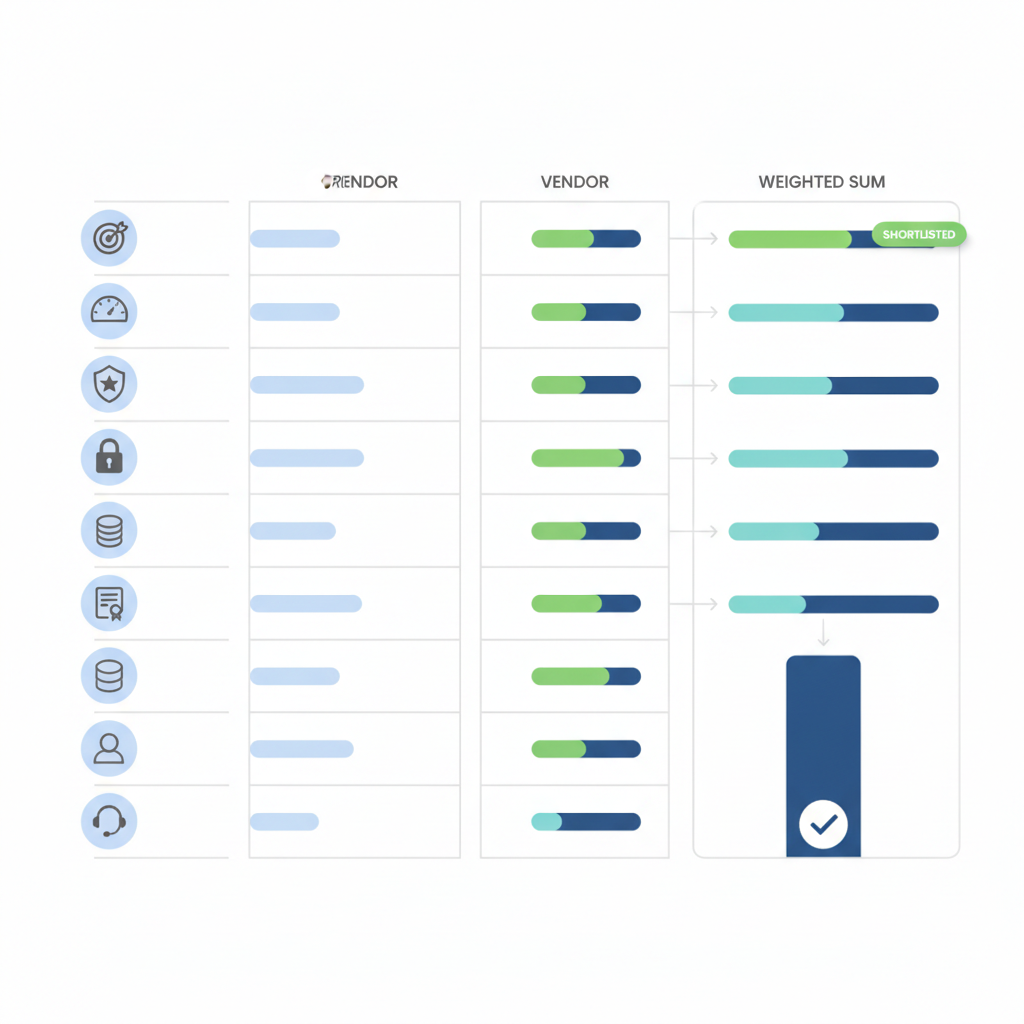
Teams that try to choose tools by committee or gut end up with long vendor lists and decision paralysis. A score ai tools evaluation matrix forces you to declare what matters, assign weights, and collect evidence. That produces three outcomes: consistent decisions, faster pilots, and defensible vendor choices for stakeholders. For example, a marketing team choosing a content assistant might weight accuracy 30%, cost 20%, and integration 25%—then they can compare three vendors with a single table and pick the one with the highest weighted score. Use concrete decision rules: if the top tool scores at least 10% more than the runner-up, run a 2-week pilot; otherwise expand evaluation criteria.
An evaluation matrix converts opinions into a repeatable procurement artifact used in vendor governance.
Who should use this matrix (roles & team size)
Small teams (2–10 people) including website owners, marketers, and developers benefit most. Typical role breakdowns that use this matrix:
- Developers: focus on integration, APIs, and performance.
- Product managers: prioritize accuracy, customizability, and roadmap fit.
- Operations/security: own privacy, compliance, and certifications checks.
Example: a three-person team (PM, dev, marketer) can complete a discovery and scoring round in one week by sharing one spreadsheet and dividing criteria between stakeholders. This helps small teams evaluate ai tools small teams with low overhead.
The 10 evaluation criteria (H3 for each criterion: definition, why it matters, scoring rubric)
Below are the ten criteria to include in your ai tool evaluation matrix. Use a 1–5 score per criterion (1 = poor, 5 = excellent) and multiply by a weight (sum of weights = 100). The following H3 entries define each criterion, explain why it matters, and give a quick rubric.
Score consistently: capture one evidence link per criterion (screenshot, API docs, SLA excerpt).
Accuracy & performance
Definition: correctness of outputs and runtime behavior under realistic inputs. Why it matters: low accuracy wastes user time and reduces trust; poor performance blocks real-time use. Scoring rubric: 5 = documented benchmarks on your task or >90% task accuracy in a sample test; 3 = adequate for prototyping with occasional errors; 1 = fails basic tests. Concrete thresholds: for text generation latency, target median latency under 300ms for interactive features; for batch tasks, P95 latency under 2s is acceptable for many marketing workflows.
Data privacy & compliance
Definition: how the vendor handles data storage, processing, and regulatory requirements. Why it matters: many firms in US/EU require clear controls for user data and rights. Scoring rubric: 5 = offers data residency options, clear DPA, and GDPR-ready controls; 3 = standard data handling with limited controls; 1 = vendor stores everything by default and cannot sign DPAs. Example checklist item: confirm whether data used for model training is excluded or opt-out available.
Integration & APIs
Definition: availability and quality of programmatic interfaces and pre-built connectors. Why it matters: integration speed reduces time-to-value for small teams. Scoring rubric: 5 = complete REST/GraphQL APIs, SDKs in major languages, and sample code; 3 = API-only with minimal docs; 1 = manual upload-only or no API. Example: require an API sandbox and sample cURL requests before pilot.
Security & certifications
Definition: technical controls, vulnerability management, and formal certifications. Why it matters: security gaps create real operational risk. Scoring rubric: 5 = ISO 27001 or SOC 2 Type II and documented pen test results; 3 = strong security practices without formal certs; 1 = no meaningful security controls. Action: ask for an SOC 2 report or equivalent and validate scopes against your data handling needs.
Cost & TCO signals
Definition: up-front pricing, predictable consumption costs, and expected total cost of ownership. Why it matters: sticker shock on consumption billing is common. Scoring rubric: 5 = transparent pricing + cost calculator + clear overage rules; 3 = opaque pricing with examples; 1 = no pricing or excessive usage surprises. Decision rule: calculate 12-month TCO including engineering hours; flag tools where projected monthly spend > expected benefit.
Support & SLAs
Definition: responsiveness, escalation paths, and guaranteed availability. Why it matters: support quality shortens time to resolution during pilots. Scoring rubric: 5 = 24/7 support, named CSM, clear SLAs; 3 = business-hours support, ticketing system; 1 = email-only and slow response times. Example requirement: request a written SLA for uptime if the tool will be customer-facing.
Ease of use & onboarding
Definition: learning curve, documentation, and available onboarding materials. Why it matters: small teams can’t absorb long ramp-up times. Scoring rubric: 5 = guided setup, example projects, and clear UX; 3 = basic docs; 1 = steep learning curve and no examples. Example KPI: reduce onboarding time under 8 hours for a two-person team.
Customizability & extensibility
Definition: ability to tune models, add plugins, or extend workflows. Why it matters: off-the-shelf models may not fit niche content or product data. Scoring rubric: 5 = fine-tuning, webhooks, and plugin APIs; 3 = parameter tuning only; 1 = no customization. Example: require at least one extensibility point (webhook or plugin API) for production use.
Vendor stability & roadmap
Definition: company funding, churn rate, and public product roadmap. Why it matters: vendor changes can force costly migrations. Scoring rubric: 5 = established vendor with transparent roadmap; 3 = early-stage with clear plans; 1 = unknown roadmap and frequent breaking changes. Evidence to collect: recent release cadence and a product roadmap summary.
Community & ecosystem
Definition: user community, third-party integrations, and marketplace availability. Why it matters: vibrant ecosystems accelerate problem solving and provide plugins you may need. Scoring rubric: 5 = active community, marketplace plugins, and third-party tutorials; 3 = small community; 1 = no ecosystem. Example: prefer vendors with public Slack/Discord or community forum and sample integrations.
How to weight criteria for different buyer personas (developer, product manager, operations)
Weighting changes with use case. Use these starter weights and adjust to your priorities. Developer-focused (API-first): Integration 30%, Security 20%, Performance 20%, Cost 10%, Others 20%. Product manager (user-facing features): Accuracy 30%, UX/onboarding 20%, Customizability 15%, Roadmap 15%, Cost 10%, Others 10%. Operations/security: Compliance 30%, Security 25%, Support 15%, TCO 10%, Integration 10%, Others 10%. Concrete step: create three columns in your spreadsheet for each persona’s weights, then compute weighted scores to see tool rank shifts.
Step-by-step scoring workflow (from discovery to pilot to shortlist)
Follow these steps: 1) Discovery: collect vendor docs and sample outputs. 2) Quick screen: apply must-have filters (API, privacy). 3) Score: three reviewers independently score against the 10 criteria. 4) Normalize and weight scores. 5) Pilot: run 2-week pilot with top 2 tools. 6) Decide: use weighted scores plus pilot outcomes to pick one. Timebox each stage: discovery 2–3 days, scoring 1–2 days, pilot 2 weeks. Record artifacts: screenshots, API responses, and cost logs for governance.
Ready-to-use spreadsheet template (how to use and adapt)
Use this simple table as your starting artifact. Copy it into Google Sheets or Excel, add weights in the top row, and paste vendor scores below.
| Criterion | Weight | Tool A | Tool B | Tool C |
|---|---|---|---|---|
| Accuracy | 25 | 4 | 3 | 5 |
| Privacy | 15 | 5 | 4 | 3 |
| Integration | 15 | 4 | 5 | 3 |
| Security | 10 | 4 | 3 | 4 |
Criterion,Weight,Tool A,Tool B,Tool C
Accuracy,25,4,3,5
Privacy,15,5,4,3
Integration,15,4,5,3
Security,10,4,3,4
... (add remaining criteria)
Copy the CSV above and save as evaluation-matrix.csv to reuse locally.
Example: scoring 3 AI assistants side-by-side
Scenario: a marketing team tests three content assistants. They set weights: Accuracy 25, Integration 20, Cost 15, Onboarding 10, Privacy 15, Support 15 (sum 100). After independent scoring and averaging, Tool C scores 78, Tool A 71, Tool B 62. Decision rule: because Tool C is >10% ahead of A, run a pilot with Tool C only. If the gap had been narrower (<10%), run pilots with top two. Capture sample outputs and track content quality metrics like publish rate and edit time during the pilot.
How to turn scores into a prioritized shortlist and next steps
Translate weighted numeric scores into actions: 80+ = pilot candidate, 65–79 = extended evaluation, <65 = reject. Next steps: for pilot candidates, prepare a 2-week success plan with clear KPIs (for example, reduce article editing time by 30% or maintain content accuracy >85%). Ask the vendor for a sandbox, test with real workflows, and track TCO during the pilot. Keep a procurement record: scoring sheet, evidence links, pilot logs, and final decision rationale for auditability.
FAQs and common scoring mistakes
- What does it mean to score and shortlist ai tools? Scoring and shortlisting ai tools means using a weighted evaluation matrix to convert subjective assessments into numeric values, then ranking vendors and choosing a small number for pilots.
- How do you score and shortlist ai tools? You select criteria, assign weights based on business priorities, collect evidence, score each vendor on a 1–5 scale, compute weighted totals, and run pilots with the top-ranked vendors.
Conclusion and downloadable template
"Use the score ai tools evaluation matrix to remove guesswork from procurement. For small teams, the biggest wins come from early checks on integration, privacy, and TCO. Download the CSV above, adapt weights to your persona, and run a two-week pilot for the top candidate. Quotable fact: "An evaluation matrix turns subjective vendor opinions into a defensible, repeatable selection artifact." Many small US/EU firms emphasize integration speed and compliance—adjust weights to reflect that reality. To streamline your approach, consider the insights from the AI Tool Procurement & Adoption Playbook that guides SMBs through the entire process."
References
- Artificial Intelligence Risk Management Framework: Generative Artificial Intelligence Profile (NIST)
- Agentic AI maturity model - AI governance and security (Microsoft Learn)
- Guidelines on the classification of high-risk AI systems (AI Act Service Desk)
- AI Assurance (MITRE)