

TL;DR
- Ambiguous pilot contracts cost time and create legal exposure; prioritize scope, data use, IP, security, and clear exit rules.
- Use explicit processing limits, audit rights, and a limited liability cap tied to pilot fees; require data return and deletion within X days.
- Negotiate three items first: data purpose limits, IP for outputs, and liability cap — use the sample scripts below.

You’re starting an ai pilot and already juggling product roadmaps, engineers, and a shrinking budget — the last thing you need is a contract that hands the vendor broad rights, vague SLAs, and unclear data rules. Ambiguous ai pilot contract terms regularly turn pilots into disputes: data gets reused, ownership of model outputs is contested, or liability for bad outputs is left undefined. This guide shows exactly which clauses to include, the red flags to avoid, and copy‑ready negotiation scripts to protect your site’s users and data.
Overview—why pilot contracts need bespoke language for AI
AI pilots differ from standard SaaS trials because models can memorize data, outputs can be copyrighted, and model behavior can change as inputs drift. A one‑size‑fits contract that works for traditional software will fail when models are involved. You need language that limits the vendor’s use of your data, defines ownership or license of model outputs, and ties liability to concrete failure modes. For more on this, see Ai vendor selection for pilots.
Data roles (quotable definitions): Data controller: the party that determines why and how personal data is processed. Data processor: the party that processes personal data on behalf of the controller.
Region-specific obligations matter: under GDPR, controllers must document lawful bases and ensure processors follow controller instructions and implement appropriate technical measures; under CCPA/CPRA, businesses must describe categories of personal data collected and give consumers deletion/opt-out rights. Insert a short, quotable contract sentence: 'Vendor will process pilot data only to perform services described; data portability and deletion will occur within X days of pilot termination.' Replace X with a clear numeric deadline (commonly 30 days).
An AI pilot is legally safe only when data use, IP, and liability are explicitly limited to the pilot scope.
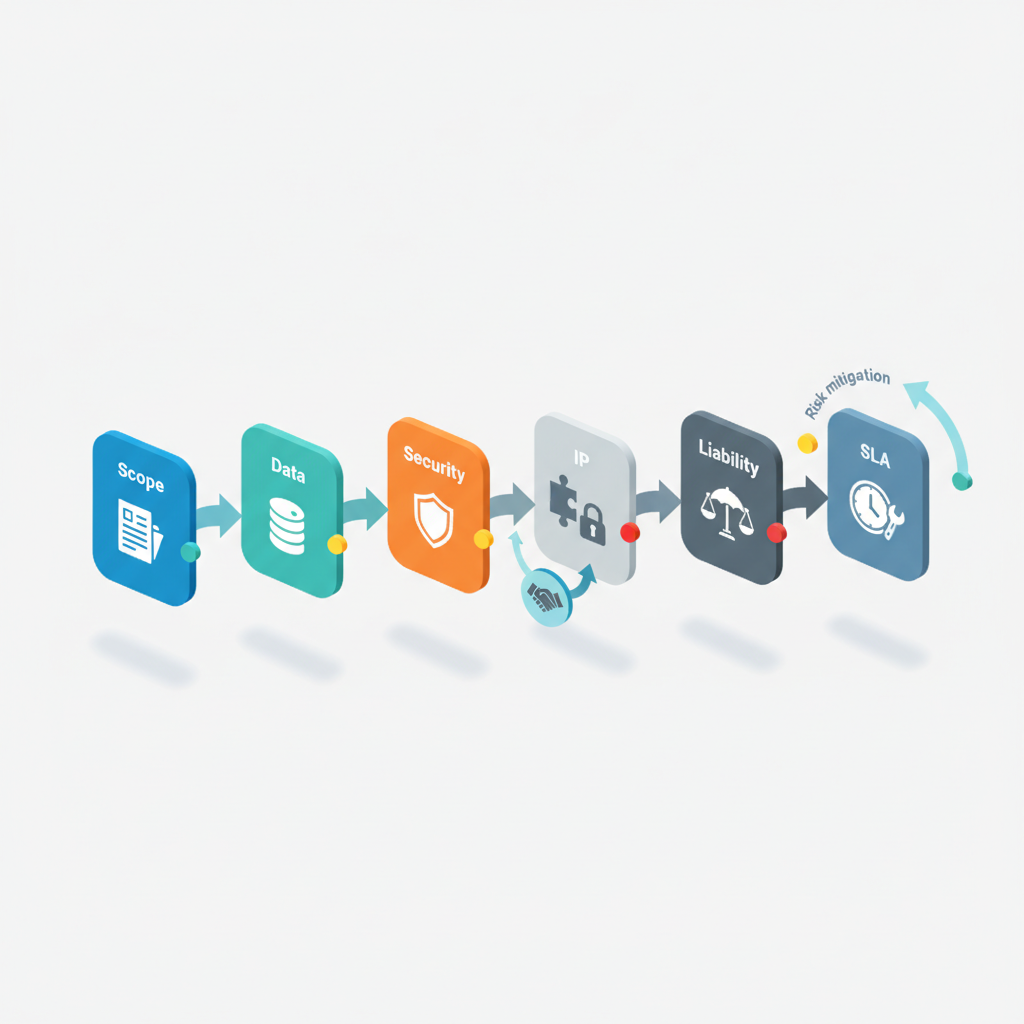
Core clauses to include (H3s below)
This section lists the contract clauses you must include for an AI pilot. Each clause is actionable and written so you can copy intent into your negotiation checklist. The headings below map to common failures and the defensive language you should insist on.
Scope of the pilot and deliverables
Define exact objectives, duration, endpoints, and accept/reject criteria. Example: "Pilot runs 60 days; vendor delivers a trained model, evaluation dataset, documentation, and a deployment script." Include measurable acceptance criteria (e.g., accuracy ≥ 85% on holdout set, false positive rate ≤ 2%). Limit the vendor’s rights to make any changes to production systems without written approval. Tie payment milestones to delivery and acceptance events.
Data handling, processing purposes, and permitted use
State data categories, retention periods, and permitted processing actions. Require the vendor to act only as a data processor if they process personal data. Include the earlier quotable template sentence exactly: 'Vendor will process pilot data only to perform services described; data portability and deletion will occur within X days of pilot termination.' Require return or secure deletion of data and a signed certificate of deletion. For GDPR: require subprocessors list and prior notice; for CCPA: ensure consumer request support. Flag reuse: prohibit vendor from using your pilot data to further train public models without explicit consent.
Security obligations and certifications
Specify minimum security controls and evidence: encryption at rest and in transit, role-based access controls, logging, and incident response timelines (e.g., notify within 72 hours of a breach). Request copies of audits or attestations such as SOC 2 Type II or equivalent. If the vendor lacks formal certifications, contractually require them to implement named controls and permit a scoped security review prior to data ingestion.
IP ownership vs. license for outputs and models
Decide who owns model weights, training artifacts, and outputs. A practical approach: you retain ownership of your input data and any labeled datasets you supplied; vendor grants you a perpetual, royalty‑free license to use outputs produced during the pilot for evaluation. If you expect to own derived models, require explicit assignment language and compensate the vendor. Avoid blanket global assignment clauses that demand all vendor IP.
Liability, indemnities and caps for model failures
Specify remedies for model failures: direct damages, limited consequential damages carve‑outs, and a clear cap usually tied to fees paid for the pilot (e.g., cap = pilot fee × 2). For high-risk pilots, carve out no cap for third‑party IP infringement or willful misconduct. Include indemnities for data breaches arising from vendor negligence. Use the keyword 'liability ai vendor' in your internal procurement checklist to flag these items during review.
Cap liability to a reasonable multiple of pilot fees but exclude willful misconduct and IP infringement from that cap.
Service levels, uptime and support during pilot
Define available support hours, escalation paths, and acceptable downtime. For API-based pilots include latency targets (example threshold: P95 latency under 300ms for inference), error budget, and credits or termination rights if availability falls below agreed levels for two consecutive weeks. Specify who provides runbooks for debugging model failures and who owns remediation tasks.
Exit, data return, and data deletion procedures
Mandate a documented exit process: data export formats, timeline for data return (e.g., 30 days), and secure deletion certificate. Require the vendor to export logs and model artifacts relevant to reproducibility. If the vendor stores backups, require deletion of backups and attestations. Include a narrowly defined survival clause listing which obligations persist post‑termination (e.g., confidentiality, deletion obligations, ongoing indemnities).
Audit rights and transparency (model audits, third‑party reviews)
Include the right to request model documentation, training data provenance, evaluation reports, and to run a third‑party audit under NDA. Limit audits to a reasonable frequency and scope; require the vendor to bear audit costs if material noncompliance is found. For public sector pilots, demand extra transparency to meet procurement rules.
Pricing, trial terms and conversion mechanics
State pilot pricing, what’s included, and how conversion to paid service works: pricing brackets, notice period to convert, and trial credits. Avoid auto‑conversion clauses that automatically enroll you in a subscription; require explicit acceptance to convert. Include pro‑rata billing for partial months and a written amendment path for expansion beyond the pilot scope.
Red flags and risky clause language to avoid
Watch for broad IP assignment, unlimited data reuse, automatic renewals, and unlimited liability waivers. Dangerous language examples: "vendor may use any data provided for any purpose" or "customer waives claims arising from AI outputs." Country‑specific red flags: clauses assigning global IP rights to vendor without geographic limitation (avoid for UK/EU customers), or language demanding assignment of moral rights — push back. When publishing local variants, link to national guidance like the ICO (UK) or CPRA resources (California) for readers who need jurisdictional detail.
Example negotiation scripts and amendment templates for SMEs
Use these short scripts during calls or in email edits. They’re concise and directly assert the customer’s positions.
- Data purpose limit: "Please add: 'Vendor will process pilot data only for the pilot's stated objectives and will not use pilot data to improve or train any models outside this contract without prior written consent.'"
- IP outputs: "We require a perpetual, royalty‑free license to outputs for internal business use; assignment of derived model weights will be discussed as a paid optional deliverable."
- Liability cap: "Set liability cap to twice the pilot fees, excluding willful misconduct and IP infringement; include indemnity for data breaches caused by vendor negligence."
Turn these into amendment templates by inserting them into a redline under a new 'Pilot Addendum' exhibit that lists data and deliverable specifics. Maintain an ai vendor contract checklist during procurement to confirm these edits were accepted.
How to align contract terms to pilot success metrics
Translate business KPIs into contractual acceptance criteria and SLAs. Example KPIs and contract mappings: accuracy ≥ 85% maps to an acceptance test; latency P95 < 300ms maps to an SLA with credits; false positive rate ≤ 2% maps to a remediation plan. Add gating language: if acceptance metrics fail at final sign‑off, require a 30‑day remediation period and the right to terminate for convenience with full refund. This makes commercial risk proportional to pilot outcomes and prevents vendors from pushing ambiguous 'value' claims.
Checklist for legal, security, and procurement review
Use this checklist during internal sign‑off. Each item should be a yes/no tick and include evidence where required.
| Review area | Item | Evidence required |
|---|---|---|
| Legal | Scope, IP, liability caps | Signed pilot addendum |
| Data privacy | Data processing agreement, deletion timeline | Signed DPA; deletion certification |
| Security | Controls & certifications | SOC 2 report or controls attestation |
| Procurement | Pricing & conversion terms | Written amendment outlining conversion mechanics |
Appendix: sample clause snippets and a one‑page contract checklist
Copy these snippets into your negotiating drafts or add them as an exhibit.
Data processing sentence (quotable):
'Vendor will process pilot data only to perform services described; data portability and deletion will occur within 30 days of pilot termination.' IP outputs license example:
'Customer is granted a perpetual, non-exclusive, royalty-free license to use outputs produced during the pilot for internal business purposes.' Liability cap example:
'Except for willful misconduct and IP infringement, liability of each party is capped at twice the total fees paid under this pilot.'
One‑page contract checklist (copyable):
| Item | Complete? |
|---|---|
| Defined scope, deliverables, acceptance tests | [ ] |
| Data use limited to pilot; deletion within X days | [ ] |
| IP ownership/licensing clear | [ ] |
| Liability cap and indemnities set | [ ] |
| Security controls & audit rights | [ ] |
FAQ
What is key contract terms for ai pilot projects? Ai pilot contract terms are the specific contractual provisions that govern scope, data use, IP, security, liability, and exit procedures during an AI pilot engagement.
How does key contract terms for ai pilot projects work? These terms work by converting pilot objectives and risk tolerances into enforceable obligations and measurable acceptance criteria, ensuring data is protected, ownership is clear, and remediation or termination rights exist if the pilot fails.
References
- Artificial Intelligence Risk Management Framework: Generative Artificial Intelligence Profile
- Secure software development practices for generative AI (NIST)
- Updated EU AI model contractual clauses
- AI acquisition memorandum (Executive Office of the President)
- IEEE 3119-2025
Key takeaway: include explicit limits on data use, clear IP licensing for outputs, measurable acceptance criteria, and a narrowly tailored liability regime in your ai pilot contract terms to keep pilots on schedule and legally manageable.