
Question: How do you negotiate ai contracts negotiation so you pay the right price, get required security assurances, and retain data control?
Answer: Start by mapping the vendor's pricing model and risk surface, then use targeted levers — trial terms, caps, SLAs, data residency clauses and clear IP language — to shift risk back to the vendor. With a checklist and a few sample clauses you can close deals that protect your users and budget.
Overview — why AI contracts need special attention
AI contracts negotiation differs from ordinary SaaS buying because models change, data can be reused to train future models, and outcomes are probabilistic rather than guaranteed. If you treat an AI purchase like a standard subscription you risk unexpected costs, data exposure, or being locked into a model that drifts from your needs.
Practical example: a marketing team buying a text-generation API may find costs spike because the vendor charges per-token and model upgrades change token usage. Another example: a developer integrates a vision API that stores training images; months later those images are surfaced in other customers' outputs unless contractually prevented.
Start your negotiation by documenting three things: data types you will send (PII, logs, images), acceptable residency and retention, and measurable success criteria (e.g., P95 inference latency under 300 ms for user-facing endpoints). Those facts let you choose clauses and pricing concessions that matter.
Contracts should convert unpredictable model behavior into predictable commercial and remediation obligations.

Who this is NOT for: if you only experiment with public demo tools and never send live user data, a full enterprise negotiation may be overkill. If your project cannot define success metrics, pause before productionizing the AI. If you lack legal or procurement capacity and cannot enforce SLAs, favor tooling that minimizes sensitive data in transit.
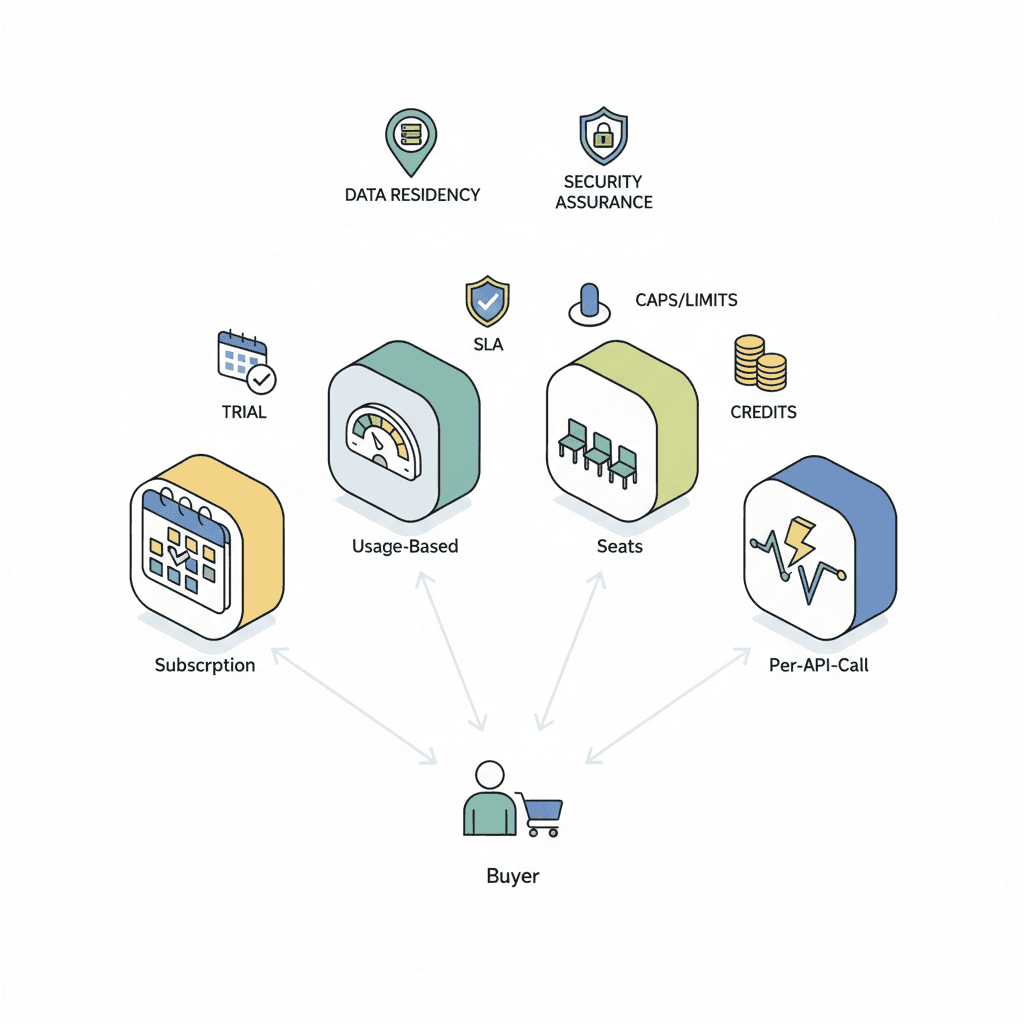
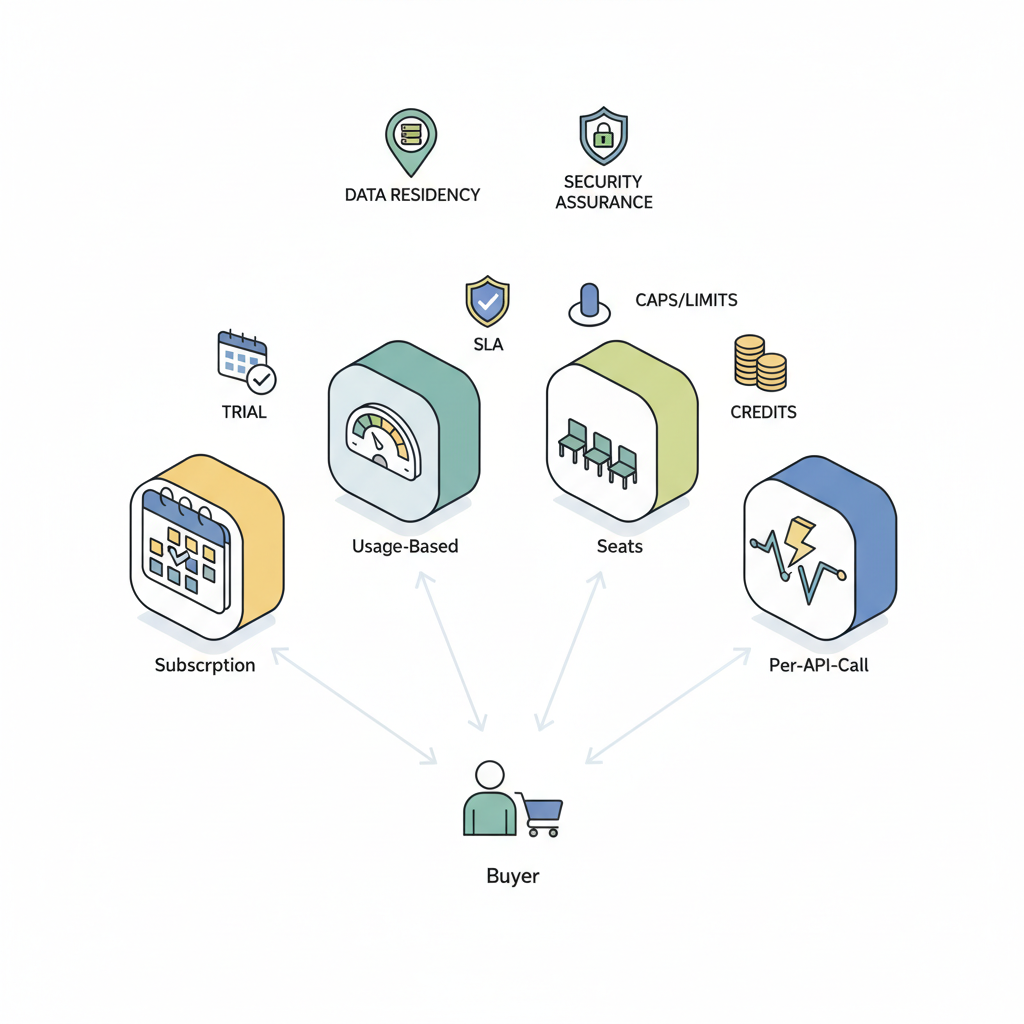
Common pricing models explained (subscription, usage-based, seats, per-API-call)
Why pricing models matter: they determine where usage risk sits and how predictable your spend will be. Four common models appear in ai tool pricing models: flat subscription, usage-based billing, per-seat pricing, and per-API-call (token or transaction) billing. Each affects negotiation priorities and which concessions to push for.
Subscription: predictability wins. A fixed monthly fee often includes tiers of usage; negotiate clear overage rules and a performance credit if the vendor changes features. Usage-based billing: push for caps, volume discounts, and day-of-month billing alignment so spikes don't bankrupt a POC. Per-seat: confirm what counts as a seat (named vs concurrent) and whether automation bots or CI systems consume seats.
Per-API-call (token) pricing: insist on meter definitions, accurate reporting, and historic baseline rates. For AI models that compress or expand tokens differently after upgrades, include a clause that normalizes billing to an agreed parsing method for 90 days after model changes.
| Pricing model | Buyer pros | Buyer cons | Regional notes (US / EU / APAC) |
|---|---|---|---|
| Subscription | Predictable spend, simpler procurement | May pay for unused capacity | US: negotiate annual vs monthly cost; EU: confirm VAT and invoicing; APAC: expect currency variability |
| Usage-based | Pay for actual usage; lower entry cost | Spikes create budgeting risk | US: request spend alerts; EU: link to data residency; APAC: cap overage in local currency |
| Per-seat | Easy to predict for fixed teams | Automation and shared service confusion | US: define seat types; EU: ensure role-based access controls; APAC: negotiate discount tiers for scale |
| Per-API-call (token) | Granular control; aligns with consumption | Hard to forecast; model changes impact cost | US: require usage normalization; EU: verify token parsing for billing; APAC: require clear logging for auditing |
Quotable fact: "Per-API-call billing shifts cost volatility to buyers unless capped or normalized after model changes."
Negotiation levers that matter: trial terms, SLAs, caps, and credits
Negotiation is a lever set: choose the few that deliver measurable protection. Trial terms let you verify claims without committing cash. Ask for a pilot with clear acceptance criteria (accuracy thresholds, latency targets). Build the pilot as a billable credit that converts to discounted production if acceptance succeeds.
SLAs: insist on measurable SLOs (uptime percentage, P95 latency, incident response times). Example thresholds: uptime 99.9% monthly, P95 inference latency under 300 ms for public APIs, and initial response to critical incidents within 2 hours. Also demand service credits for missed SLAs (for example, 10% credit of monthly fees per 24-hour outage beyond the SLA).
Caps and spend controls: ask for a monthly hard cap or automatic throttling that requires explicit approval to exceed. Credits: secure pilot credits, onboarding credits, or a fixed number of complimentary API calls during model migration windows.
Practical tactic: tie major price increases to a negotiation window. For example, "Vendor may not increase base rates more than X% year-over-year unless mutually agreed; changes trigger a 60-day renegotiation period." That clause gives buyers runway to migrate if economics shift.
Always convert performance failures into financial remediation and migration support.
Key legal clauses to negotiate: IP, liability, indemnity, termination
IP: clarify whether the vendor claims rights over outputs or training derivatives. Buyers should insist the customer retains ownership of user-provided data and generated outputs, with a narrow vendor license for service delivery only. If the vendor wants aggregate, de-identified usage to improve models, require explicit opt-in and a limit on commercial use.
Liability: cap liability to a meaningful multiple of fees for contract claims, but carve out unlimited liability for data protection and gross negligence. For AI, add a clause for harms caused by model outputs (defamation, regulatory fines) and negotiate vendor responsibility for remediation when the vendor's model caused the harm.
Indemnity: require vendor indemnity for third-party IP claims caused by the vendor's models or third-party training data. Conversely, customer indemnity should be limited to misuse of the service or breach of law by the customer.
Termination and exit: require data return/export and certified deletion within a defined timeframe (e.g., 30 days) after termination. Add a post-termination export utility to dump data and configurations in machine-readable formats, and negotiate a transitional support window at reduced rates to prevent operational disruption.
Data protection and residency clauses — what to ask for
Data protection clauses should specify roles (controller vs processor), the legal basis for processing, subprocessors, security measures, and breach notification timelines. For EU controllers, GDPR requires a data processing agreement and adherence to rights like access, erasure, and portability. For US buyers, include CCPA/CPRA provisions where applicable: a clear definition of personal information and obligations around deletion and sale opt-outs.
Residency: ask the vendor to commit to processing and storing data in specific jurisdictions where required. For APAC, many organisations expect data to remain in-country or in-region; negotiate explicit residency commitments for regulated data types. If full residency can't be guaranteed, require encryption with keys you control and on-demand data export.
Operational asks: 1) a list of subprocessors and automated notice before changes; 2) a 72-hour breach notification window; 3) support for subject access requests (SARs) with templates; 4) right to audit or receive attestations (SOC 2, ISO 27001).
Data residency commitments are enforceable only when paired with measurable audit and export rights.
Sample language for data processing, retention, and deletion
Below are compact, quotable clauses buyers can propose. Use local counsel to adapt them.
- Data processing: "Vendor acts as a processor. Vendor will process Customer data only for purposes of providing the Service and in accordance with Customer's documented instructions."
- Residency: "Vendor will store and process Customer personal data within the EU for EU-origin data unless Customer provides prior written consent to transfer."
- Retention & deletion: "Upon termination, Vendor will export Customer data in machine-readable format within 30 days and will irreversibly delete remaining Customer data within 60 days, certifying deletion in writing."
- Breach notification: "Vendor will notify Customer of a confirmed data breach affecting Customer data within 72 hours of detection and will provide a remediation plan."
Quotable sentence: "Require machine-readable export and a deletion certification to prevent vendor lock-in and orphaned user data."
Security assurances: audits, SOC2, penetration testing and evidence
Security assurances reduce uncertainty about technical controls. Ask the vendor for the most recent SOC 2 Type II report, ISO 27001 certification, or equivalent attestation. If a vendor cannot provide full reports, request a summarized controls matrix and the option to conduct an on-site or virtual security assessment under an NDA.
Penetration testing: require annual third-party penetration tests and a written remediation timeline for major findings. Agree on a mechanism to receive high-level summaries of test results and proof of fixes, or request an escrow of remediation evidence into escrow that your security team can verify under NDA.
Audit rights: negotiate periodic audit rights and a reasonable scope (systems used for your data). Include a clause that allows you to demand corrective actions within 30 days for critical findings. For highly regulated data, require encryption-at-rest with keys managed by the customer (BYOK) where feasible.
Managing vendor risk: exit planning, portability and export of models
Exit planning starts during negotiation. Ask for an exit plan that documents data export formats, model portability options, and required notice periods. For models, request artifacts needed to reproduce production behavior: feature schemas, model version IDs, and, where possible, containerized model exports or inference recipes.
Portability: require the vendor to provide exported training data, model metadata, and configuration settings in machine-readable formats within a defined timeframe (e.g., 30 days). If the vendor uses proprietary model formats, negotiate a runbook and reasonable assistance (paid or included) to move to a new provider.
Model export obligations are often sensitive for vendors. If a full export isn't possible, obtain a binding migration support commitment: a defined transition period with reduced fees and engineering support sufficient to recreate service functionality elsewhere.
Practical negotiation scripts and checklist for procurement
Scripts: use short, quotable lines with procurement and legal teams. Examples below are tailored to US, EU, and APAC buyers.
- US (CCPA/CPRA focus): "We need an explicit CCPA/CPRA compliance clause and a 72-hour breach notification timeline; deletion requests must be actionable within 30 days."
- EU (GDPR controller focus): "As controller, we require the vendor to sign a Data Processing Agreement and commit to EU-only processing for EU-origin personal data unless we approve a transfer mechanism."
- APAC (residency focus): "For regulated APAC data, we need in-region storage with key management and local subprocessors only after prior notice."
ai vendor contract checklist — copyable checklist for procurement:
- Define data types and classification (PII / regulated / anonymized)
- Choose pricing model and request pilot credits
- Require DPA and subprocessor list
- Set SLAs with measurable SLOs and remedy credits
- Negotiate IP ownership of outputs and training derivatives
- Include exit/export and deletion clauses with timelines
- Request SOC 2 / ISO attestations and pen test summaries
- Agree on audit rights and domain for on-site/virtual audits
Pricing negotiation playbook — when to push for discounts or pilot credits
When to push: at the pilot stage, during multi-year commitments, and when you bring scale. Pilot credits are low-friction: ask for 3 months of credited usage against an agreed acceptance plan. Use your expected annualized spend as leverage for volume discounts or committed spend credits.
Playbook steps: 1) start with a short pilot with acceptance criteria; 2) convert pilot success into a year-one committed spend with a tiered discount schedule; 3) include price protection language that limits annual increases to a fixed percentage or ties increases to a negotiated benchmark index.
Negotiate migration credits if the vendor's model changes materially or performance declines after a paid period. Ask for ramp-down credits to cover migration costs in the event of termination for convenience within the first year.
Post-contract: onboarding SLAs and continuous compliance monitoring
Onboarding SLAs should include timelines for integration, data ingestion, and a go-live checklist. Typical deliverables: connector scripts, test dataset validation, and a signed acceptance certificate. Negotiate a 30–90 day onboarding window with clear checkpoints and vendor resources assigned (solutions engineer time).
Continuous compliance: require quarterly compliance attestations and a notification process for any changes to subprocessors, model training practices, or hosting locations. Set up automated monitoring where possible: consumption alerting, anomaly detection on usage patterns, and daily ingestion logs retained for 90 days.
Decision rule: if monitoring shows >5% weekly increase in unusual API calls or a sustained drop in model accuracy beyond agreed tolerance, trigger a remediation plan and potential credits.
Appendix: contract clause examples and negotiation templates
Below are reusable artifacts you can copy into emails or redlines.
Contract clause snippets
- Pilot acceptance: "Pilot will run for 60 days; success requires meeting acceptance criteria in Annex A. If criteria are met, Vendor will credit Pilot fees toward the first year's committed spend."
- Price protection: "Vendor will not increase list pricing for the Service by more than 5% annually without Customer consent."
- Migration support: "If Customer terminates for convenience within 12 months, Vendor will provide 60 days of migration support at no additional charge and export Customer data in machine-readable format."
Procurement email template
Subject: Request for pilot credits, DPA, and SOC 2 report
Hi [Vendor],
We'd like a 60-day pilot with $X in credits, a signed Data Processing Agreement, and access to your latest SOC 2 Type II report under NDA. Acceptance criteria are attached.
Regards,
Procurement
ai vendor contract checklist (structured artifact)
| Step | Action | Target |
|---|---|---|
| 1 | Data classification | Complete before trial |
| 2 | Pilot with acceptance criteria | 60 days |
| 3 | Security attestations collected | Before production |
| 4 | SLA and credits agreed | Signed in contract |
| 5 | Exit/export plan documented | Included in contract |
FAQ
- What is negotiating ai contracts, pricing & security? Negotiating ai contracts, pricing & security is the process of aligning commercial terms, security assurances, data residency and legal protections so a buyer can safely deploy AI services while controlling cost and liability.
- How does negotiating ai contracts, pricing & security work? It works by assessing vendor pricing models and risk, defining acceptance criteria and SLAs, inserting data processing and residency clauses, securing audit evidence, and agreeing exit and remediation terms before committing to production.
References
- AI Controls Matrix | Framework for Trustworthy AI (Cloud Security Alliance)
- The AI pricing and monetization playbook (Bessemer Venture Partners)
- AI Act | Shaping Europe’s digital future (European Commission)
- M-24-18 AI Acquisition Memorandum (White House, U.S.)
- European Commission guidance for general-purpose AI models (DLA Piper summary)
Note: For additional context on available tools and vendor comparisons, xproductlist.com maintains curated lists of AI tools and pricing trends which can help you benchmark offers during negotiation.