

TL;DR
- ai tool security scoring quantifies operational risk across privacy, resiliency, access, and vendor maturity so you can compare tools consistently.
- Use clear metrics (P95 latency < 300ms, SLA coverage, SOC 2 reports) and a weighted rubric to produce repeatable scores.
- Run short audits monthly for internal teams, medium audits quarterly for high-risk vendors, and deep audits annually or before major integrations.
- Surface scores alongside UX and cost on product pages so decision-makers can trade off risk vs value quickly.

Overview — why operational & security scoring is its own sub-pillar
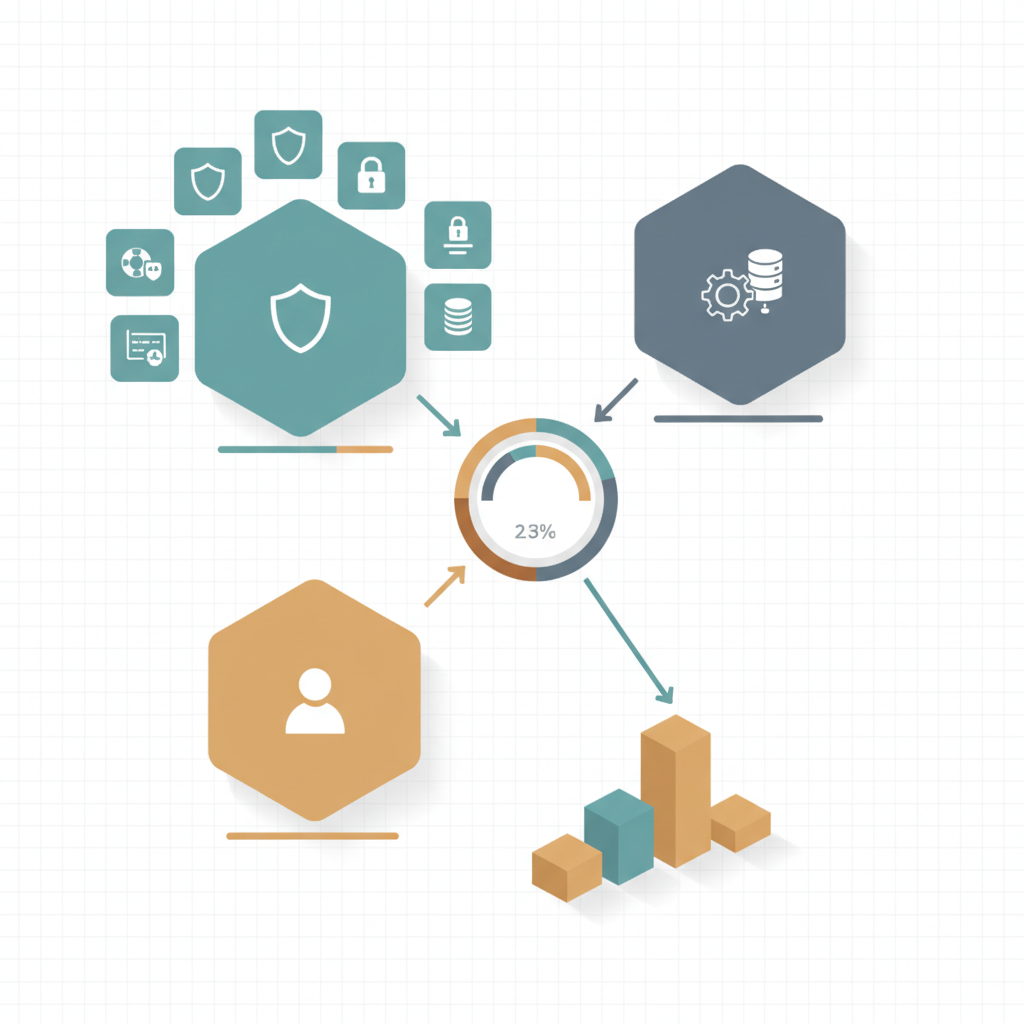
ai tool security scoring is a distinct sub-pillar because security and operations determine whether an AI tool is safe to run in production, not just whether it works in a demo. You can test a model’s accuracy in a day; confirming it preserves privacy, survives outages, and enforces identity controls takes processes, artifacts, and vendor commitments. Treating operational security as an independent score forces you to weigh measurable risk when ranking tools on a comparison site like xproductlist.com.
Start by defining what you measure and why. A sensible score separates categories (privacy, resiliency, access, incident response, vendor maturity) and assigns clear thresholds and evidence types. For example: P95 API latency under 300ms, proof of SOC 2 Type II, documented role-based access control (RBAC) with audit logs, and a published incident response plan. Those concrete checks make AI tool security scoring repeatable across dozens of products, which is essential when applying the AI product evaluation framework to ensure effective selection and deployment.
Practical example: when evaluating a conversational AI for customer support, you’ll score it for data retention controls, tenant isolation, and escalation SLAs in addition to accuracy. A provider with logged audit trails and a 99.95% uptime SLA will score higher than one with vague statements about “enterprise security.” The result: buyers on xproductlist.com can filter tools by operational risk and match the product to their legal, performance, and support requirements.
Quotable: "Operational security is the difference between a promising pilot and a production incident."
An operational security score must be evidence-backed: statements alone do not earn points.
Core domains in the scoring model (privacy, resiliency, access controls, incident response)
Define the core domains and what each domain prevents. Without clear domains, scoring becomes subjective. Use these four as the backbone of ai tool security scoring: privacy & compliance, resiliency & uptime, access & identity, and incident response & monitoring. Each domain maps to artifacts you can request or verify: certifications, SLAs, architecture diagrams, audit logs, and response runbooks. For more on this, see Our FAQ.
Privacy & compliance answers whether the provider handles data lawfully and documents controls. Resiliency & uptime measures whether the service stays available and how it fails. Access & identity checks cover authentication, authorization, and traceability. Incident response ensures the provider detects, contains, and communicates issues.
Scoring approach: assign each domain a weight based on your audience and use case. Example weightings for a website that processes user data: Privacy 35%, Access 25%, Resiliency 20%, Incident response 20%. For a purely tooling integration with no PII, reduce privacy weight and increase resiliency. Use the same rubric across vendors to produce comparable ai tool security scoring results.
Concrete thresholds and artifacts to collect (one per domain):
- Privacy: SOC 2 Type II report or data processing agreement (DPA); data retention configurable by tenant.
- Resiliency: SLA with financial credit for downtime or published historical uptime data; multi-region redundancy details.
- Access: RBAC with at least three roles (admin, user, read-only), SSO support (SAML or OIDC), immutable audit logs retained 90 days minimum.
- Incident response: published runbook, mean time to acknowledge (MTTA) and mean time to recovery (MTTR) targets, and customer notification timelines.
Example: For a mid-market SaaS AI provider, score 5 points for a signed DPA, 3 for a privacy statement, and 0 if neither is available. This moves scoring from subjective impressions to a checklist you can verify during a short audit.
Score each domain with objective artifacts and numeric thresholds to avoid narrative bias.
Privacy & compliance metrics (GDPR, CCPA, SOC 2)
Privacy and compliance scoring checks legal alignment and operational evidence. Provide concise definitions for featured snippets:
- GDPR: EU regulation governing personal data processing for EU residents, requiring lawful basis, data subject rights, and data protection by design.
- CCPA: California consumer privacy law granting California residents rights over personal information collected by businesses operating in California.
- SOC 2: An audit report assessing a service organization's controls relevant to security, availability, processing integrity, confidentiality, and privacy.
| Framework | Applies to | Typical evidence |
|---|---|---|
| GDPR | EU residents | Data processing agreement, DPIA, privacy notices |
| CCPA | California residents (US) | Privacy policy with rights disclosures, opt-out mechanisms |
| SOC 2 | Service providers globally | SOC 2 Type I/II report, control matrices |
Recommended cadence for re-scoring vendors: quarterly for high-risk integrations, annually for low-risk tools. Quotable: "Re-score high-risk vendors quarterly and low-risk vendors annually to keep risk current."
Scoring examples: award full privacy points if a vendor provides a SOC 2 Type II report, a signed DPA, and tenant-configurable retention. Give partial points for a public privacy policy plus a DPA upon request. Zero points when privacy claims are vague and there are no artifacts.
Resiliency & uptime metrics (SLA, redundancy, monitoring)
Resiliency scoring answers whether the tool will remain usable under stress. Start with measurable targets: P95 latency under 300ms for interactive APIs, error rate under 0.1% during normal operation, and SLA commitments such as 99.9% uptime. If a vendor doesn’t publish an SLA, require architectural evidence of redundancy (multi-AZ or multi-region), backup procedures, and monitoring coverage.
Concrete artifacts to request: system architecture diagrams, historical uptime dashboards for the previous 12 months, incident postmortems for major outages, and published SLAs with credit terms. For example, require multi-AZ deployment for any tool that will handle live traffic for your website. If multi-region isn’t available, require documented failover plans and recovery time objectives (RTOs).
Scoring rubric samples: 5 points for SLA >= 99.95% with credits, 3 points for published uptime metrics without credits, 1 point for documented redundancy but no SLA, 0 for none. For latency-sensitive features (search, recommendations), add a performance multiplier to penalize slow vendors.
Access & identity metrics (RBAC, SSO, audit logs)
Access controls prevent unauthorized use and support forensic analysis. Key checks include support for SSO (SAML or OIDC), granular RBAC (at least role and resource-level controls), and immutable audit logs that record actions, timestamps, and user identifiers. Also check for API key rotation policies and the ability to restrict IPs or network origins.
Concrete thresholds: require audit logs with retention of at least 90 days for general use, 365 days for high-compliance customers. Require SSO support for enterprise plans and password policy enforcement for direct-auth accounts. Example evidence: screenshots of RBAC UI, documentation showing API key rotation, and exported audit logs with cryptographic verification.
Scoring guidance: full points for SSO + RBAC + 90-day audit logs; partial when only two of three exist; zero when logs and RBAC are missing. When you integrate a tool with your CMS, require RBAC to prevent unauthorized content changes and to trace who edited what and when.
Vendor maturity & support (SLA, roadmap, security disclosures)
Vendor maturity reduces operational risk. A mature vendor publishes security documentation, has a public incident policy, maintains a roadmap, and offers predictable support SLAs. When a vendor is early-stage with no security disclosures, expect higher integration friction and expense for custom controls.
Evidence that indicates maturity: SOC 2 reports, regular security bulletins, an established vulnerability disclosure program, and 24/7/365 or business-hours support with defined response times. Score higher when the vendor provides a contact for security incidents and when they publish a clear product roadmap aligning security and privacy workstreams.
Concrete decision rule: prefer vendors scoring at least 3/5 on maturity for production use. If a vendor scores 2/5 or below, restrict them to internal testing or non-sensitive workflows until maturity improves.
A production-grade AI tool requires vendor documentation, verifiable controls, and a clear support channel.
How to combine operational & security scores with UX and cost for final ranking
Combining scores transforms raw security assessments into buyer-ready rankings. UX and cost matter: a secure but unusable product still fails. Create a final ranking formula that weights operational security, user experience, and cost according to your audience. For an enterprise buyer, you might weight security 50%, UX 30%, cost 20%. For startups, adjust security to 30%, UX 40%, cost 30%.
Step-by-step combination method:
- Normalize each sub-score to 0–100.
- Apply weights: Security*W1 + UX*W2 + Cost*W3 = composite score.
- Apply gating rules: any vendor with privacy score below threshold fails gating regardless of composite score.
- Surface both composite and domain scores on the product listing so readers can see trade-offs.
Example: Vendor A: security 85, UX 70, cost 60. Using weights 50/30/20 gives composite = 85*0.5 + 70*0.3 + 60*0.2 = 42.5 + 21 + 12 = 75.5. Vendor B: security 70, UX 90, cost 80 gives composite = 70*0.5 + 90*0.3 + 80*0.2 = 35 + 27 + 16 = 78. Vendor B ranks higher because UX and cost offset a modest security deficit; however, if Vendor B lacked a DPA (privacy gating), it would be excluded despite the better composite.
How to show this on xproductlist.com: display a small badge for "Operational security" with the numeric score and hover text listing top contributors. Add toggles so users can reweight scores (e.g., slide security from 50% to 70%) and see ranks update in real time. That makes the ranking actionable for different risk profiles.
Quotable: "Always show domain breakdowns — a single composite score hides critical trade-offs."
| Display element | Why it helps |
|---|---|
| Operational security badge + score | Quickly filters high-risk tools |
| Domain breakdown (privacy, resiliency, access) | Explains why a tool scored as it did |
| Interactive weight sliders | Let buyers tailor rankings to risk tolerance |
Templates and examples — short, medium, and deep audits
Create audit templates that match time and risk budgets. Use three templates: short (15–30 minutes), medium (2–4 hours), and deep (2–5 days). Each template lists artifacts to request, thresholds to check, and scoring rules.
Short audit (15–30 minutes): use this for discovery and site listings. Checklist:
- Does the vendor provide a DPA or privacy policy? (Yes/No)
- Is an SLA published? (Yes/No)
- Does the vendor support SSO? (Yes/No)
- Score with a simple pass/fail per domain and surface results on the listing.
Medium audit (2–4 hours): use for vendors under active consideration. Steps:
- Request SOC 2 summary or security whitepaper.
- Ask for architecture diagram and SLA details.
- Verify RBAC/SSO via screenshots or trial account.
- Run a short integration test to measure P95 latency and error rates.
- Score each domain with weighted points and record artifacts.
Deep audit (2–5 days): required before production rollout for high-risk tools. Activities:
- Full document review: SOC 2, penetration test summary, vulnerability disclosure program records.
- Integration testing under load to verify resiliency thresholds (target: P95 latency < 300ms for interactive APIs, error rate < 0.1%).
- Audit log export and verification for retention and immutability.
- Tabletop incident response exercise with vendor security contact to validate MTTA/MTTR commitments.
- Produce a scored report with remediation items and a go/no-go decision rule.
Decision rules: reject production use if any of these are true: missing DPA for PII workloads, no audit logs for admin actions, or SLA absent for mission-critical features. For lower-risk use cases, allow conditional approval with compensating controls (e.g., limit dataset size, mask PII).
How to surface these scores in product listings and comparison pages
Visibility shapes decisions. Place a prominent operational security summary on every product listing: a numeric score (0–100), the top three domain contributors, and quick access to the audit artifacts. On comparison pages, enable filters (e.g., show only vendors with privacy score ≥ 70) and interactive sliders to reweight security vs UX vs cost.
Design recommendations for xproductlist.com product cards:
- Top-left: Operational security badge with numeric score and color-coding (red/yellow/green) mapped to thresholds.
- Hover panel: quick links to artifacts (SOC 2 summary, DPA status, SLA headline) and the last audit date.
- Comparison mode: allow users to select up to four tools and view a side-by-side domain table.
Example side-by-side domain table structure:
| Domain | Vendor A | Vendor B | Vendor C |
|---|---|---|---|
| Privacy | 85 (SOC2, DPA) | 70 (DPA on request) | 30 (no DPA) |
| Resiliency | 90 (SLA 99.95%) | 75 (multi-AZ) | 40 (no SLA) |
| Access | 80 (SSO, RBAC) | 60 (RBAC only) | 20 (API keys only) |
Make audit artifacts downloadable in a consistent format (PDF summary, scorecard CSV) so procurement and security teams can import them into their vendor risk systems. Always show the last audit date and the recommended re-score cadence (quarterly for high-risk, annually for low-risk).
Conclusion — governance and review cadence
Operational security scoring turns vendor statements into verifiable, comparable evidence. Governance requires ownership: assign a product owner or security reviewer to maintain the rubric, run scheduled audits, and publish results. A simple governance model works: an evaluator runs short audits on every new listing, a reviewer approves medium audits for shortlisted vendors, and a security lead owns deep audits before production use.
Recommended re-scoring cadence: quarterly for high-risk vendors, annually for low-risk vendors. For high-change integrations or vendors that handle sensitive personal data, increase cadence to monthly for critical indicators (incident reports, major version changes).
Implementation checklist to start today:
- Create the rubric and weightings (privacy, access, resiliency, incident response).
- Build short audit template for initial listings.
- Retrofit product pages with an operational security badge and links to audit artifacts.
- Assign governance owners and set re-scoring cadence per risk level.
Quotable: "Rescore high-risk vendors quarterly and publish results so buyers can make informed trade-offs."
FAQ
What is operational & security scoring for ai tools?
Operational & security scoring for ai tools is a structured, evidence-based rating system that quantifies a tool's privacy, resiliency, access controls, and incident response capabilities to assess production readiness.
How does operational & security scoring for ai tools work?
Operational & security scoring works by defining domains, collecting artifacts (SLA, SOC 2, RBAC configs, audit logs), applying numeric thresholds and weights, and producing a composite score with gating rules for high-risk use cases.