

TL;DR
- Use a simple scorecard that weights authentication, encryption, testing, and incident readiness when evaluating third-party AI.
- Include threat modeling for AI, prompt injection risk assessment, and regular ai model penetration testing in vendor evaluations.
- Require vendor incident response metrics (MTTD, MTTR) and align disclosure SLAs with GDPR and local state breach laws.
- Ship a third-party ai security checklist and two reusable artifacts: a procurement checklist and a scoring table to copy into evaluations.

Introduction: Integrating third-party AI models into websites and products speeds feature delivery, but it also adds new attack surfaces. This guide explains ai security risk scoring: what to evaluate, how to test models, how to translate findings into a numeric score, and which incident-response metrics to demand from vendors. You’ll find concrete examples, a reusable third-party ai security checklist, and thresholds you can copy into procurement.
Why security scoring is essential for third‑party AI models
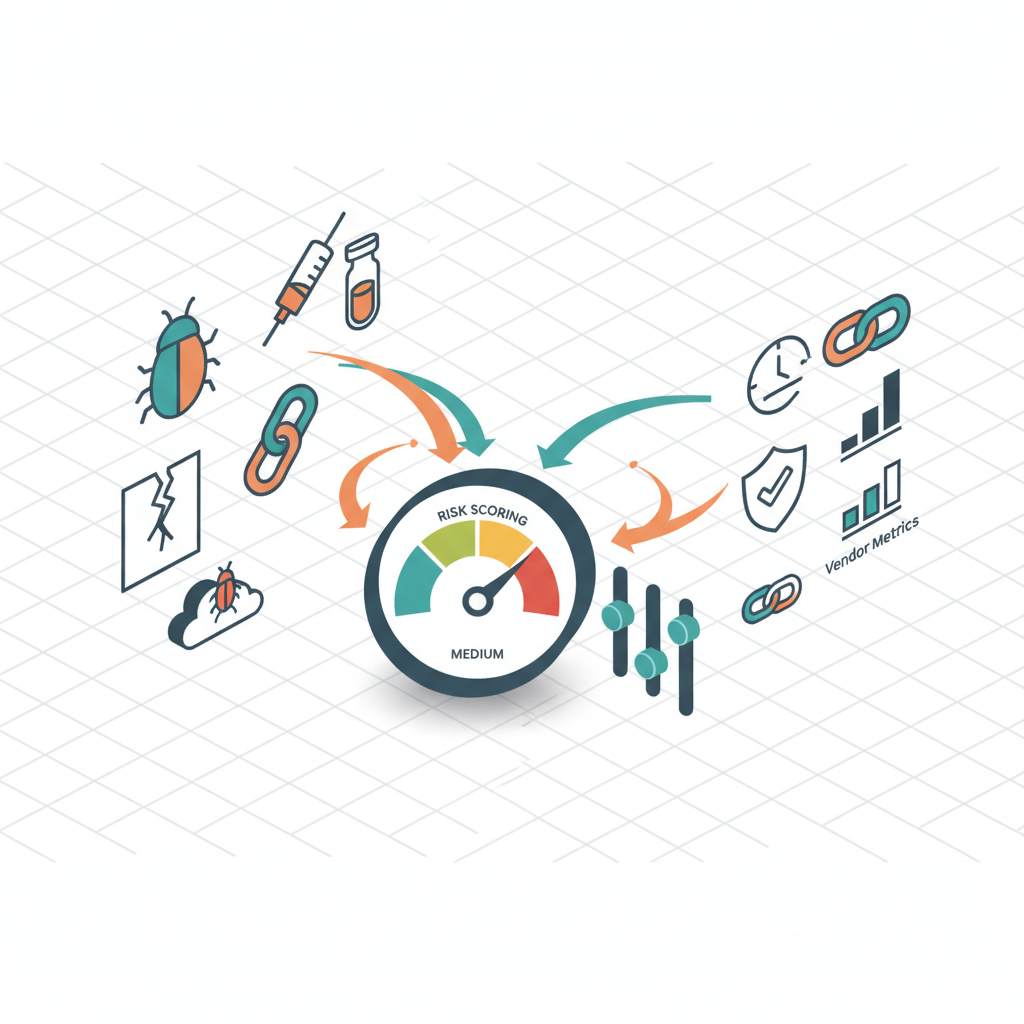
"Without a consistent scoring approach, teams approve AI integrations on faith and discover gaps after an incident. A repeatable ai security risk scoring process, as discussed in operational and security scoring for AI tools, forces vendors and internal reviewers to compare the same controls and evidence: authentication strength, encryption in transit and at rest, testing cadence, governance artifacts, and incident readiness. For example, a marketing team integrating a third-party summarization API should score that vendor lower if it lacks per-customer API keys, role-based access, or proof of pen-testing."
Actionable threshold: require at least 2-factor authentication for admin consoles, TLS 1.2+ for network traffic, and AES-256 or equivalent at rest where applicable. Score each control 0–5 (0 = no evidence, 5 = strong evidence) and weight authentication and encryption at 25% each, testing 20%, governance 15%, incident readiness 15% for a 100-point system.
An AI vendor without documented pen tests should be considered high risk until proven otherwise.
Common threat vectors for AI integrations
Threat modeling for ai must start with data flows: where user input enters the system, what data leaves, and which third parties see intermediate artifacts. Common vectors include prompt injection, data poisoning, model extraction, and supply-chain compromise. Each vector affects confidentiality, integrity, or availability differently: prompt injection threatens integrity of outputs, data poisoning threatens model behavior, model extraction threatens intellectual property, and supply‑chain issues threaten availability and trust.
Practical example: a site that uses a chat-based third-party AI assistant must treat user-provided attachments as untrusted, sanitize prompts before storage, and log raw prompts for post-incident analysis. Use threat modeling for ai to produce a prioritized list of risks and map controls to each.
Prompt injection & data poisoning
Definition (quotable): "Prompt injection is an input that manipulates a model's outputs by embedding adversarial instructions in user-provided text." Prompt injection risk assessment should measure how easily user inputs can change model behavior and whether the vendor applies input validation, output filtering, and instruction isolation (e.g., system prompt hardening).
Data poisoning—contaminating training or fine-tuning data—requires a different control set: provenance, dataset vetting, and signed-data workflows. For scoring, assign a risk multiplier for models that accept customer-supplied fine-tuning data without a vetting pipeline. Actionable test: ask the vendor whether they maintain dataset provenance and automated checks for anomalous training examples.
Model extraction and intellectual property leakage
Definition (quotable): "Model extraction is the process of reconstructing a model or its behavior by repeatedly querying it and analyzing responses." Practical defenses include rate limiting, query auditing, and response watermarking. For scoring, reduce points for vendors offering unconstrained, high-rate public APIs without per-customer rate limits or per-key telemetry.
Example: if a developer can recreate sensitive prompts or proprietary behavior by automated queries in a test environment, the vendor should provide usage caps and anomaly detection as compensating controls. Include a simple extraction test in your ai model penetration testing plan: attempt to replicate a known output pattern with scripted queries and watch for throttling or logging.
Supply-chain and third‑party dependency risks
Supply-chain risks arise when a vendor depends on other models, data providers, or infrastructure. Score vendors on transparency (dependency lists), code signing, and their own third-party audits. Require vendors to disclose critical sub-processors and to provide SOC 2 or equivalent audit reports where available.
Concrete artifact: demand a one‑page dependency diagram showing every external model or dataset used in production and the controls each supplier provides. Assign a 0–5 score based on documentation completeness and whether compensating controls (e.g., encryption, isolation) exist. For more on this, see Ai product evaluation framework.
Penetration testing & red‑team approaches for AI services
Penetration testing for AI services expands traditional web pen-testing to include model-level attacks. An ai model penetration testing engagement should combine input manipulation, prompt injection risk assessment, model extraction attempts, and data leakage checks. Red teams should test both the integration (API, auth, rate limits) and the model's behavior to adversarial inputs.
Testing cadence: require external penetration tests at least annually and after major updates, with scoped adhoc checks after any data pipeline change. For critical integrations, mandate quarterly targeted ai model penetration testing and continuous monitoring and logging for anomalous query patterns.
Pen tests that ignore the model’s semantic behavior miss the highest-risk failures.
What to include in AI-specific pen tests
At minimum, include these test classes: authentication and authorization bypass, prompt injection attempts, model extraction scripts, data exfiltration paths, and dependency compromise scenarios. Example test case: send adversarially crafted prompts that try to exfiltrate a hidden API key and verify whether the model returns or suppresses it.
Deliverable checklist for tests: scope document, attack scripts, evidence of findings (logs, transcripts), remediation recommendations, and a retest plan. Use the results to update your third-party ai security checklist and to re-score the vendor.
Interpreting pen test results and translating to scores
Translate findings into the scoring rubric by mapping each vulnerability to control categories and calculating impact × likelihood. For example: a critical prompt injection that leaks PII = impact 9/10, likelihood 7/10. Convert that into a weighted deduction in the integrity portion of your ai security risk scoring rubric.
Actionable rule: convert raw findings into a remediation timeline (critical: 7 days, high: 30 days, medium: 90 days) and reduce the vendor’s score until remedial evidence (patch, retest report) is provided. Document evidence types you accept: retest report, code change logs, or triage tickets.
Incident response readiness & security operational metrics
Vendor incident response readiness is measurable. Require documented playbooks, a named security contact, and vendor incident response metrics that include detection and response times. Ask vendors for prior incident summaries (redacted) and proof they perform post-incident root cause analysis.
Quotable metric definition: "Mean time to detect (MTTD) is the average time between a security event and when the vendor first identifies it." Another quotable: "Mean time to respond (MTTR) is the average time the vendor takes to contain and remediate a known incident." Require vendors to provide current MTTD and MTTR figures and explain the evidence behind them.
Mean time to detect (MTTD) and mean time to respond (MTTR) expectations
Set expectations relative to risk. For high-risk integrations, demand vendor MTTD under 24 hours and MTTR under 72 hours where possible. For lower-risk uses, longer windows may be acceptable but should be documented. Ask vendors how they measure MTTD/MTTR and what tooling (SIEM, EDR, model-monitoring) supports these metrics.
Example: a vendor reports MTTD = 6 hours and MTTR = 48 hours and provides SIEM alerts and incident tickets as evidence; accept that as a strong signal. If vendors cannot provide metrics, assign a low incident-readiness score and require compensating controls.
Disclosure timelines and SLA for security incidents
Geographic alignment matters. In the EU, GDPR requires data controllers to notify supervisory authorities within 72 hours of becoming aware of a personal data breach. US state breach notification laws vary; many require notice within roughly 30–60 days. Include a contractual requirement that vendor notification timelines align with the strictest regulator applicable to your data.
Actionable clause: require vendors to commit to an initial notification timeline (e.g., 72 hours for incidents affecting EU data) and to provide weekly status updates until containment. Score vendors on whether they offer contractual SLAs and on their historical compliance with disclosure timelines.
Building a security risk scoring rubric (controls vs. evidence)
Separate controls from evidence. Controls are claimed capabilities (e.g., encryption at rest). Evidence is documentation: config screenshots, audit reports, pen-test reports, and telemetry. Build a rubric that lists controls, required evidence, and point values for each.
| Control | Required evidence | Score (0–5) |
|---|---|---|
| Authentication & authorization | Config export showing RBAC, 2FA enabled | 0–5 |
| Encryption (in transit & at rest) | TLS configuration, KMS usage notes | 0–5 |
| Pen testing | Pen test report within 12 months | 0–5 |
| Incident readiness | MTTD/MTTR metrics and playbook | 0–5 |
Example scoring categories: authentication, encryption, testing, governance
Example weights (copyable): authentication 25, encryption 25, testing 20, governance 15, incident readiness 15. Scoring rule: vendor must score at least 70/100 to be approved for production with sensitive data; 50–69 requires compensating controls; under 50 is not permitted.
- Authentication: require per-customer API keys, RBAC, and 2FA for admin access.
- Encryption: TLS 1.2+ and AES-256 or equivalent for stored secrets.
- Testing: annual third-party pen test and quarterly internal AI-specific checks.
- Governance: documented data retention, deletion policies, and data provenance.
Playbook: procurement questions, required artifacts, and red flags
Procurement checklist (copyable):
- Does the vendor provide recent pen-test reports and remediation evidence?
- Can the vendor produce a dependency diagram and list of sub-processors?
- What are the vendor's MTTD and MTTR figures and supporting evidence?
- Is per-customer isolation available (keys, rate limits, logging)?
- Does the vendor perform prompt injection risk assessment and model monitoring?
Red flags: no pen-test evidence, undefined MTTD/MTTR, no per-tenant isolation, or a refusal to disclose critical dependencies.
Quick remediation strategies and compensating controls
If a vendor scores poorly on one axis, apply compensating controls: implement input sanitization and prompt templating client-side to reduce prompt injection risk, enforce per-request masking to limit PII exposure, and add API gateway rate limiting to reduce model extraction risk. For slow vendors, require notification hooks and block high-risk data flows until remediation.
Concrete thresholds: impose per-key query caps (e.g., P95 < 1,000 queries/day per key for low-risk plans) and require logging retention of at least 90 days for incident investigation.
When NOT to apply this scoring
This scoring approach is not appropriate when the integration is purely experimental, when the model never touches production data and is isolated, or when the vendor is an internal, fully owned team under the same security perimeter. Do not apply the same thresholds to low-sensitivity prototypes; scale expectations up as data sensitivity increases. Avoid using this rubric for models where outputs cannot be audited or when the business impact of model failure is negligible.
Conclusion: integrating security scores into procurement and vendor management
Make ai security risk scoring part of procurement and operational reviews. Require the third-party ai security checklist and evidence before production use, demand ai model penetration testing and prompt injection risk assessment, and bind vendors to vendor incident response metrics in contract language. Scorecard-driven approvals make risky decisions visible and remediations auditable.