
Why vendor selection matters for AI pilots
How do you pick the right partner when you want to run an AI pilot without blowing your timeline or exposing customer data? The right vendor reduces technical risk, protects your data, and delivers measurable time-to-value during the pilot.
ai vendor selection for pilots starts with matching vendor capabilities to the pilot's objective, plus concrete contractual protections and testable success gates. In practice that means choosing vendors who can show relevant integrations, clear data handling rules, and a realistic deployment plan that fits your time-to-first-value benchmark. For more on this, see Our FAQ.
If you skip careful vendor selection you get one of two outcomes: an unusable prototype that never integrates with your stack, or a data exposure that creates remediation costs. For website owners, marketers, and developers building proofs-of-concept, vendor selection reduces wasted engineering cycles and gives stakeholders objective reasons to greenlight production.
Define 'pilot' and 'trial' up front: for SMBs a pilot is typically a fast, scoped test that proves concept and user benefit within 30–60 days; for enterprises a pilot often includes security reviews, integrations, and compliance checks and commonly runs 60–120 days. These timelines feed vendor selection: choose providers who commit to milestones that match the expected cadence.
Include explicit data residency and access-control clauses when vendors process EU personal data (GDPR Article 28 obligations).

Practical example: a small e-commerce site wants to trial an AI-based product-recommendation API. For an SMB pilot, you prioritize rapid integration (JavaScript snippet or lightweight API), limited sample data, and a 30–45 day time-to-first-value. An enterprise retailer will require a staging integration, penetration testing, and a 90-day pilot with clear rollback procedures. Those differences determine which vendors should move to the top of your shortlist.
When not to run an AI vendor pilot
- If you cannot measure outcomes—do not pilot when you cannot define a primary KPI (for example, conversion lift or query accuracy).
- If data cannot be de-identified or legally shared for testing—do not pilot where data residency or consent rules block vendor access.
- If the vendor cannot provide a repeatable rollback plan—do not pilot when recovery from failures is unclear.
- If cost of failure materially exceeds expected benefits—do not pilot when remediation costs outstrip projected ROI.
An AI prototype is production-ready only when failures are predictable, recoverable, and cheaper than the value the system delivers.
Preparing your team and stakeholder requirements
If you want vendors to succeed, prepare the organization first. That means naming an owner, aligning stakeholders on KPIs, and ensuring legal, security, and product teams can review vendor materials quickly. Without this coordination, even a well-scoped pilot stalls.
Start by appointing a pilot owner (product or engineering) and a stakeholder group that includes a business sponsor, a data owner, and a technical reviewer. Example roles and responsibilities:
- Product owner: defines success metrics and acceptance criteria.
- Engineering lead: integrates the vendor system and verifies performance targets.
- Data owner/Privacy officer: approves datasets and ensures compliance with GDPR, UK DPA, or CCPA/CPRA where applicable.
- Procurement or legal reviewer: negotiates trial terms and IP clauses.
Develop a one-page pilot charter that includes objective, scope, success criteria, timeline, and the named stakeholders. A sample charter item: "Objective: improve on-site search relevance; primary KPI: P@5 click-through rate increase of 8% vs baseline; duration: 60 days; time-to-first-value target: 45 days." That charter becomes the touchstone for vendor conversations and contract negotiation.
Operational readiness: ensure you have a sandbox environment, a data export pipeline with de-identified records, and monitoring hooks (logs, latency metrics, error rates). If you are a website owner or marketer using xproductlist.com to find vendors, include the pilot charter in vendor RFPs to force apples-to-apples responses.
Require evidence of prior pilots in your vertical or with comparable data sizes before granting production access.
Technical, legal, and operational requirements checklist
- Technical: API specs, supported data formats, latency targets (example: P95 latency < 300ms for user-facing features or for typical SaaS apps target under 200ms), authentication methods (OAuth2, API keys), and integration examples.
- Legal: data processing agreements, data residency commitments, subcontractor disclosures, and sample termination/exit clauses.
- Operational: support SLAs, response times for critical incidents, maintenance windows, and runbooks for rollback.
- Security: encryption at rest and in transit, role-based access controls, and proof of recent penetration testing or SOC/ISO certifications (if required by procurement).
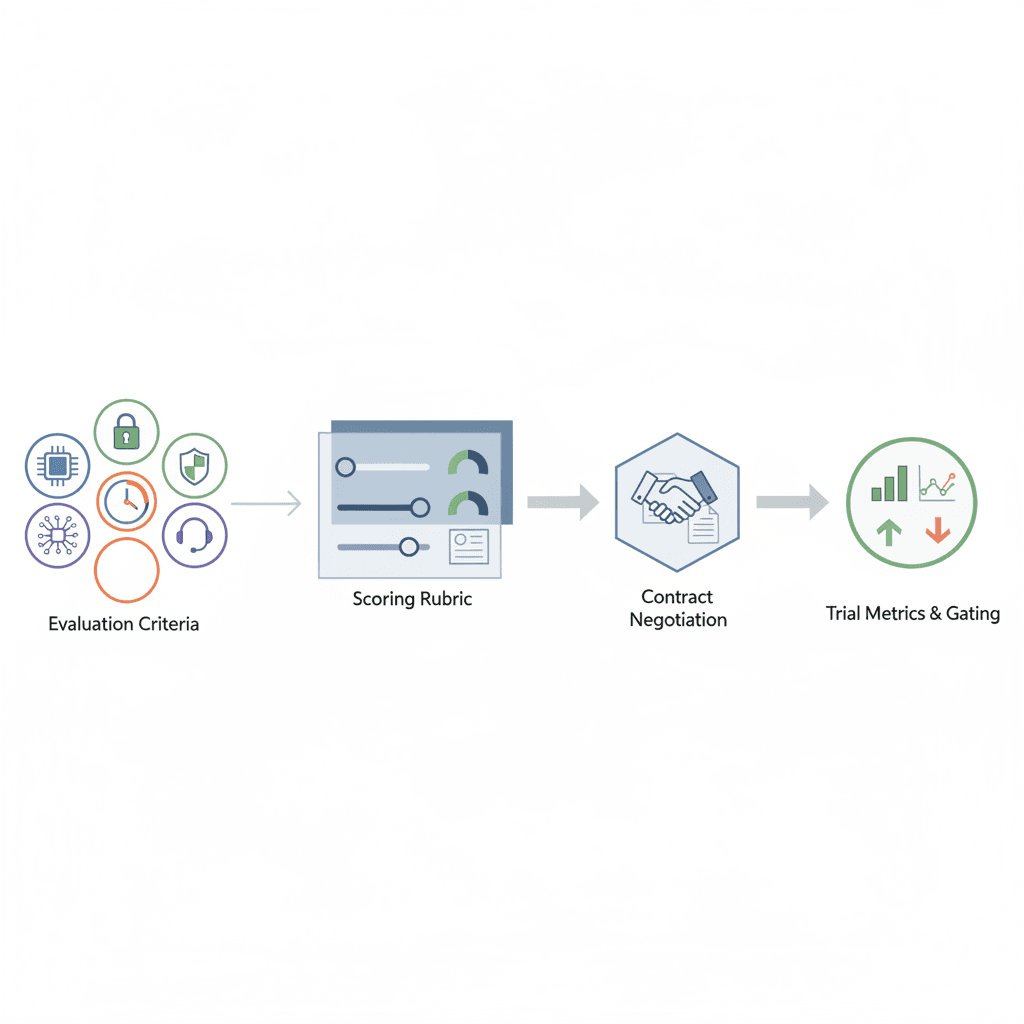
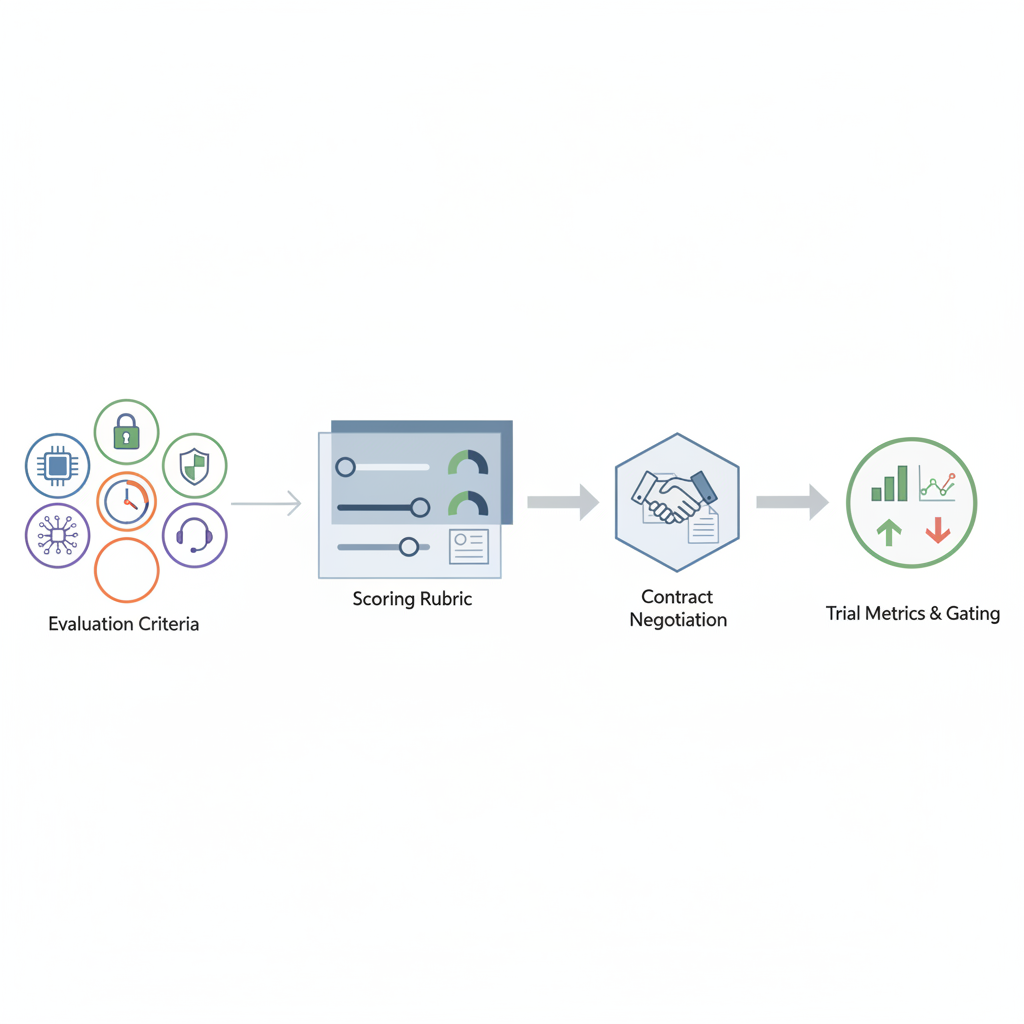
Evaluation criteria (capabilities, data handling, SLAs, support)
When you evaluate vendors, weigh technical capability, data handling practices, contractual protections, and support. Use criteria that map to your charter so vendors are judged on what matters for your pilot.
Practical evaluation checklist items:
- Functional fit: Does the vendor demonstrate the exact workflow you need (e.g., search reranking, content tagging, or image inference)? Ask for a short demo using a sanitized sample of your data.
- Data handling: How is data stored, processed, and deleted? Confirm retention periods and ability to purge data on request.
- Explainability and model behavior: Ask for model cards, failure mode descriptions, and example inputs that produce incorrect outputs.
- Performance: Test for P95 latency, throughput under expected load, and error rates. Use a simple load test to verify vendor claims.
- Support & SLAs: What is the support channel (email, Slack, phone)? What are response times for P1 incidents? Get these terms in writing for the pilot period.
Example: if you run personalized recommendations on a high-traffic marketing site, require vendors to show 99.9% uptime and P95 inference latency under 200ms in a staging test. If the vendor cannot meet that under a realistic workload, they are not a match for user-facing pilots.
These technical checks also feed legal negotiation. For instance, vendors that cannot guarantee data deletion or provide audit logs will need stronger contractual safeguards before receiving production data.
Scoring rubric sample and weighting recommendations
Use a weighted scoring rubric to compare vendors objectively. Example weights (adjust to your priorities):
| Category | Weight | Scoring notes |
|---|---|---|
| Functional fit | 30% | Demonstrated task accuracy and workflow match |
| Data handling & compliance | 20% | Residency, deletion, audit logs |
| Performance & reliability | 20% | Latency, uptime, error rates |
| Support & SLAs | 15% | Response times, dedicated support |
| Cost & commercial terms | 15% | Pilot pricing, transition costs |
Score vendors 1–5 for each category and compute weighted totals. Example decision rule: choose the vendor with the highest weighted score and at least 80% on data handling and performance combined.
Trial & pilot contract terms to negotiate
Negotiating clear trial terms keeps pilots short and reversible. Focus on scope, data rights, liability limits, termination and rollback, and transition support. Ask the vendor to provide a one-page pilot addendum that amends the master terms for the trial period.
Key clauses to negotiate in the pilot contract:
- Scope and deliverables: exact features to be delivered, demo datasets, and acceptance criteria tied to the charter's KPIs.
- Duration and extension: fixed pilot period with defined milestones and an option to extend only by mutual written agreement.
- Pricing: trial pricing or credits, and clear terms for conversion to paid service including any volume or onboarding fees.
- Liability and indemnity: cap liability for pilot-related work and define responsibilities for data breaches.
- Confidentiality and IP: who owns derivative improvements created during the pilot and whether the vendor can include anonymized learnings in case studies.
Include gating decisions in the contract: specify what metrics or milestones, when met, allow the pilot to proceed to expanded testing or production. For example, "If the vendor meets a 10% lift in primary KPI within 60 days and maintains P95 latency < 300ms, the parties will negotiate commercial terms." This avoids ambiguity about whether the pilot succeeded.
Data access, IP, model explainability, exit & rollback clauses
These clauses are the heart of safe pilots. Be explicit: who can access raw training data, who owns models trained on customer data, and what happens to outputs after termination.
- Data access: limit access to named vendor engineers and require MFA, logging, and least-privilege controls. State retention periods and purge processes.
- IP: define ownership of custom models and mappings. A common pattern is customer ownership of customer data and derived models for the pilot, with the vendor granted a limited license to operate during the pilot only.
- Explainability: require model cards or behavior documentation and an incident response plan for high-severity errors.
- Exit & rollback: require a rollback plan, exportable copies of outputs and models, and a 30-day period where the vendor will keep archived data to facilitate troubleshooting before final deletion.
Quotable line: "Include explicit data residency and access-control clauses when vendors process EU personal data (GDPR Article 28 obligations)." That sentence can be inserted directly into vendor agreements or review notes to signal regulatory expectations.
Running vendor trials: success metrics and gating decisions
Run trials like experiments: define hypotheses, control groups, measurement windows, and gating decisions. The gating approach prevents scope creep and keeps pilots accountable.
Example pilot experiment for a search relevance vendor:
- Hypothesis: new ranking model increases P@5 CTR by 7% vs baseline.
- Design: A/B test on 10% of user traffic for 30 days, with pre- and post-period baselines.
- Metrics: primary KPI (P@5 CTR), secondary KPIs (session length, bounce rate), safety KPIs (error rate, latency, and complaint volume).
- Gates: pass if primary KPI improves by at least 5% and safety KPIs remain within tolerances (error rate < 0.5%, P95 latency within agreed threshold).
Make gating decisions binary where possible: pass, fail, or conditional pass with remediation. Define remediation steps (e.g., additional tuning window of 30 days) in the pilot contract so there's a predictable path forward.
Track both business and technical metrics. An increase in KPI without acceptable latency or increased complaint volume is a conditional fail. Conversely, stable performance without KPI improvement is a fail unless the vendor commits to a plan to improve accuracy within a fixed remediation period.
Example KPI dashboard for vendor pilots
Design a lightweight dashboard to show progress at-a-glance. Key widgets to include:
- Primary KPI trend line with confidence intervals (daily)
- Latency heatmap and P95/P99 numbers
- Error rate and incident log
- Data processed and retention status
- Contract milestones and gate status
| Metric | Target | Current | Gate |
|---|---|---|---|
| P@5 CTR | +8% vs baseline | +6.2% | Conditional pass |
| P95 latency | <300ms | 220ms | Pass |
| Error rate | <0.5% | 0.3% | Pass |
Managing multi-vendor pilots and vendor comparison templates
When you run side-by-side pilots, you need consistent inputs, synchronized timelines, and a neutral scoring process. Multi-vendor pilots are useful when you cannot preselect a single candidate, but they multiply coordination work.
Steps to manage multi-vendor pilots:
- Create a single sanitized dataset and test harness that all vendors use; this reduces variance from differing inputs.
- Standardize evaluation windows and traffic splits (for A/B tests) so results are comparable.
- Assign a neutral technical reviewer or panel to score qualitative elements like ease of integration and documentation quality.
- Use the weighted scoring rubric and decision rules defined earlier to produce a single ranking and a recommended winner.
Comparison template example (condensed):
| Vendor | Functional score | Data/compliance | Performance | Weighted total |
|---|---|---|---|---|
| Vendor A | 4.5 | 4.0 | 4.2 | 4.3 |
| Vendor B | 4.0 | 4.8 | 3.9 | 4.1 |
Decision rule example: pick the vendor with the highest weighted total that also meets minimum thresholds in data/compliance and performance. If no vendor meets thresholds, run a remediation round of 30 days with the top two vendors restricted to specific technical fixes.
Practical templates (RFP checklist, scoring sheet, sample clause)
This section gives reusable artifacts you can copy into procurement and legal workflows. Use them as starting points and adapt to your compliance needs and local regulations.
RFP checklist (copyable)
- Project charter attached (objectives, KPIs, timeline)
- Sanitized sample dataset and schema provided
- Integration points and technical contacts listed
- Required compliance statements (GDPR/CCPA/other) requested
- Pilot pricing and conversion terms requested
- Support and escalation procedure requested
Scoring sheet (CSV-friendly)
| Vendor | Functional (1-5) | Data/Compliance (1-5) | Performance (1-5) | Support (1-5) | Commercial (1-5) | Weighted score |
|---|---|---|---|---|---|---|
| Vendor X | 4 | 5 | 4 | 3 | 4 | -- |
Sample clause: pilot data and exit
"Pilot data" means Customer data provided to Vendor for the purpose of the Pilot. Vendor shall process Pilot data only as instructed by Customer, retain Pilot data for no longer than 30 days after termination, and provide an export of processed outputs at termination. Vendor will implement agreed access controls and provide audit logs upon request.Include the above clause in your pilot addendum and adjust retention windows to match regulatory requirements. For EU personal data, explicitly reference GDPR Article 28 obligations in vendor agreements.
Conclusion: next steps after pilot selection
After you select a vendor, move fast but methodically: sign a pilot addendum that documents gates and exit terms, schedule integration and test runs, and stand up the KPI dashboard. Use the charter and scoring artifacts to onboard internal stakeholders so everyone understands the acceptance criteria and timeline.
Next-step checklist:
- Execute pilot addendum and confirm data access and residency terms.
- Schedule engineering integration and initial smoke tests within the first week.
- Run the agreed measurement plan and populate the KPI dashboard daily.
- Hold a mid-pilot review at 30–50% of the timeline to decide on remediation or extension.
- At pilot end, apply the gating decision rule and either proceed to procurement or document remediation learnings.
Final quotable sentence: "Monitoring an AI system without tracking data drift converts silent model decay into a production outage." Use this as a reminder to include drift detection and run-rate monitoring as part of any post-pilot rollout plan.
FAQ
What is selecting and managing ai vendors for pilots?
Selecting and managing ai vendors for pilots is the process of shortlisting vendors, defining trial scope and KPIs, negotiating pilot-specific contractual terms (including data handling and exit rights), running controlled tests against measurable gates, and deciding whether to expand or terminate based on preset acceptance criteria.
How does selecting and managing ai vendors for pilots work?
The process works by creating a pilot charter, issuing an RFP or shortlist, evaluating vendors with a weighted rubric, negotiating a pilot addendum that includes data and exit clauses, running the pilot against defined KPIs, and applying gate rules to decide on production rollout, remediation, or termination.
References
- Artificial Intelligence Risk Management Framework: Generative Artificial Intelligence Profile (NIST)
- Advancing governance, innovation, and risk management for agency use of AI (Executive Office of the President)
- Updated EU AI model contractual clauses (Public Buyers Community)
- Joint guidance on deploying AI systems securely (CISA)
- AI Procurement in a Box (OECD.AI)