

TL;DR
- Use an ai security privacy scoring checklist to compare vendors on the same criteria, not gut feel.
- Score both technical controls (encryption, logging) and legal controls (DPA, data transfers) with a clear rubric.
- Verify claims using SOC/ISO reports and recent penetration-test artifacts before procurement.
- Include a data residency checklist and contract clauses to limit cross-border transfers.
- When a vendor fails, apply mitigations: scoped pilots, contractual SLAs, and encryption-in-use options.

The following guide gives website owners, marketers, and developers a practical ai security privacy scoring checklist you can apply during vendor selection and procurement. The checklist balances technical controls and contractual protections, and includes a quotable checklist excerpt for snippet extraction. GDPR (EU) governs personal data processing — require a DPA and clear data transfer mechanisms; CCPA (US) grants consumer rights and requires responsive data mapping; APAC trends favor data localization and additional residency controls.
When NOT to use this checklist
Do not apply this checklist when choosing purely open-source models you host entirely in-house, when your project processes only aggregated non-personal telemetry, or when procurement is for experimental research with no production data. Also avoid using this rubric for one-off consumer plugins where contract negotiation is impossible. If your use case is emergency disaster response with no time for audit, prioritize operational availability and ephemeral data handling over the full vendor assessment below.
Why security & privacy scoring belongs in every AI comparison
If you skip structured scoring, procurement decisions default to marketing claims and feature checklists; that leads to hidden risk. An ai security privacy scoring checklist forces consistent answers to questions that matter: where is data stored, who can access training logs, how are model outputs retained? For example, comparing two conversational AI vendors on feature parity is useless if one stores transcripts indefinitely and the other offers ephemeral sessions with guaranteed deletion. Use concrete thresholds: require encryption-at-rest using AES-256, TLS 1.2+ in transit, and role-based access control with multi-factor authentication for administrative accounts. That makes vendor comparisons objective and repeatable. For more on this, see Ai tool comparison template.
Regulatory overview: GDPR, CCPA, HIPAA and regional equivalents (summary table)
Regulatory requirements shape which checklist items are mandatory versus recommended. GDPR (EU) governs personal data processing and demands lawful basis, a DPA, and robust transfer mechanisms (e.g., SCCs or adequacy decisions). CCPA (California) grants rights to access, deletion, and opt-out of sale; implement data mapping and consumer request processes. HIPAA applies when handling protected health information — require Business Associate Agreements and technical safeguards. APAC jurisdictions increasingly require data residency or local notification. Use the short table below when you score vendors by region.
| Regime | Key requirement | Action for scoring |
|---|---|---|
| GDPR (EU) | DPA, lawful basis, transfer rules | Require DPA + clear transfer mechanism (SCCs) — score 0/1/2 |
| CCPA (CA, US) | Consumer rights, notice, opt-out | Verify data mapping and response SLA — score 0/1 |
| HIPAA (US) | PHI safeguards, BAA | Require BAA + encryption at rest/in transit — score 0/1 |
| APAC (varies) | Localization & registration | Confirm residency options and local legal counsel — score 0/1 |
Reference NIST's AI Risk Management Framework for governance controls and the EDPB opinion on AI models for GDPR-specific guidance when scoring model-level processing (NIST AI RMF, EDPB opinion).
Core checklist categories (data classification, encryption at rest/in transit, access control, logging, DPA)
Score every vendor across consistent categories. Use the following core categories as a minimum: data classification (PII, PHI, aggregated), encryption at rest (AES-256) and in transit (TLS 1.2+), access control (RBAC + MFA), logging and retention (immutable logs, retention windows), DPA and subprocessor lists, and model governance (model cards, explanation of training data). Each category should have a pass/partial/fail state and a maturity note.
- Data classification: require vendor to map incoming fields to PII/PIA/none; score 0–2.
- Encryption: demand AES-256 at rest and TLS 1.2+ in transit; score 0–2.
- Access control: RBAC for least privilege plus MFA for admins; score 0–2.
- Logging: centralized logs with retention and exportable audit trails; score 0–2.
- DPA: signed DPA and subprocessors list with termination rights; score 0–2.
Score technical controls and contractual controls separately; combine them only after weighting to avoid bias toward marketing claims.
Scoring methodology: binary checks vs weighted maturity levels
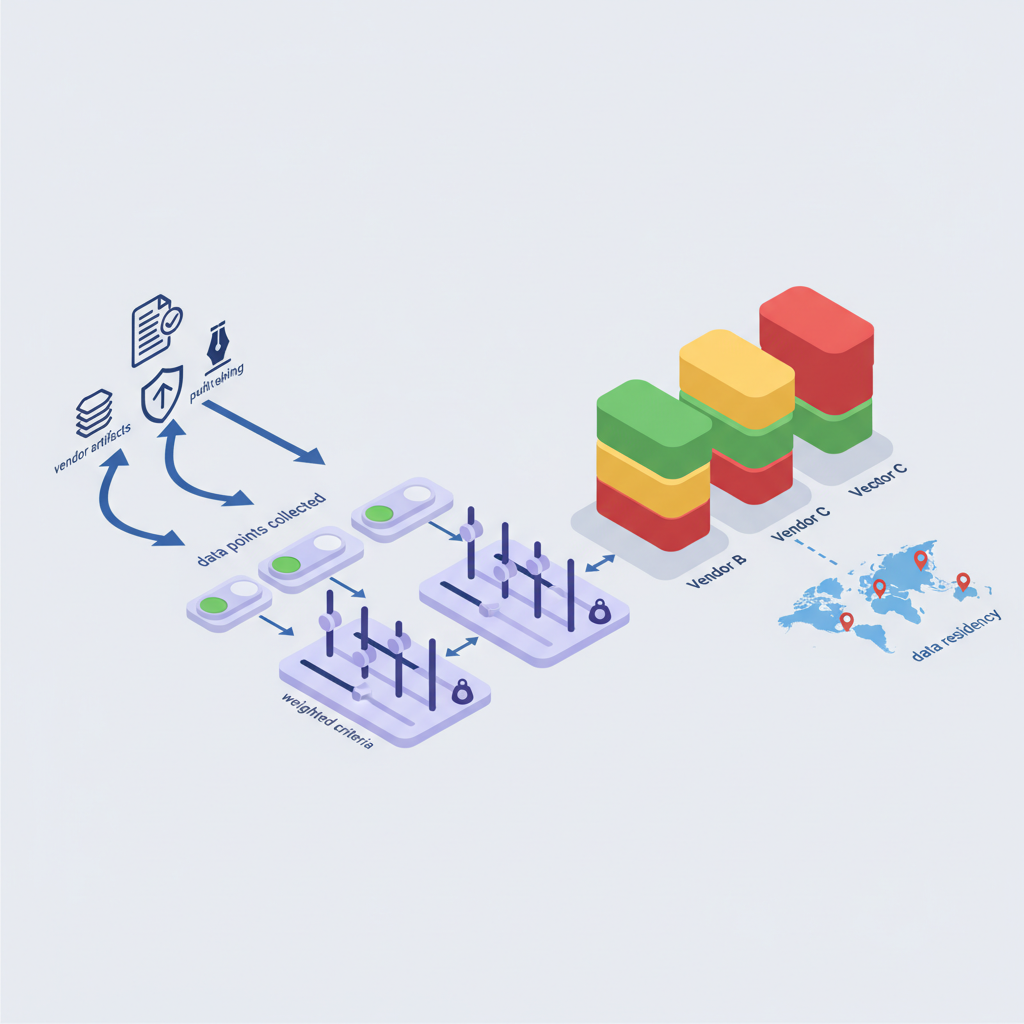
Binary checks (yes/no) simplify procurement but hide nuance. Weighted maturity levels (0 = none, 1 = basic, 2 = mature) capture progression. For many teams, a hybrid works best: use binary for deal breakers (e.g., no DPA = fail) and weighted scores for operational controls. Example decision rule: require a minimum total of 60% across all categories and 100% on deal-breaker binaries before shortlisting. Use weighting to reflect impact; for example, encryption and data residency might each have weight 1.5, while marketing claims have weight 0.5. Store scores in a simple ai security scoring matrix for repeatable comparisons.
Example scoring rubric and sample vendor responses
Sample rubric (excerpt): Encryption at rest: 0 = none, 1 = provider-managed AES-256, 2 = customer-managed keys (CMKs). Data residency: 0 = no control, 1 = region choice, 2 = single-country residency with contractual guarantees. Sample vendor response: "Provides provider-managed AES-256, region choice but not single-country residency, signed DPA available." Under the rubric, that vendor scores: encryption 1, residency 1, DPA 2. Use these scores to generate a ranked shortlist.
| Category | 0 | 1 | 2 |
|---|---|---|---|
| Encryption at rest | None | AES-256 (provider keys) | CMKs / BYOK |
| Data residency | No choice | Region selection | Country-level contract guarantee |
| DPA | None | Standard DPA | Negotiated DPA + subprocessors |
How to verify vendor claims (SOCs, ISO, penetration test reports, third-party audits)
Never accept claims without artifacts. Ask for recent SOC 2 Type II or ISO 27001 certificates and review the scope to ensure AI/data handling is included. Request sanitized penetration-test summaries or attestations of remediation timelines. For model-level assurances, ask for model cards or audit logs that show training-data provenance. If a vendor cites a third-party audit, confirm the auditor's name and the audit date. Cross-reference findings with threat trends reported by ENISA (ENISA Threat Landscape).
Verification succeeds only when artifacts are recent, scope-inclusive, and accompanied by remediation evidence.
Building a side-by-side privacy matrix for procurement reviews
Create a single spreadsheet where rows are vendors and columns are scored items. Include raw artifacts (DPA PDF, SOC cover letter, pen-test date) as linked evidence. Add computed fields: weighted score, deal-breaker flags, and final recommendation. Example column headers: Vendor, Encryption score, Residency score, DPA present (Y/N), SOC/ISO (scope), Last pen-test date, Weighted score, Recommendation. Use conditional formatting to highlight failed deal-breakers. This matrix becomes the primary document for legal and technical sign-off.
Templates for data residency and cross-border transfer checks
When assessing residency, verify where backups, logs, and model training data live. Use this data residency checklist: 1) Primary storage region; 2) Backup locations and retention; 3) Cross-border subprocessors; 4) Transfer mechanisms (SCCs, adequacy); 5) Customer control over deletion. If a vendor cannot commit to single-country residency, require contractual limits on transfer destinations and documented SCC usage where applicable.
| Residency check | Acceptable evidence |
|---|---|
| Primary storage country | Vendor attestation + architecture diagram |
| Backup locations | List of regions and retention policy |
| Cross-border transfers | SCCs or adequacy reference |
Actionable steps if a vendor fails checks (mitigations, contractual clauses, pilot limitations)
If a vendor fails non-deal-breaker items, negotiate mitigations: scoped pilots that use anonymized data, contractually required remediation timelines, escrow of logs, and explicit SLAs for incident response. Add clauses that require quarterly security attestations and the right to audit. For serious deficiencies, require technical mitigations such as client-side encryption or a gateway proxy that strips PII before it reaches the vendor. If the vendor refuses contractual protections, remove them from consideration.
Downloadable checklist + audit questions for technical and legal teams
Below is a compact, copy-paste checklist for procurement and security reviews. Use it in RFPs and procurement spreadsheets.
- Signed DPA with subprocessors list (Y/N)
- Encryption at rest: AES-256 or better (Y/N)
- Encryption in transit: TLS 1.2+ (Y/N)
- Customer-managed keys option (Y/N)
- Data residency: region choice or country guarantee (specify)
- SOC 2 Type II / ISO 27001 in-scope for AI services (attach)
- Recent penetration test dated within 12 months (attach)
- Retention and deletion policy for model outputs (attach)
For legal teams: include breach notification timelines (48–72 hours), audit rights, and specific indemnities for data breaches involving PII or PHI.
Conclusion: integrating security scores into procurement decisions
Integrate your ai security privacy scoring checklist into procurement as a hard filter: require minimum scores and pass/fail on deal-breaker items before feature evaluation. Use the side-by-side privacy matrix to document evidence and escalate gaps. Over time, maintain a vendor scorecard and revisit it quarterly or after major product changes. This reduces surprises and aligns legal, security, and engineering around the same facts. For more on this, see Ai product evaluation framework.
FAQ
- What is side-by-side security & privacy scoring checklist for ai tools (gdpr, ccpa, data residency templates)?
An ai security privacy scoring checklist is a structured rubric that scores AI vendors across technical controls, contractual protections, and regulatory requirements to enable objective vendor comparison.
- How does side-by-side security & privacy scoring checklist for ai tools (gdpr, ccpa, data residency templates) work?
The checklist assigns binary and weighted scores to categories like encryption, access control, DPA presence, and residency; procurement teams aggregate weighted scores and require minimum thresholds and deal-breaker pass criteria before approval.