
Why this guide — who it's for and what you'll learn
A small marketing lead watches the analytics dashboard at 9 a.m. and sees the ad creative underperforming, the blog pipeline slipping, and a social calendar full of empty slots. They need faster creative, clearer measurement, and a practical way to pilot tools without breaking the budget.
This guide explains how ai tools for marketing work, how to match them to real use cases, and how to choose and onboard tools so your team sees measurable ROI. You’ll get specific examples, step-by-step templates, and reusable artifacts you can copy into planning decks. For more on this, see Compare ai content creation tools guide.
Why this matters: marketing teams that test AI strategically move faster. Survey: ~60% of mid-market marketing teams reported using at least one AI tool in 2024; typical pilot timeline is 30–90 days. This guide is written for website owners, marketers, and developers who need intermediate-level, actionable guidance — not abstract theory.
Who this is for: you run or staff a content team, manage paid channels, or own a product marketing roadmap and need to decide which ai marketing tools to pilot and how to measure success. You’ll also find instructions developers can implement to integrate APIs and protect data privacy.
When not to use AI tools for marketing (boundary conditions):
- You cannot define an objective or evaluation metric for generated outputs (for example, unable to measure relevance or conversion).
- Your legal/privacy constraints forbid sending training data or PII to third-party APIs and no on-premise alternatives exist.
- Your team lacks the bandwidth to review and edit outputs — automated content pushed without human quality control will harm your brand.
- Cost of automation exceeds value (for micro-scale campaigns where manual effort is cheaper than tooling fees).
Actionable takeaway: before you test any tool, define one clear metric, one sample dataset, and a 30–90 day pilot window.
State of AI in marketing and content (definitions and key terms)
Definition for clarity: AI marketing tools are software systems that use machine learning, natural language processing, or generative models to create, optimize, or automate marketing content and campaigns. They include everything from headline generators to ad-bid optimizers and customer intent prediction models.
Quotable fact: "AI tools for marketing typically fall into content creation, performance optimization, social automation, and analytics — choose by use-case and data access requirements."
Key adoption note: SMBs in North America and Europe lead adoption; local GDPR/CETA rules often affect how marketing data can be processed. Many teams reported pilot programs in 2023–2024; use-case selection commonly drives whether a pilot proceeds to production.
Core concepts you should know:
- Generative models: produce new text, images, or video from prompts (used for headlines, captions, concept images).
- Retrieval augmented generation (RAG): supplements generation with your documents or site data to produce context-aware outputs.
- Sequence models & transformers: the architecture behind modern text generators and classifiers.
- Fine-tuning vs prompt engineering: fine-tuning trains a model on your data; prompt engineering crafts inputs to general models to get desired outputs.
Specific example: a content team might use a generative model to draft a blog outline, then a separate SEO tool to optimize headings and meta descriptions before scheduling the post. A performance marketer might use an AI bidding engine to adjust bids in real time while using a content AI to create dozens of ad variations.
An AI pilot that lacks a pass/fail acceptance rule is just a time sink; define acceptance criteria before you start.

Actionable takeaway: document one line of truth for each pilot — the metric you will use to decide go/no-go (e.g., CTR uplift, time-to-publish reduced by 50%, or 10% lower creative production cost).
Categories of AI marketing tools (content creation, SEO, social, analytics, automation)
Grouping tools by capability makes selection practical. Use these categories to map vendor features to your use cases.
- Content creation: tools that draft blog posts, emails, ad copy, and creative briefs using generative models. Example workflows: topic -> outline -> draft -> editorial pass.
- SEO & content optimization: tools that analyze search intent, score pages, recommend keywords, and optimize meta tags or headings. These often integrate with CMSs for on-page suggestions.
- Social media content: scheduling, caption generation, hashtag suggestion, and short-form creative generation (images and short video concepts).
- Analytics & insights: automated attribution modeling, anomaly detection in KPIs, competitive analysis, and customer segmentation using ML models.
- Marketing automation: personalization engines, programmatic ad-bidding, lead scoring, and automated nurture flows.
Specific example: a midsize e-commerce team might combine a content creation tool for product descriptions, an SEO tool to score pages before publish, and a personalization engine to show product recommendations on-site and in email.
How xproductlist.com helps: use the directory to filter tools by category, compare feature matrices, and read vendor summaries that highlight integration options and pricing tiers so you can narrow choices before running pilots.
Actionable takeaway: start by listing your top three use cases, then choose one vendor from two distinct categories to pilot together if integration is required (for example, a content generator plus an SEO optimizer).
Typical features and terminology by category
Understanding common features avoids confusion when evaluating vendors. Below are the typical capabilities you’ll see listed in product pages and RFPs.
- Content creation: bulk generation, tone-of-voice presets, content templates, translation support, built-in plagiarism checks.
- SEO: keyword gap analysis, SERP intent classification, on-page optimization score, schema recommendations.
- Social tools: calendar scheduling, auto-generated captions, creative variants, community moderation assistants.
- Analytics: model-based attribution, forecasted demand curves, anomaly alerts (P95 latency < 300ms for real-time systems is a typical performance target for responsiveness).
- Automation: API-first webhooks, identity resolution, audience segmentation rules, campaign orchestration flows.
Example glossary items: "generation prompt" (input given to a generative model), "RAG" (using your data store to ground outputs), "customer propensity score" (model probability a user converts).
Actionable takeaway: require vendors to explain technical terms in plain language during demos and ask for examples of actual outputs using your sample data.
How to map your marketing use cases to tool categories
If you’re deciding where to invest first, map each business outcome to a measurable metric and then to a tool category. This avoids buying shiny tools that don’t move the needle.
Step 1 — list the outcomes you need, for example:
- Reduce time-to-publish for long-form blog posts by 50%.
- Increase paid search CTR by 10% on targeted campaigns.
- Grow organic social engagement by 20%.
Step 2 — map outcomes to categories and minimal features:
- Time-to-publish: content creation tool + editorial workflow support (bulk generation, version control).
- Paid search CTR: ad creative generator + A/B testing platform + analytics engine for quick attribution.
- Social engagement: caption generator + scheduling + performance insights and creative variants.
Step 3 — pick pilot experiments scoped to 30–90 days. Example pilot: run the content creation tool on five high-value product pages, measure publishing time, organic traffic, and conversion rate over 60 days.
Concrete thresholds and rules to use when mapping:
- Set a minimum sample size for evaluation: at least 5–10 assets (posts, ads, pages) per pilot to reduce variance.
- Define statistical targets where possible: e.g., aim for 5–10% uplift in CTR or reduce content production time by 40%.
- Prioritize low-risk content for early pilots (product descriptions, captions), not legal or critical support content.
Actionable takeaway: produce a one-page pilot brief for each use case that contains objective, audience, datasets, evaluation method, and rollback criteria.
Selection framework for small and mid-size teams (skills, budget, privacy, integration)
Small and mid-size teams face constraints that change how a tool should be selected. Focus decisions on four dimensions: skills required, budget fit, data/privacy constraints, and integration complexity.
Skills required: assess how much editorial or developer effort the tool needs. A turnkey SaaS writer with an editor-friendly UI demands less development work than API-first platforms. Example: if you lack a developer, choose a tool with native CMS plugins and a visual editor.
Budget fit: categorize vendors into budget bands (low, medium, high) and identify realistic TCO, including seats, overages, and integration engineering. For small teams, prefer predictable pricing with per-seat caps over usage-based models that can spike costs.
Privacy and compliance: determine whether marketing data contains personal data covered by GDPR/CETA and whether you can send hashed or aggregated data to third-party APIs. If not, prefer vendors offering EU-hosted or on-premise processing or vendors that provide data processing agreements and SOC2 reports.
Integration complexity: list required integrations (CMS, ad platforms, analytics, CRM) and score vendors on connector availability. A concrete decision rule: only consider vendors with direct connectors for 2 out of your top 3 systems, or with a documented API and sample code you can test within 14 days.
Choose the tool that reduces your team's friction, not the one with the flashiest demo.
Evaluation matrix (suggested): create a 5x5 scoring grid with columns for cost, time-to-value, data control, integration, and reliability. Score each vendor 1–5 and use weighted totals to rank options.
Actionable takeaway: require a 30–90 day pilot with a capped spend and a written go/no-go decision based on predefined KPIs and integration success.
7-step vendor evaluation checklist (pilot-ready)
Use this checklist to move from shortlisting to running a pilot. Each item is binary: pass/fail — keep the vendor only if you meet the pass threshold.
- Define pilot objective and success metric (must be measurable).
- Confirm data residency and DPA terms meet your legal needs.
- Validate connectors/APIs for your CMS, ad accounts, and analytics suites.
- Request a sample output using your data (no credit card) and review quality.
- Confirm pricing model and put a 90-day cap on usage during the pilot.
- Ask for an SLA or reliability report and any compliance certifications.
- Document rollback steps — how to remove or stop integrations if the pilot fails.
Actionable takeaway: require vendors to complete items 2–4 before contracting; treat items 5–7 as negotiation and onboarding conditions.
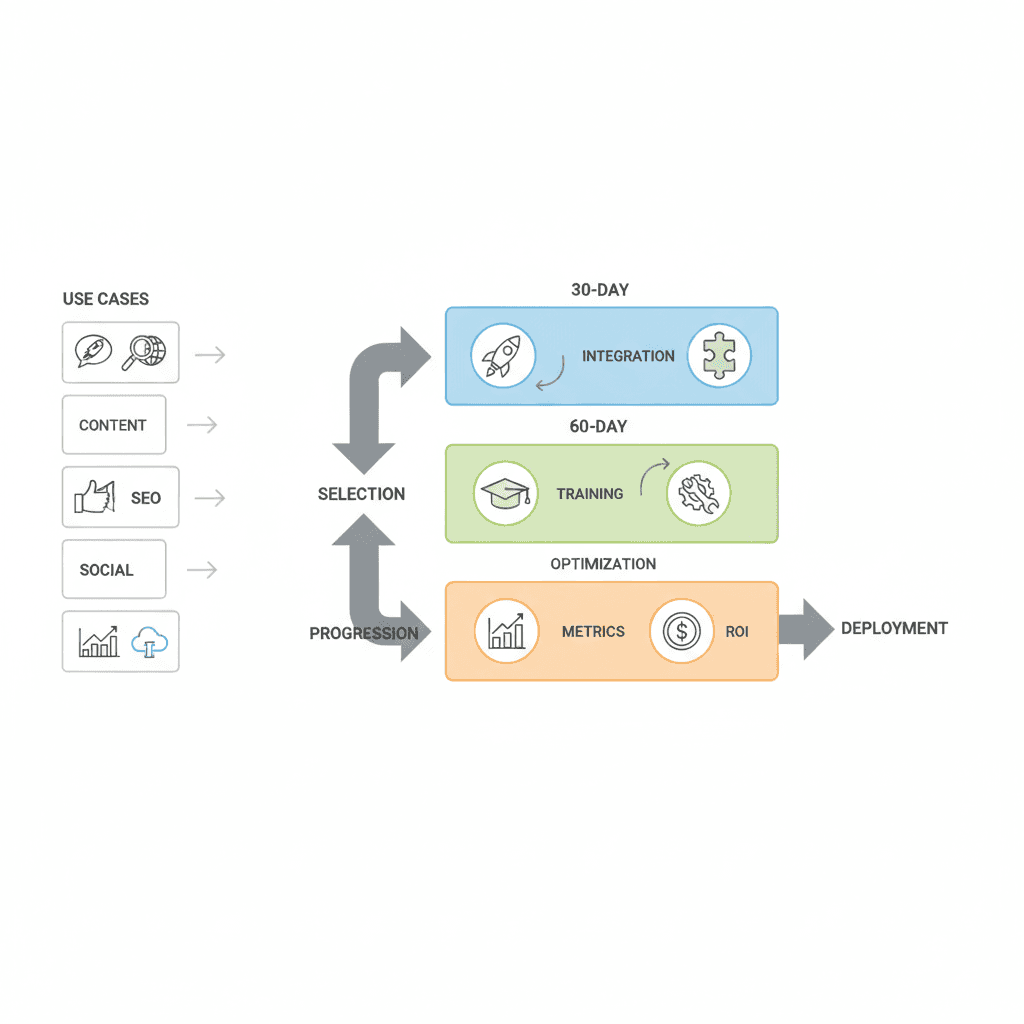
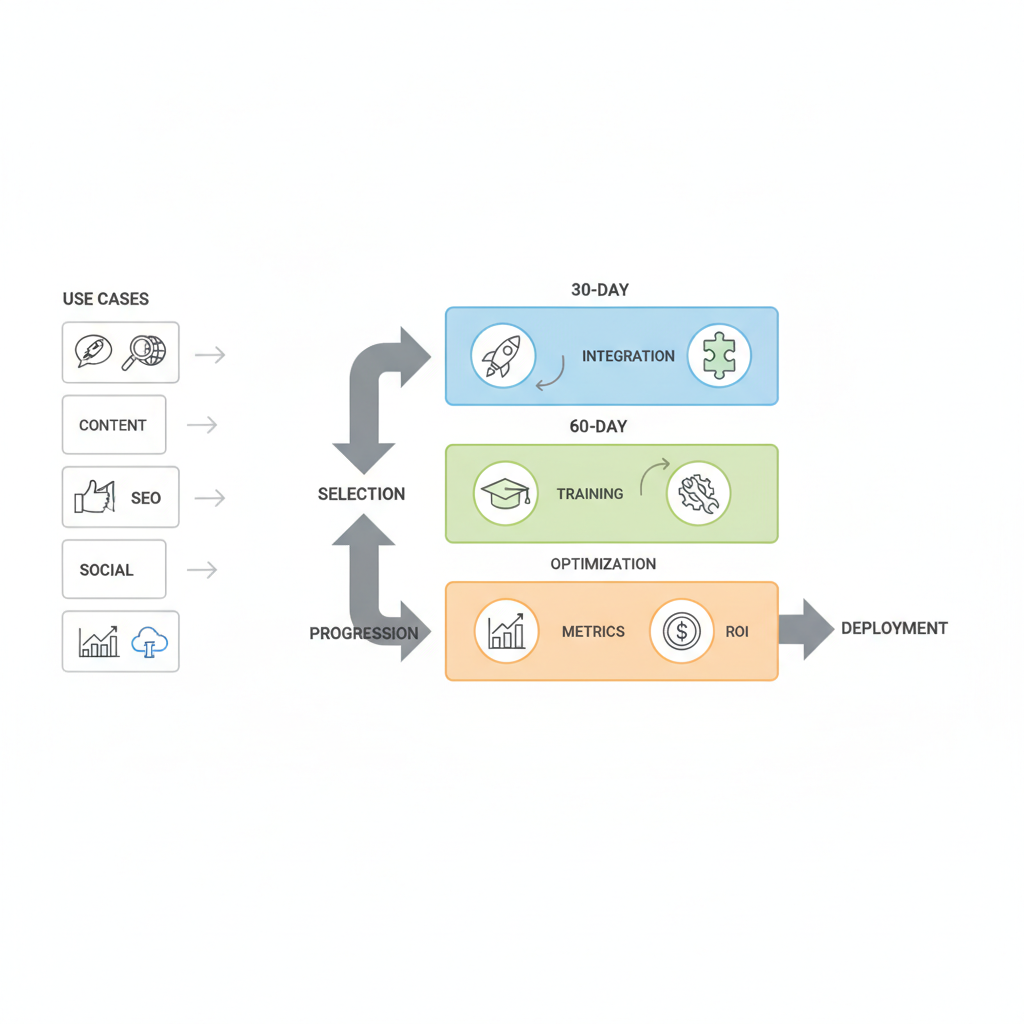
Integration & onboarding playbook (30/60/90 days)
Successful adoption follows a phased plan. Below is a practical 30/60/90 playbook designed for small-to-mid teams running a production pilot.
0–30 days: setup and quick wins
- Assign roles: pilot owner (product/marketing), integration lead (developer), editorial reviewer (content lead).
- Install connectors and run sample jobs with sandboxes or staging environments only.
- Deliverable: 3–5 outputs (ads, posts, pages) evaluated against acceptance criteria.
31–60 days: optimization and scale
- Iterate on prompts, templates, and content workflows based on qualitative review and early metrics.
- Set up dashboards that show pilot KPIs (see measuring success section).
- Deliverable: repeatable pipeline that reduces editorial cycle time (example: from 5 days to 2 days for a specific asset type).
61–90 days: decision and rollout
- Conduct a go/no-go decision review using the documented KPI targets and costs.
- If go: plan a phased rollout and training schedule; if no-go: document lessons learned and rollback plan.
- Deliverable: either a signed contract with implementation milestones or a closed pilot report with recommendations.
Concrete artifacts to prepare during onboarding:
- Prompt library with approved tone and content constraints.
- Data mapping sheet for fields exchanged via APIs.
- Editorial style guide and quality checklist for AI outputs.
Actionable takeaway: require a weekly sprint review during the first 60 days and prioritize human-in-the-loop checks to catch quality drift early.
Roles, data flows, and training tips
Clear responsibilities prevent confusion. Assign these roles at a minimum:
- Pilot owner: accountable for outcomes and go/no-go decision.
- Integration lead: handles API keys, connectors, and access control.
- Content editors: review and correct AI outputs before publish.
- Data steward: ensures privacy, consent, and dataset quality.
Data flow example: CMS content -> enrichment via RAG-enabled tool -> editorial review -> publish -> analytics tracking back to dashboard. Use tokenization or hashing for user identifiers when sending data to third-party APIs to reduce privacy risk.
Training tips for teams:
- Hold a half-day workshop on prompt design and expected failure modes.
- Create a small test dataset that reflects real content and use it for acceptance testing.
- Maintain a feedback loop: store rejected AI outputs and reasons to improve prompts or consider fine-tuning.
Actionable takeaway: keep training cycles short (2-week iterations) and log human corrections for continuous improvement.
Measuring success — KPIs, dashboards, and ROI templates
Define clear KPIs tied to your initial objectives. Below are common KPIs mapped to use cases and suggested dashboard elements.
- Content speed: time-to-publish, pages per week, editorial hours per asset.
- Engagement: organic sessions, time on page, social likes/shares, CTR for ads.
- Efficiency: cost per asset, cost per conversion, total tool spend vs previous manual cost.
- Quality: editorial rejection rate, accuracy score from SMEs, compliance incidents.
Dashboard elements to build:
- Pilot overview: objective, start/end dates, owner, status.
- KPI panel: primary metric trend line, control vs experiment comparison, statistical significance indicator.
- Cost panel: tool spend, staff hours saved, projected annualized savings.
ROI template (simple):
| Item | Baseline | After pilot | Delta |
|---|---|---|---|
| Monthly editorial hours | 400 | 280 | -120 |
| Tool monthly cost | 0 | $1,200 | $1,200 |
| Staff cost saved (monthly) | $0 | $6,000 | $6,000 |
| Net monthly value | $4,800 |
Quotable KPI line: "Measure both time savings and quality changes — faster output with lower quality is not a win."
Track one leading indicator and one lagging indicator for every pilot to keep measurement manageable.
Actionable takeaway: build a one-page KPI dashboard before launch and update it weekly during the pilot. Use statistical significance thresholds where applicable (p < 0.05) for experiments involving conversion metrics.
Risk, compliance & data privacy considerations for marketing data
Marketing teams handle user data that may be subject to GDPR, CETA, or other local rules. Treat data privacy as part of vendor selection, not an afterthought.
Checklist for compliance:
- Confirm data residency options (EU, US, or specific regions) if required by law.
- Obtain a Data Processing Agreement (DPA) and confirm subprocessors.
- Use hashed or pseudonymized identifiers when possible; never send raw PII unless necessary and contractually permitted.
- Review vendor security posture: SOC2, ISO 27001, or equivalent certifications where available.
- Request model transparency details: what data the vendor uses to train public models and whether outputs may leak training data.
Example mitigation: for email personalization pilots, use aggregated engagement signals instead of raw email addresses when sending data to an external model, and store mapping tables within your infrastructure.
Documented practices from standards: follow NIST's guidance for AI risk management when possible, and consult platform-specific responsible AI notes for model transparency and usage rules (for example, references are available in vendor docs or standards bodies).
Actionable takeaway: include privacy approval as a mandatory gating item in your 7-step checklist. No pilot proceeds without a signed DPA or documented mitigation for data residency.
Recommended tool stacks for common team profiles (content-first, performance marketing, social-heavy)
Below are starter stacks built for typical team profiles. These are not endorsements of specific vendors; they’re frameworks showing how categories combine into practical stacks. Use xproductlist.com to filter actual vendors that match these stacks.
Content-first team (small marketing team focused on owned media):
- Content generation tool with CMS plugin — to speed drafts and product descriptions.
- SEO optimizer — to score and prioritize content updates.
- Analytics engine with page-level attribution — to measure organic impact.
Performance marketing team (ads-driven growth):
- Creative generator for ad variants — to produce headline and image options quickly.
- Bid optimization engine — to automate budget allocation across campaigns.
- A/B testing platform — to test creative and landing pages.
Social-heavy team (brand and community focus):
- Social content assistant — for captions, hashtag research, and calendar scheduling.
- Community moderation assistant — to triage and suggest replies for high volume.
- Short-form creative generator — to produce image or video concepts for posts.
Actionable takeaway: pick one vendor per capability initially, then expand to more integrated systems only after verifying data flows and ROI in a 60–90 day window.
Example stacks with pros/cons and budget bands
Example 1 — Low-budget content-first stack (monthly cost band: low):
- Pros: fast time-to-value, minimal engineering.
- Cons: limited customization, potential content similarity across competitors.
Example 2 — Mid-budget performance stack (monthly cost band: medium):
- Pros: better integrations with ad platforms, support for experiments.
- Cons: requires some developer time for API keys and data syncing.
Example 3 — High-budget enterprise stack (monthly cost band: high):
- Pros: custom models, SLAs, on-prem or EU-hosted options.
- Cons: longer procurement cycles and higher implementation costs.
Actionable takeaway: select a stack that matches both headcount and procurement capability; smaller teams should prioritize lower friction and predictable pricing.
Comparison methodology and resources (how we test and rank tools)
At xproductlist.com we evaluate AI tools using a repeatable methodology to make vendor comparisons meaningful. Our ranking incorporates feature fit, integration readiness, privacy posture, output quality, and TCO over a 12-month horizon.
Testing steps we recommend you adopt:
- Seed the tool with a standardized dataset or brief so outputs are comparable across vendors.
- Score outputs on objective criteria (accuracy, relevance, adherence to style). Use a 1–5 scale and require at least three independent reviewers where possible.
- Measure time-to-value: the elapsed time between first integration and first approved production output.
- Track operational overhead: number of manual corrections per asset and developer hours for integration.
- Assess privacy and compliance readiness via documentation and DPAs.
Resources to consult during evaluation include vendor docs for APIs, NIST's AI risk framework for governance guidance, and platform-specific transparency notes for model behavior.
Actionable takeaway: require vendors to process the same challenge brief and return comparable outputs in a sandbox; evaluate those outputs blind to vendor branding where possible.
Quick-start checklist & decision templates (downloadable)
Below are two reusable artifacts you can copy: a pilot checklist and a decision template to use at the end of a 90-day evaluation.
Pilot readiness checklist:
- Objective and primary KPI documented.
- Pilot owner and team roles assigned.
- Data privacy sign-off or mitigation documented.
- Integration plan (connectors/API) with estimated developer hours.
- Cost cap and billing contact confirmed.
- Sample dataset uploaded and vendor sample outputs received.
- Rollback plan documented.
Go/no-go decision template (use at 60–90 days):
| Criteria | Target | Result | Pass? |
|---|---|---|---|
| Primary KPI improvement | +10% | ||
| Time-to-publish reduction | -40% | ||
| Integration stability (uptime) | >99% | ||
| Privacy/compliance clearance | Yes | ||
| Cost vs savings | Positive within 6 months |
Actionable takeaway: adapt these templates to your team's cadence and make the go/no-go decision a documented sign-off with fiscal owner approval.
Next steps and internal links to comparative reviews and how-to articles
Ready to act: prioritize one pilot aligned to a clear business outcome, use the 7-step checklist to qualify vendors, and follow the 30/60/90 playbook to integrate and measure results. Visit xproductlist.com to filter and compare vendors by category and read side-by-side summaries that reduce shortlist time.
Suggested next moves:
- Create a three-row pilot backlog (now/next/later) and pick the top priority for a 30-day quick test.
- Run an internal workshop on prompt engineering and editorial guardrails before onboarding any tool.
- Document privacy requirements and have legal sign off before data sharing.
Actionable takeaway: publish pilot results internally to build momentum or capture lessons learned for future tool decisions; documenting failures is as valuable as documenting wins.
Appendix — glossary, vendor scoring matrix, and citations
Glossary (select):
- Prompt: the input instruction given to a generative model.
- RAG: retrieval-augmented generation, combining a knowledge base with a generator.
- Fine-tuning: adapting a model to your dataset for consistent outputs.
Vendor scoring matrix (copyable):
| Vendor | Feature fit (1–5) | Integration (1–5) | Privacy (1–5) | Cost (1–5) | Total |
|---|---|---|---|---|---|
| Vendor A | |||||
| Vendor B |
FAQ
What is ai tools for marketing & content teams (2026)?
AI tools for marketing are software systems using ML, NLP, or generative models to create, optimize, or automate marketing content and campaigns.
How does ai tools for marketing & content teams (2026) work?
These tools ingest prompts, datasets, or tracking data and apply models to produce outputs (text, images, recommendations) which are then reviewed, scored, and integrated into campaigns or content pipelines.
References
- Artificial Intelligence Risk Management Framework: Generative Artificial Intelligence Profile
- Introducing GPT-4.1 in the API
- Use system instructions | Generative AI on Vertex AI
- Transparency Note for Azure OpenAI in Microsoft Foundry Models
- AI Adoption Is Surging in Advertising, but is the Industry Prepared for Responsible AI?