

TL;DR
- Use an ai vendor access checklist before any integration to limit data scope, require a DPA, and map subprocessors.
- Run a short pilot with scoped data and require SOC2 Type II (or equivalent) evidence before production traffic.
- Include specific ai vendor contract clauses for liability, data residency, SCCs (EU), and consumer data handling (CA/India).

The following vendor access & contract checklist helps website owners, marketers, and developers evaluate third-party AI tools before granting access to site data or systems. This ai vendor access checklist lays out practical pre-contract assessments, required contract language, operational controls, validation steps and ready-to-copy artifacts you can paste into procurement emails and SOWs. Use it to reduce integration risk and speed approvals.
When not to integrate third-party AI tools
Do not proceed with integration when any of these conditions apply: the vendor refuses a DPA or subprocessors list; the model cannot be evaluated for safety on representative data; the integration requires sharing sensitive customer identifiers without encryption; or the vendor’s SOC/ISO evidence is absent and cannot be provisioned within your onboarding window. These constraints typically indicate that the risk exceeds the business value and the project should pause until remediation. For more on this, see Evaluate ai integration and data privacy.
Why vendor access & contracts matter for AI integrations
Without disciplined vendor access controls and tight contracts, AI integrations can leak PII, expose proprietary prompts, or create persistent dependencies. An ai vendor access checklist codifies who touches what data, under which controls, and what happens when things go wrong. For example, a marketing team granting API keys to a summarization vendor should specify: only page content is sent (no user emails), requests are rate-limited, and logs are retained for no more than 30 days. That single set of clauses avoids later disputes about data retention and IP of outputs.
An AI vendor is production-ready only after you’ve tested least-privilege access, verified subprocessors, and confirmed breach notification timelines in contract. For more on this, see Ai product evaluation framework.
Quick checklist overview (one-page summary / downloadable template)
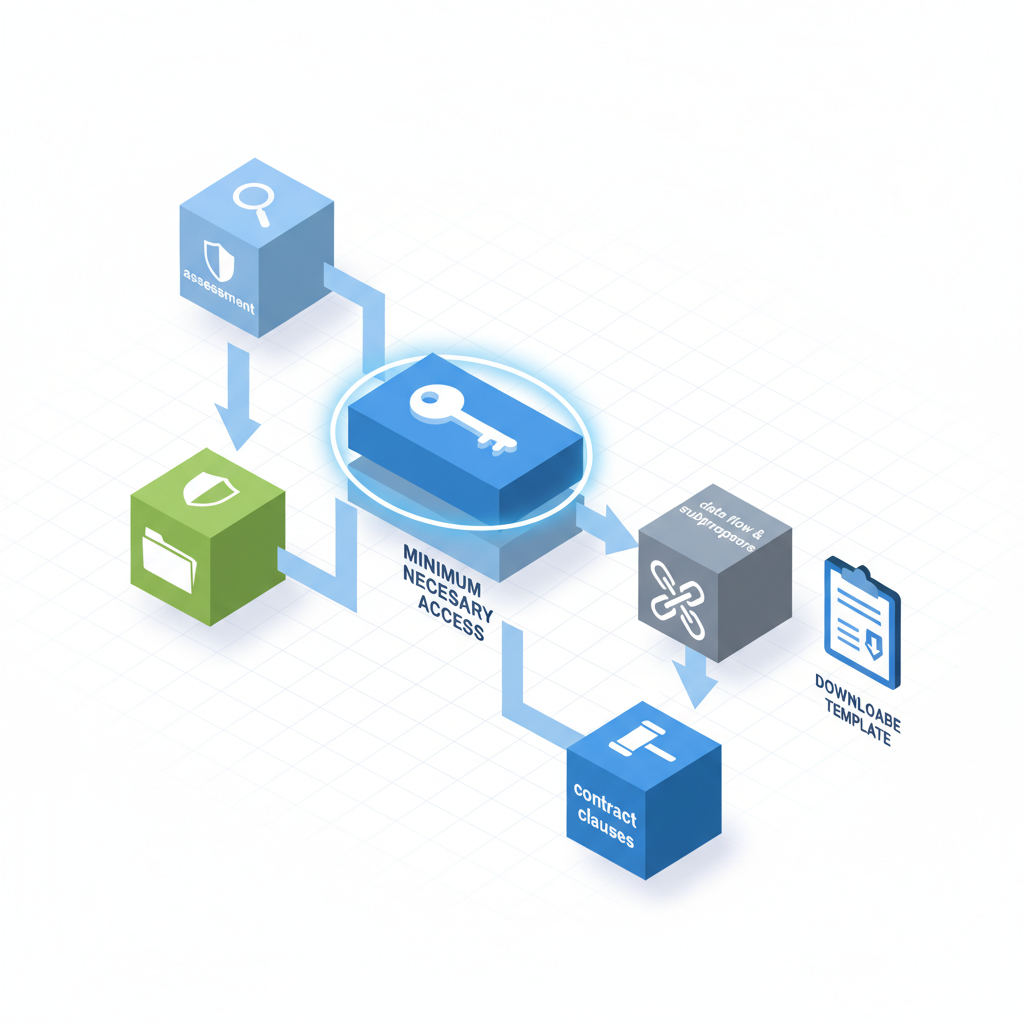
Use this one-page third-party ai vendor checklist as the first gate in procurement. It fits in the procurement packet and helps engineers and legal confirm basic fit before deeper review.
| Item | Pass/Fail | Notes |
|---|---|---|
| Vendor identity & pedigree | Company name, HQ, customers | |
| Minimum necessary access defined | Fields, API scopes | |
| DPA & subprocessors list | GDPR Art. 28 cited | |
| SOC2/ISO evidence | Most recent report | |
| Pilot with scoped data | Test data only |
Copy-ready checklist (paste into procurement emails):
- Please provide a signed DPA and the current list of subprocessors.
- Share SOC2 Type II or ISO 27001 evidence and latest pen test summary.
- Confirm data residency and any required SCCs for EU transfers.
- Confirm model output IP assignment and any reuse restrictions.
Pre-contract assessment
Pre-contract screening reduces costly rework. Start with an ai supplier risk assessment that rates the vendor against: data sensitivity, access model (API, hosted, on-prem), subprocessors, and regulatory exposure. Use a simple scorecard: Data sensitivity (0–3), Technical access risk (0–3), Compliance maturity (0–3). Require a minimum combined score before legal will draft contract terms. As an example: if the vendor will process customer-identifiable data (score 3) and the vendor cannot provide a DPA, escalation to senior management is required.
Vendor identity and pedigree checks
Verify legal name, registration, and public references. Ask for at least two customer references in your industry and confirm active support channels. Check for recent security incidents and leadership changes. If the vendor is a startup with limited history, require tighter operational controls, a short pilot, and escrow or rollback provisions in the SOW.
Data classification and minimum necessary access
Classify data before sharing: public, internal, confidential, regulated. Apply minimum necessary access: for web integrations, send only the HTML body, strip user identifiers, and replace emails with tokens. Example threshold: PII never leaves the client-side unless encrypted in transit and at rest.
Subprocessor and third-party use
Require a subprocessors schedule that lists cloud providers and analytics vendors. Contractually require vendor to notify you 30 days before adding subprocessors and to allow rejection of specific subprocessors if they conflict with residency or sector rules.
Require vendors to commit in contract to a DPA, SOC2 Type II or equivalent, and explicit breakout of subprocessors.
Contract clauses to require
Core ai vendor contract clauses reduce ambiguity. Required clauses include data scope and handling, DPA reference, breach notification timelines, liability caps (carefully calibrated), termination and data return/deletion, audit rights, subprocessors, and IP rights for model outputs. Include a table in the SOW that maps each API endpoint to allowed data fields, retention window, and access roles. Specify that any changes to model training on customer data require written consent.
Data Processing Agreement (DPA) essentials
Reference GDPR Article 28 for processor obligations: describe purposes, types of data, retention periods, security measures, subprocessors, and assistance with data subject requests. For US-facing services mention CCPA/CPRA implications—vendors acting as service providers must process consumer data per your instructions and are prohibited from selling it.
Liability, indemnity and breach notification timelines
Require breach notification within 72 hours for security incidents affecting personal data; for critical incidents that include data exfiltration, require immediate escalation. Set liability caps that reflect the value at risk—avoid broadly unlimited exclusions for intentional misconduct.
Data residency and transfer clauses (SCCs, adequacy)
Define data residency by dataset class. For EU personal data, require either transfers to countries with adequacy decisions or execution of Standard Contractual Clauses (SCCs). For California consumer data, require explicit restrictions on sale and targeted advertising under CCPA/CPRA. For India, call out any data localization requirements and ensure the vendor confirms compliance if required.
Intellectual property and model ownership / rights to outputs
Specify whether outputs generated by the vendor’s models are owned by you or licensed. If the vendor uses customer data to improve models, require explicit consent and a narrow license or an opt-out. Include a clause forbidding vendor reuse of proprietary prompts or fine-tuning on your data without a separate agreement.
Operational controls to include in SOWs
SOWs should convert contract language into engineering tasks: API scopes, key rotation cadence, log retention policy, encryption standards, and rollback plans. Include acceptance criteria and KPIs: response latency P95 < 300ms for API calls, error rate < 1% over a 24-hour window, and successful deletion confirmation within 30 days after termination. Tie payment milestones to security and privacy deliverables.
Access controls, audit logs, and least privilege
Require role-based access, MFA for vendor accounts, and audit logs retained for at least 90 days. Define exact privileges for support staff versus engineering staff and require periodic access reviews.
Change management and versioning
Vendor must provide release notes and a versioned API. Require 30-day notice for major model or API changes and a rollback option if the update introduces regressions for your traffic.
How to validate vendor commitments (evidence & tests)
Validation combines paperwork and tests. Ask for SOC2/ISO reports, recent pen-test summaries, and the subprocessors list. Then run a scoped functional test with synthetic or anonymized data. Use the pilot to verify retention, deletion, and that no unexpected identifiers are transmitted to third parties.
Requesting SOC/ISO reports and pen-test summaries
Request the latest SOC2 Type II or ISO 27001 certification and a redacted pen-test summary. Verify the report dates and the auditor identity. If unavailable, require a compensating control plan and shorter pilot window.
Running a limited pilot with scoped data
Run a 2–4 week pilot that uses non-production or tokenized data and defined success criteria: no PII leaks in logs, expected throughput, and correct deletion on request. Escalate failures to stop-state immediately.
Red flags that should block integration
Block integration if the vendor refuses a DPA or subprocessors list, will not provide SOC/ISO evidence, lacks a clear data deletion mechanism, or insists on ownership of generated outputs without compensation. Also block when vendor's data residency commitments conflict with regulated-data requirements in your jurisdictions.
Sample contract checklist and email templates for procurement
Sample procurement checklist: DPA signed, subprocessors listed, SOC2 or ISO provided, pilot plan approved, SOW includes access and rollback clauses. Copy-paste email template opener: “Please provide a signed DPA, current subprocessors list, SOC2 Type II report, and your pen-test summary. We will start a scoped pilot upon receipt.” Attach the one-page checklist above when emailing procurement.
Conclusion and next steps (priority actions for engineering, legal, procurement)
Priority actions: engineering defines data scopes and technical acceptance tests; legal drafts DPA and required ai vendor contract clauses; procurement collects evidence and runs the one-page third-party ai vendor checklist. Assign a single owner to track remediation items and a go/no-go date for production launch.
FAQ
What is vendor access & contract checklist for integrating third-party ai tools? The ai vendor access checklist is a one-page, actionable list that ensures vendors are vetted for identity, DPA obligations, subprocessors, SOC/ISO evidence, minimum necessary access, pilot requirements, and contract clauses before integration.
How does vendor access & contract checklist for integrating third-party ai tools work? The checklist gates procurement: vendors must supply documentation and pass a scoped pilot before engineering provisions keys or production traffic, and contracts must include DPA, breach notification, residency and IP clauses.
References
- Cybersecurity Supply Chain Risk Management Practices for Systems and Organizations (NIST)
- AI Controls Matrix | Framework for Trustworthy AI (Cloud Security Alliance)
- OWASP Top 10 for LLM Applications 2025 (OWASP)
- Artificial intelligence and machine learning Supply chain risks and mitigations (NCSC NZ)
- Advancing Governance, Innovation, and Risk Management for Agency Use of AI (U.S. Executive Office)