

TL;DR
- Use an ai vendor data handling checklist to verify how vendors collect, store, and use your data before integration.
- Ask 12 targeted questions covering inputs, storage, training, access controls, and SLAs.
- Validate vendor claims with evidence: architecture diagrams, pen-test reports, and a signed contract clause on data residency.

Integrating AI tools into your website or workflow improves experiences, but it also exposes data flows you must control. This vendor data handling checklist explains what to ask, what to expect in answers, and how to validate claims so your marketing, product, and engineering teams can safely deploy AI features. The primary goal is to give website owners, marketers, and developers an actionable ai vendor data handling checklist they can use during vendor evaluation.
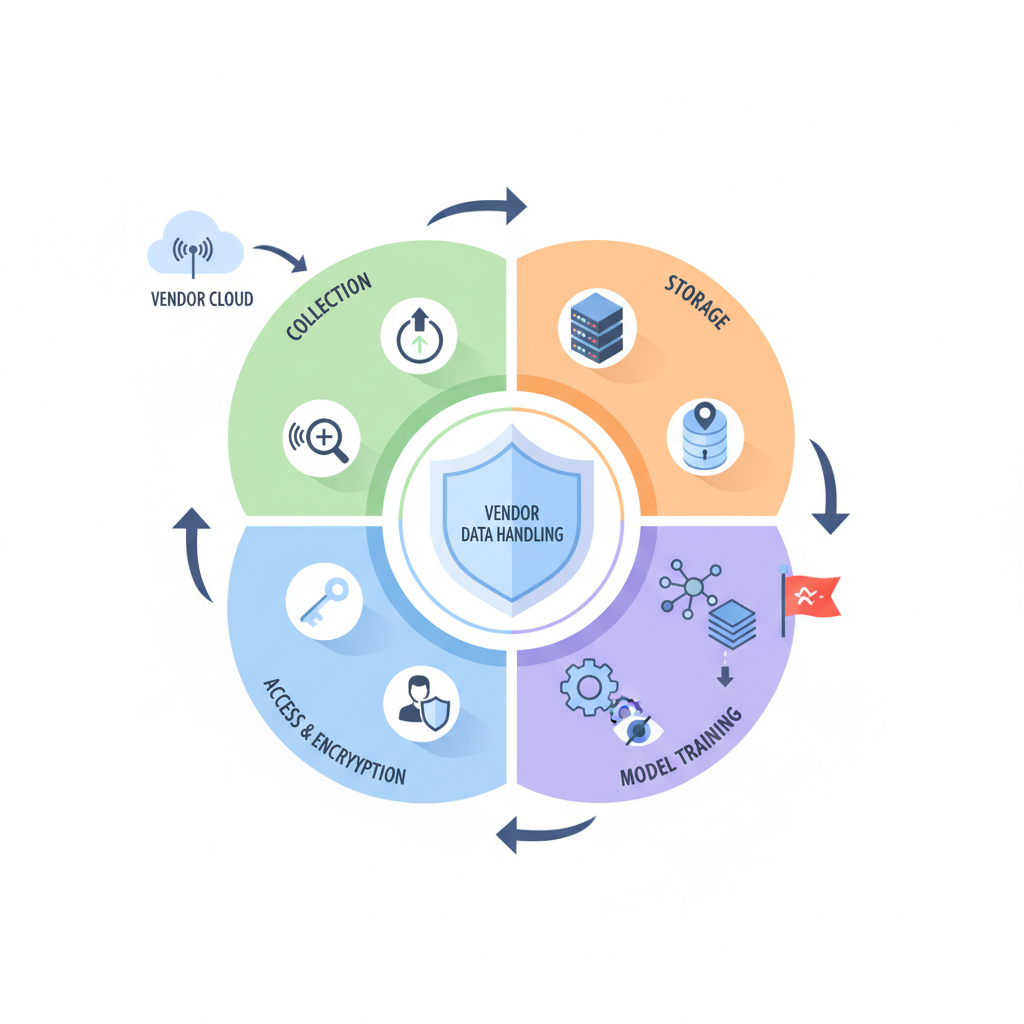
Why vendor data handling matters for AI projects
Without clear answers about data handling, AI integrations can leak customer information, create compliance risk, and open your product to data-driven attacks. AI vendors often need raw text, images, or metadata to deliver value — but those inputs can include personal data or intellectual property. Use a vendor data privacy checklist to avoid surprises: ensure the vendor documents which fields are sent, whether they store inputs, and whether they use data to improve their models. For more on this, see Evaluate ai integration and data privacy.
For example, a marketing site that sends customer emails to an AI summarization service must confirm the vendor will not retain or reuse those emails for model training. A developer integrating an image-generation API must know whether uploaded images are logged and whether model outputs could accidentally disclose private inputs. Asking ai data handling questions early reduces legal review cycles and avoids costly rollbacks during a launch.
Always require a documented data flow diagram showing every network hop between your systems and the vendor.
Key definitions — data residency, processing, sharing, and PII
Clear definitions let procurement and engineering evaluate vendor answers consistently.
- Data residency: the legal and physical location where data is stored and processed. Data residency matters because different jurisdictions enforce different rules for cross-border transfers and access by local authorities (see the EDPB opinion on AI models for GDPR context).
- Processing: any operation performed on data, including collection, storage, analysis, and transformation.
- Sharing: transfer of data to third parties, including subprocessors and analytics providers.
- PII (personally identifiable information): "Information that identifies or is reasonably capable of identifying a person." Example: in the US, an email address often qualifies as PII; in the EU, identifiers plus contextual data (location, IP with user ID) are treated more strictly under GDPR.
Quotable definitions for featured snippets:
- "Data residency is the physical country or region where data is stored and subject to local law."
- "PII is any information capable of identifying an individual; EU rules treat broader contextual data as personal data compared with typical US definitions."
Citation: the European Data Protection Board has issued guidance on AI and cross-border transfer risks, and the UK ICO outlines lawfulness for AI processing (see References).
Label every data field you send as sensitive, personal, or non-personal and require vendors to map each to storage and retention rules.
12 essential questions to ask every AI vendor
Below are the 12 core ai data handling questions—organized into topical groups—to include in procurement questionnaires and technical RFPs. Use them as a vendor data privacy checklist and adapt to your product's risk tolerance. For more on this, see Ai product evaluation framework.
- What exact fields are collected as inputs? (Provide a sample request payload.)
- Do you store input data or derived artifacts? If so, for how long?
- Is data used to train, fine-tune, or improve models? Are there opt-out mechanisms?
- Where is data stored and processed (data residency)? Can we require EU/US-only hosting?
- Who are your subprocessors and what access controls do they have?
- Do you retain logs, and are logs purged on customer request?
- What encryption is used in transit and at rest?
- Describe your authentication, role-based access, and audit logging.
- Do you produce derivative data (embeddings, indexes) and how are they segregated per customer?
- What incident and breach notification timelines do you commit to?
- What SLA, support, and responsibility sections will you add to the contract regarding data handling?
- Can you provide third-party audit reports, pen-test results, or SOC 2 certification evidence?
These ai data handling questions map directly to technical checks your engineers can verify during a proof-of-concept (POC). The following H3 sections expand the most technical items.
Questions about data collection & inputs
Ask vendors to produce a sample request and a data dictionary. That sample shows exactly what will leave your systems. Require fields be categorized (e.g., sensitive, personal, non-personal) and ask whether any automatic enrichment occurs (IP geolocation, device fingerprinting).
Actionable tests: run a POC with synthetic PII-laden payloads and confirm which fields appear in vendor logs. Confirm the vendor documents a masking or tokenization option; if they don’t offer masking, require it contractually. Include the phrase what to ask ai vendors in your internal checklist so legal and engineering use consistent language when requesting the sample payload.
Questions about storage, retention, and residency
Demand explicit answers: where (which cloud region) is your data stored, what storage tier is used, and what retention policies apply. If you need ai integration data privacy for EU customers, require EU-only residency and contract clauses specifying cross-border transfer mechanisms (SCCs or equivalent).
Concrete thresholds and artifacts: require P95 recovery point objective (RPO) under 24 hours for backups and retention deletion within 30 days of contract termination. Ask for architecture diagrams that show replication and the names of cloud providers and regions. A vendor claiming 'we don’t retain data' should provide a logging policy and an attestation of deletion procedures.
Questions about model training, fine-tuning, and derivative data
Clarify whether vendor models are updated with customer data and whether derivative artifacts (embeddings, vector indexes) are considered database records. If the vendor performs fine-tuning, require opt-out or dedicated-instance guarantees so your data never joins a shared training corpus.
Example clause to request: "Customer data, including derivatives, will not be used for model training without explicit written consent and must be stored in a customer-dedicated namespace." Use the vendor data privacy checklist to force vendors to state how they segregate derivative data.
Questions about access controls and encryption
Verify multi-tenant isolation, role-based access, MFA for admin accounts, and audit logging that records data access. Encryption expectations: TLS 1.2+ in transit and AES-256 at rest or equivalent. Ask for key management details: who manages keys (vendor-managed vs. customer-managed keys), and whether hardware security modules (HSMs) are used.
Actionable test: request temporary, scoped access and review audit logs for the access session. If the vendor refuses to show audit logs, treat that as a high-risk response in your what to ask ai vendors matrix.
Red flags in vendor responses and how to probe deeper
Common red flags include vague answers, refusal to provide architecture diagrams, and blanket statements like "we don’t retain customer data" without proof. If a vendor says "data may be used to improve models," probe for written opt-out procedures and whether your data will be commingled with other customers'.
Probe deeper by requesting:
- Network-level diagrams and data flow charts.
- Copy of subprocessors and their contracts.
- Redacted SOC 2 Type II or ISO 27001 audits and recent penetration test reports.
Call out vendors that refuse contract-level commitments on residency or model-training exclusions—these are often non-negotiable for regulated customers.
Vague claims about "not using customer data" are a contractual risk until proven by audits or log evidence.
How to validate claims — requests for evidence and tests
Validation must be both documentary and technical. Start with documents: SOC 2 report, pen-test summary, subprocessors list, and a signed data processing agreement (DPA). Then run technical checks during a POC: send bounded test traffic, inspect vendor logs, and confirm deletion requests are honored within your required timeframe.
Checklist for validation tests (examples):
- Require an engineering-run test showing no persistent storage of test payloads within 48 hours.
- Confirm encryption in transit with a network capture showing TLS and certificate chains.
- Trigger an account-level data export and account deletion and measure the time to complete — compare to contract SLA.
Sample contract clauses and SLAs to request
Insert explicit clauses into the DPA and master services agreement. Include obligations on data residency, no-use-for-training guarantees, breach notification timelines, and audit rights. Ask for concrete SLA numbers for availability and incident response.
| Clause | Example language | Target |
|---|---|---|
| Data residency | "Customer data will be stored and processed only in EU regions unless Customer provides written approval." | EU-only for EU customers |
| No training use | "Vendor will not use Customer data to train or improve models without prior written consent." | Explicit opt-in required |
| Breach notification | "Vendor will notify Customer within 72 hours of a confirmed data breach affecting Customer data." | <72 hours |
Quick checklist you can copy into vendor evaluations
Use this short, copy-paste checklist during vendor scoring.
- Provided sample payload and data dictionary: Yes / No
- Stores inputs or derivatives: Yes / No — retention period specified
- Uses data for training: Yes / No — opt-out available
- Data residency options: EU-only / US-only / Global
- Subprocessors listed and approved: Yes / No
- Encryption: TLS & AES-256 confirmed
- Audit evidence provided: SOC 2 / ISO 27001 / Pen-test
- Contract clauses accepted: residency, no-training, breach SLA
Conclusion — next steps for teams evaluating vendors
Start every procurement with this ai vendor data handling checklist and require concrete evidence rather than promises. Combine the 12 essential questions with POC-level tests and contract clauses to move from vendor claims to verifiable controls. For a launch, prioritize vendors that accept residency requirements, provide signed DPAs, and supply third-party audits. Repeat the vendor validation annually or when you expand integrations.
Final quotable takeaway: "Requiring a signed DPA, a data flow diagram, and audit reports is the fastest way to turn vendor claims into enforceable controls."
FAQ
What is vendor data handling checklist for ai integrations?
An ai vendor data handling checklist is a compact set of questions and tests that procurement and engineering teams use to verify how an AI vendor collects, stores, processes, and shares customer data.
How does vendor data handling checklist for ai integrations work?
The checklist works by standardizing vendor responses into verifiable artifacts: sample payloads, architecture diagrams, audit reports, and contractual clauses, then applying POC tests to confirm vendor claims.