

TL;DR
- Use explicit decision gates to turn unpredictable pilots into repeatable production outcomes.
- Apply four gates — Proof, Integrate, Stabilize, Scale — with measurable pass/fail criteria before each handoff.
- Use a reusable 0–5 scoring rubric for accuracy, latency, cost, and compliance, and require signed evidence from Data, Legal, Security, and Product owners.
- Follow a pilot to production checklist AI teams can copy: baseline comparison, latency targets, observability, error budgets, and a cost model tied to vendor SLAs.

Introduction: why explicit decision gates reduce risk
Decision gates are short, evidence-driven checkpoints that answer one question: is this AI automation ready to move forward? A clear decision gate prevents rushed launches and hidden technical debt by converting subjective judgments into objective pass/fail criteria. In this guide you’ll find a practical framework for decision gates ai process automation pilot to production, complete with examples, a scoring rubric, a production checklist, and governance artifacts you can reuse on xproductlist.com or in your own stack.
Definition (quotable): "A decision gate is a documented checkpoint with measurable acceptance criteria and a named approver who signs the go/no-go."
When NOT to move an AI automation to production
- The pilot cannot be measured against a reliable baseline (no labeled ground truth).
- Data pipelines are unstable or lack provenance and replay capability.
- Costs per transaction exceed expected user value and no cost-control plan exists.
- Regulatory requirements (e.g., GDPR) or data residency rules are unresolved for the target region.
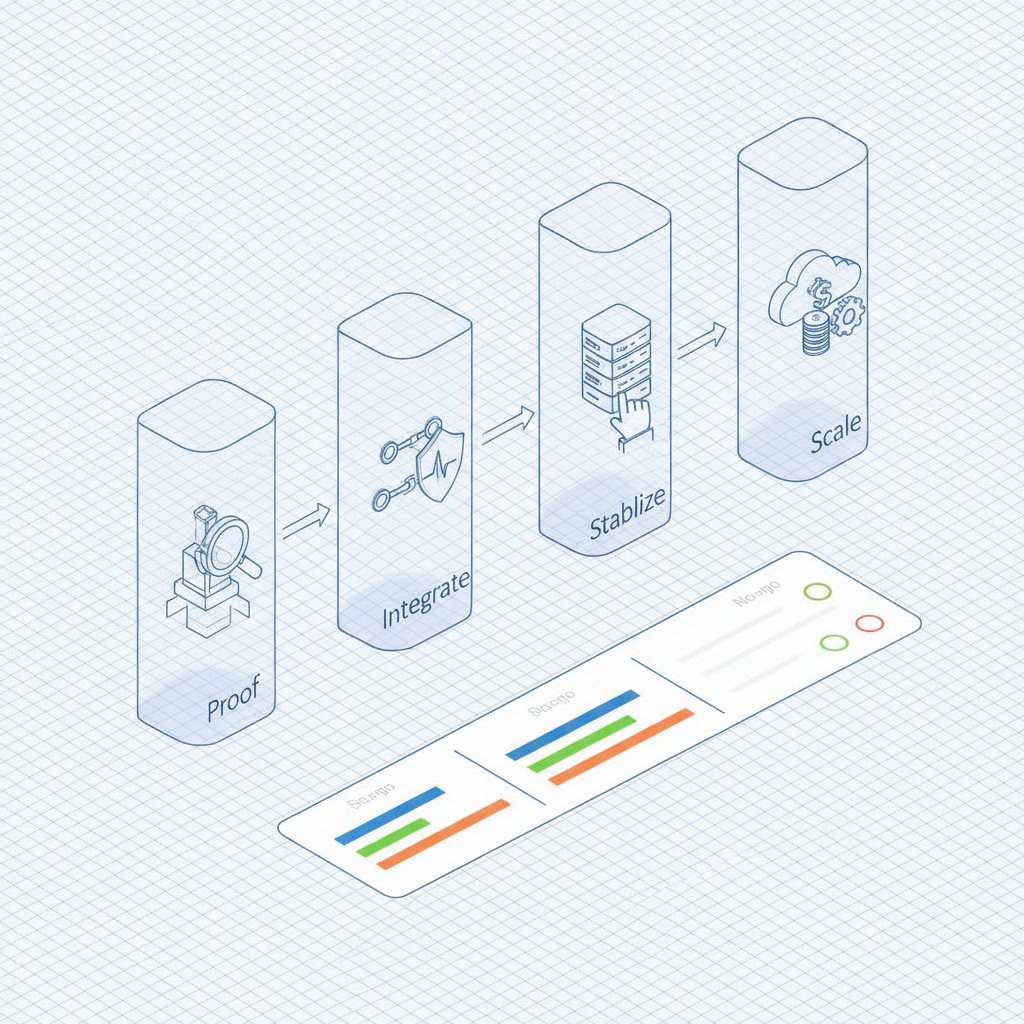
Framework: 4 decision gates for AI automation (Proof, Integrate, Stabilize, Scale)
The four-gate framework breaks the pilot-to-production path into manageable stages. Each gate focuses on a distinct risk class and produces artifacts required for the next stage.
- Proof — model quality, uplift versus baseline, and business case validation.
- Integrate — data reliability, latency, authentication, and security checks.
- Stabilize — monitoring, error budgets, human-in-the-loop policies, and retraining plans.
- Scale — cost model, vendor SLAs, capacity planning, and operational playbooks.
Why this structure works: separating model performance from integration and operations forces teams to fix different failure modes independently. You’ll run the ai pilot decision gates as a staged checklist, not a single “ship it” decision.
An AI prototype is production-ready only when failures are predictable, recoverable, and cheaper than the value the system delivers.
Gate 1 — Proof: accuracy, baseline uplift and business case
Gate 1 answers: does the model improve a measured business metric sufficiently to justify production costs? Required artifacts: labeled evaluation set, A/B or holdout results against a baseline, costed business case, and a simple failure-mode analysis.
Concrete thresholds (typical-case): aim for a model accuracy improvement over baseline of at least 10% relative uplift or an absolute accuracy target consistent with the task (for example, an intent classifier with F1 > 0.80 for routing support tickets is commonly acceptable for many SaaS workflows). If your application is safety-sensitive, require higher margins and manual review.
Example: a support-triage pilot routes 1,000 requests; the model reduces manual assignments by 20% while maintaining SLA compliance in a holdout. The gate requires an uplift report, confusion matrix, and a decision rule for ambiguous cases (route to human). This maps directly to the pilot to production checklist AI teams must follow: labeled test set, uplift percentage, and fallback path.
Gate 2 — Integrate: data reliability, latency and security checks
Gate 2 asks: can the model operate reliably inside your production stack? Key checks cover data freshness and provenance, throughput and latency, authentication, and encryption. Provide load tests, P95/P99 latency profiles, and a data tracing artifact that shows sample inputs and outputs end-to-end.
Concrete thresholds (typical-case): for synchronous user-facing automation, target P95 latency < 300ms; for internal async tasks, target mean latency under 2s. Verify data lineage: every record processed in production must map back to a source event and a schema version in your pipeline.
Security items: threat model, access controls, secrets handling, and a penetration-test summary where applicable. Integrate the ai rollout criteria into your CI/CD gates to prevent unapproved model versions from reaching production.
Gate 3 — Stabilize: observability, error budgets, and human-in-the-loop policies
Gate 3 determines whether you can detect, quantify, and remediate failures in production. Deliverables include dashboards with key metrics (accuracy on sampled live data, latency, error rate), a clearly defined error budget, and documented escalation/playbook entries for human-in-the-loop intervention.
Example observability stack: an incident dashboard showing daily labeled-sample accuracy, drift indicators, and a consumer-impact metric (e.g., % of transactions requiring manual review). Define an error budget (typical-case: <1% critical failures per week) that triggers throttling or rollback when exceeded, and publish a step-by-step rollback runbook.
Policy example: any output with confidence below a threshold goes to human review; if manual review exceeds X% of traffic for 3 days, revert to baseline policy. These rules make go no-go ai pilot decisions deterministic during early runs.
Gate 4 — Scale: cost model, vendor SLAs, and operational readiness
Gate 4 confirms the business can sustain the automation at target volume and regulatory footprint. Required artifacts: a cost model with cost-per-transaction, vendor SLA reviews, capacity plans, support handoff documents, and a compliance checklist for target regions (GDPR for EU, data residency for APAC).
Region examples: for EU rollouts include a GDPR checklist that documents lawful basis, data minimization, retention policy, DPIA where required, and a processor agreement. For APAC, list data residency flags and ensure your cloud configuration can pin storage to approved regions.
Operational readiness: ensure 24/7 on-call for critical services, runbook ownership, and a runbook drill that demonstrates recovery within your SLA window. Only sign off scale when the cost model shows sustainable unit economics at planned volumes.
Sample scoring rubric and go/no-go decision template
Below is a reusable 0–5 rubric teams can apply to each gate metric. Score each metric and average to produce a pass/fail threshold (typical pass threshold: average >= 3.5 and no critical metric at 0–1).
| Score | Meaning |
|---|---|
| 0 | Not met — blocking issue |
| 1 | Major gaps — high risk |
| 2 | Partial — significant remediation required |
| 3 | Meets minimum — monitored closely |
| 4 | Good — minor improvements expected |
| 5 | Excellent — production-grade |
Apply the rubric to metrics: accuracy, latency, cost per transaction, compliance risk, and operability. Then use this go/no-go matrix:
| Gate | Required artifacts | Decision rule |
|---|---|---|
| Proof | Evaluation report, uplift vs baseline, business case | Pass if accuracy score >=3 and uplift >= typical threshold |
| Integrate | Load tests, latency profile, data lineage | Pass if latency < target, lineage verified |
| Stabilize | Observability dashboard, error budget, HITL policy | Pass if error budget sustainable and runbook tested |
| Scale | Cost model, SLA review, compliance artifacts | Pass if unit economics positive and legal signs off |
Monitoring an AI system without tracking data drift converts silent model decay into a production outage.
Common failure modes and how to design gate-specific mitigations
Common failure modes map to gates and demand targeted mitigations.
- Proof failures: noisy labels or overfitting. Mitigation: increase holdout size, add cross-validation, and run adversarial tests.
- Integration failures: schema changes break inference pipelines. Mitigation: schema contracts, versioned APIs, and synthetic replay tests.
- Stability failures: silent model drift. Mitigation: implement daily sampled labeling, drift alerts, and automated rollback triggers.
- Scale failures: runaway costs or vendor rate limits. Mitigation: quota enforcement, cost alarms, and multi-vendor fallback plans.
Roles & governance: who signs each gate and what evidence is required
Assign clear sign-off roles and the evidence each role reviews. Below is a compact table you can copy into your playbook.
| Role | Typical responsibilities |
|---|---|
| Data owner | Validates evaluation dataset, drift controls, and data lineage |
| Legal | Approves contracts, GDPR DPIA, and processor agreements |
| Security | Approves threat model, encryption, and access controls |
| Product | Signs business metrics, rollout plan, and user communication |
Evidence required per gate should be stored in a versioned artifact repository and include: evaluation notebooks, load-test results, incident runbooks, and signed checklists from the roles above. For auditable regions, attach the compliance artifacts directly to the gate decision record.
Example timelines and playbook entries for each gate
Typical timelines vary by complexity, but you can use these sample windows as starting points for planning and resourcing.
- Proof: 2–6 weeks — gather labeled samples, run holdout tests, and produce uplift analysis.
- Integrate: 2–4 weeks — implement inference API, run load tests, and verify data lineage.
- Stabilize: 4–8 weeks — deploy observability, establish error budgets, and test human-in-the-loop flows.
- Scale: 4–12 weeks — finalize cost model, validate SLAs, and complete compliance sign-offs.
Playbook entry example (Integrate): checklist item — "Deploy inference service to staging; run P95 latency test at 2x expected traffic; record sample inputs/outputs for lineage; sign off by Data Owner and Security." Embed the scoring rubric and the decision matrix in the CI/CD pipeline so gates are visible in pull requests.
Conclusion and recommended next steps
"Decision gates in AI process automation pilot to production reduce risk by forcing measurable answers at every handoff. Start by copying the four-gate framework and the 0–5 rubric into your team’s playbook, then require named sign-offs and artifact uploads for each gate. For teams wondering when to move AI automation to production, the rule is simple: only when the relevant gate's pass criteria and evidence artifacts are complete. To effectively implement this, consider following a structured approach outlined in our 90-day pilot-to-production playbook."
Quotable: "Require signed artifacts — not verbal approval — before promoting any model to production."
FAQ
What is decision gates & rollout criteria for ai process automation?
Decision gates & rollout criteria for AI process automation are a staged set of checkpoints that validate model quality, integration readiness, operational stability, and scale economics before production deployment.
How does decision gates & rollout criteria for ai process automation work?
The process works by requiring specific artifacts and measurable thresholds at each gate (Proof, Integrate, Stabilize, Scale), using a scoring rubric and named approvers to produce a documented go/no-go decision.