

TL;DR
- Problem: small teams waste budget picking the wrong AI video pricing model.
- Quick answer: for most 3–10 person marketing or product teams, pick a predictable seat-based plan if collaboration and review cycles dominate; pick usage-based if you render often but have few simultaneous collaborators. Use a short pilot to validate renders/month and adjust.
- Artifacts included: a pricing comparison table and a 30-day pilot checklist.

Overview — common pricing models for AI video tools
You need video content, but comparing provider billing models feels like decoding tariffs. The core problem: teams with 3–10 people either overpay for unused seats or blow budgets on unexpected render charges. This article gives an ai video creation pricing tiers comparison that helps you choose—and budget—before you sign a contract.
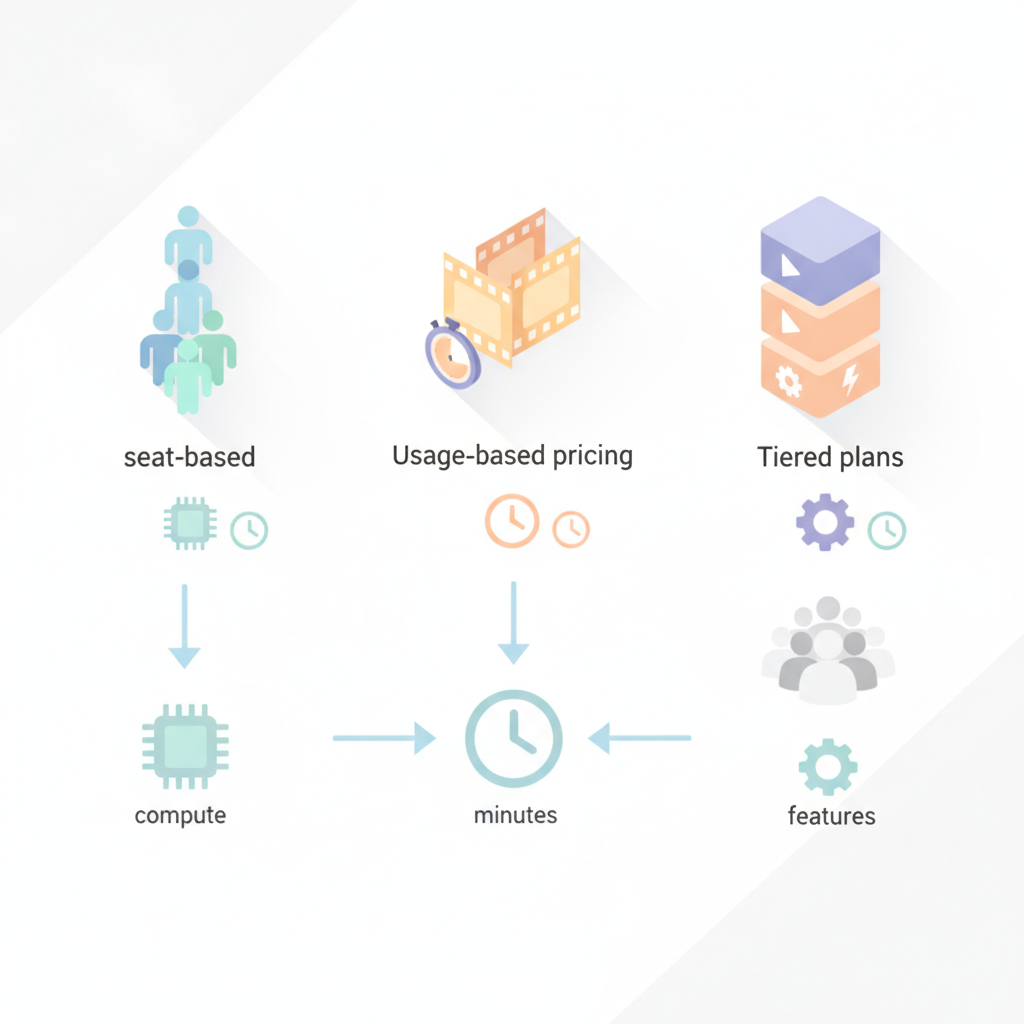
There are three common pricing models you’ll see: flat monthly seats, usage-based billing (minutes, renders, compute units), and feature-tiered subscriptions (basic, pro, enterprise). Each model changes cost predictability and who pays for scale.
Regional price sensitivity: SaaS is listed in USD and EUR; EU invoices often add VAT and sometimes pass VAT through to the buyer. For EU data processors, include a clause requiring GDPR-compliant data handling and a right-to-audit. Expect a predictable per-seat plan to cost [10–30]% more than usage-based for teams under 10 members (replace with your target range when negotiating).
Quotable definition: "Usage-based pricing charges per render or minute; seat pricing charges per active collaborator."
Prefer seat pricing when review cycles demand concurrent access; prefer usage models when renders drive costs, not collaborators.
Flat monthly seats
Seat pricing charges a fixed monthly fee per named user or active seat. It’s predictable: you multiply seats by the monthly rate and add any listed overages. That reliability helps small teams keep marketing budgets steady across quarters.
Example workflow that fits seats: a 6-person marketing + product team where three people edit, two approve, and one handles exports. Each person needs their own editor access and version history. Seat plans often include collaboration features—team folders, shared assets, and priority support—that usage plans may gate behind higher tiers.
Trade-offs: seats are wasteful if only one or two people actually create content and others only occasionally review. Also check whether the vendor charges for inactive seats or has a minimum seat count per team.
Usage-based (minutes, renders, compute units)
"Usage pricing bills you for what you consume: minutes rendered, exports, or compute units. This model can be cost-efficient for a single-heavy creator or a small team that batch-renders monthly. It’s also common for tools that offer pay-as-you-go video generation or high-quality GPU renders, which are essential considerations when choosing AI video creation tools in 2026."
Example scenario: if your team produces ten short social clips (30–60 seconds) per month, you may find usage pricing cheaper because you avoid paying for idle seats. But usage unpredictability bites when you run experiments, re-render edits, or increase export quality—costs can spike without caps.
Look for volume discounts, pre-purchase bundles, or thresholds that reduce per-minute rates once you pass a monthly cutoff. Also confirm whether preview renders count toward usage.
Feature-tiered (basic, pro, enterprise)
Feature-tiered pricing groups capabilities—watermark removal, commercial licensing, higher-resolution exports, and advanced AI models—into tiers. This model is flexible because it separates access from scale: a low-cost plan might let many users view projects, but only higher tiers enable 4K exports or custom branding.
Example: a small team may start on a pro tier for brand controls and then add seats or purchase usage credits. Feature tiers can combine with seat or usage billing; check what the tier unlocks versus what adds incremental cost.
Actionable check: list three must-have features (e.g., 1080p export, team folders, commercial license) and confirm whether the feature is in the base tier or gated.
What small teams actually pay — benchmark ranges and examples
Benchmarks are useful only as starting points. Replace the values below with vendor quotes during negotiation. For a 3–10 person team, typical billing patterns are:
- Small, low-volume teams: pay mostly for seats or a low-tier subscription plus occasional usage credits.
- High-render teams: pay by minutes/renders and often buy monthly credits or reserved compute.
- Teams requiring compliance or SSO: typically move to mid-tier or enterprise plans due to added contract and support costs.
Quotable benchmark: "For teams under 10, per-seat plans are often the simplest to budget; convert assumed renders/month into usage credits before deciding."
Typical entry-level vs mid-tier cost drivers
Entry-level costs are driven by seats and base-feature gating: named users, watermark removal, export resolution. Mid-tier jumps usually occur because of: SSO/SAML, dedicated support, higher concurrency, and SLA guarantees. If your workflow needs faster render queues or bulk API access, prepare for an enterprise uplift.
Example cost driver checklist: concurrent renders (how many simultaneous exports you’ll need), API calls per month, required export resolution, and legal/license requirements for commercial use. Map these to vendor feature lists and mark which tier unlocks them.
Decision framework: which pricing model suits 3–10 person teams
Make one clear decision early: are collaborators or renders your scarce resource? If collaboration is the limiter, seat pricing wins. If render volume is the limiter, go usage-based. This single rule simplifies negotiations and forecasting.
Decision steps (copyable):
- Estimate active creators and reviewers—count named editors you need each month.
- Estimate renders/month and average length (in minutes).
- Map features you require to the vendor tiers (SSO, export resolution, IP/licensing).
- Run a 30-day pilot under both models if possible and compare actual spend.
Choose the billing model that matches the single biggest driver in your workflow: collaboration or renders.
Low-volume creators vs production-focused teams
Low-volume creators (1–3 active creators) usually favor usage-based pricing or a single seat plus usage credits. Production-focused teams (4–10 members pushing frequent renders) often favor seats plus an allowance for renders to keep approval cycles fluid.
Worked example: a 5-person team with two editors and three approvers will likely prefer 5 seats on a seat plan that includes collaboration and shared project history. Conversely, a 3-person team that outsources editing but runs A/B renders should buy usage credits.
Predictability vs scalability trade-offs
Predictability comes from seat plans and annual commitments; scalability comes from usage models and elastic compute. For marketing budgets, predictability often outweighs marginal efficiency. For experimentation-heavy teams, elasticity can reduce total cost if you cap experiments and monitor spend.
Concrete threshold: set a soft alert at your expected monthly spend and a hard cap in any usage plan to avoid surprises. Use the vendor’s billing dashboard and export monthly usage CSVs to include in your budget review.
Practical step: building a cost forecast for each pricing model
Forecasting forces the trade-offs into numbers. Create a 3-column forecast (seat, usage, feature-tiered) with inputs and annualized totals.
| Input | Description | Example |
|---|---|---|
| Seats | Number of named users | 5 |
| Renders/month | Average exports including previews | 40 |
| Avg clip length | Minutes per export | 0.75 |
| Export quality | 1080p vs 4K (affects compute) | 1080p |
Turn these inputs into costs by applying vendor per-seat rates or per-minute rates and add a contingency buffer (10–20%). Run the forecast monthly for three months during a pilot to get realistic numbers.
Inputs to collect (videos/month, length, export quality, collaborators)
Collect these inputs before you ask vendors for quotes: monthly videos, average and peak lengths, expected concurrency (simultaneous renders), required export quality, need for API access, SSO/SCIM needs, and legal/IP clauses. Use a spreadsheet with cells for each input so you can swap vendor rates quickly.
Actionable artifact: create a single-sheet forecast with these inputs and three vendor columns. Share it with finance before signing.
Hidden fees & contract pitfalls to watch for
Vendors list base prices but hide costs in overages, reserved render queues, and enterprise add-ons. Watch for minimum-term clauses, auto-renewal with price increases, and audit rights. For EU teams, check whether VAT is added and whether invoices support reverse-charge mechanisms.
Negotiation tip: get the definitions in writing—what counts as a render, whether preview exports are charged, and how refunds work for failed renders.
Overages, render queues, enterprise add-ons, IP/licensing clauses
Overages: confirm overage rates and whether they're capped. Render queues: ask about priority rendering for paid plans. Enterprise add-ons: SSO, account management, and custom SLAs often cost extra. IP/licensing: obtain a written commercial license for generated content and confirm whether the vendor claims any rights to your outputs.
Example clause to request: a pilot clause that converts pilot usage to a multi-month credit at negotiated rates if you proceed to a full contract.
Real-world comparisons (3 anonymized vendor examples with mock pricing scenarios)
Below are three anonymized examples using typical vendor patterns; replace placeholders with actual quotes.
| Vendor | Model | Best for | Notes |
|---|---|---|---|
| Vendor A (example: Synthesia) | Seat + feature tiers | Teams needing many editors and presenter avatars | Good for collaboration, check seat minimums and enterprise features. |
| Vendor B (example: Runway) | Usage-based with credits | High-volume renders and advanced model access | Watch preview counts and GPU-quality export pricing. |
| Vendor C (example: Descript / Pictory) | Feature-tiered consumer-to-pro | Fast editing, transcription, and lightweight exports | Great for iterative editing; confirm commercial license terms. |
Negotiation checklist & pilot clause suggestions for small buyers
- Ask for a 30–60 day pilot with usage caps and a credit if you convert.
- Get definitions in writing: "what counts as an export" and "what counts as an active seat."
- Request VAT-inclusive and VAT-exclusive quotes for EU negotiations.
- Include data processing addendum (DPA) with GDPR commitments for EU processors.
- Negotiate a capped overage rate or an alerting threshold at 80% of forecast spend.
Conclusion — pick & pilot: action checklist for the first 30 days
Quick final steps: (1) map collaborators vs renders, (2) build the 3-column forecast, (3) run a 30-day pilot with one seat and usage caps, (4) compare actual spend to forecast, (5) negotiate a contract with a pilot-conversion credit and a DPA for EU teams. This ai video creation pricing tiers comparison shows that for many 3–10 person teams the right approach is a short pilot that proves either seat predictability or usage efficiency.
Quotable summary: "Run a one-month pilot under both billing models; real usage beats assumptions every time."
FAQ
What is pricing tiers compared?
Pricing tiers compared is a structured analysis of the billing models vendors use—seat-based, usage-based, and feature-tiered—to help buyers choose the most cost-effective plan.
How does pricing tiers compared work?
The comparison works by mapping your team's inputs (seats, renders/month, export quality, and required features) to each vendor's pricing model, running a short pilot, and using the resulting data to select and negotiate the optimal contract.