

TL;DR
- Use an ai process automation procurement checklist before vendor selection: align data residency, export windows, and measurable SLAs.
- Compare pricing models for ai automation with a table—subscription vs usage-based vs per-transaction—using expected volume scenarios.
- Require contract clauses for data handling requirements ai vendor, IP, portability, and explicit exit assistance.
- Negotiate clear sla requirements ai tools (uptime, latency P95, throughput) with financial remedies and monitoring hooks.

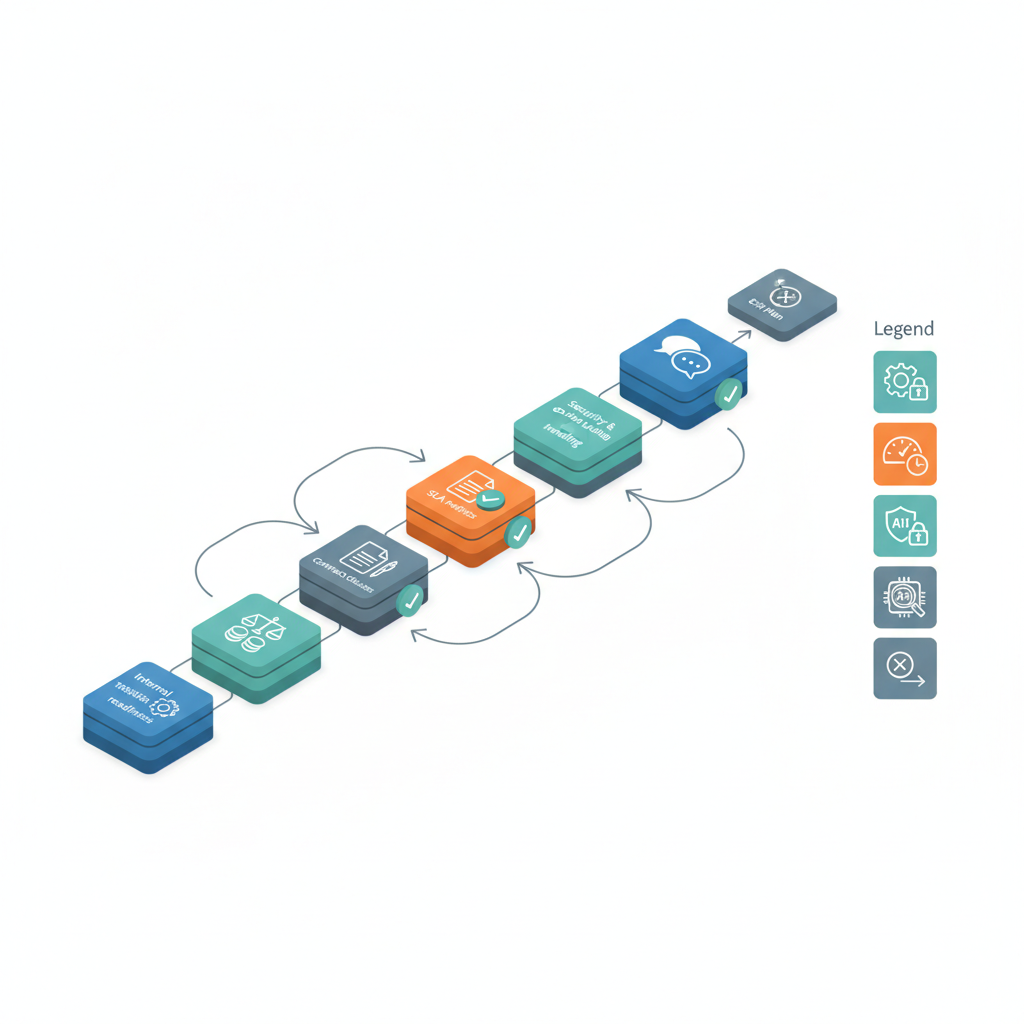
Introduction
Scaling AI process automation changes procurement from a buying exercise into a systems-integration discipline. This ai process automation procurement checklist guides website owners, marketers, and developers through readiness, pricing comparisons, contract terms, security, vendor risk, negotiation scripts, RFP content, integration expectations, and post-award validation. Quotable guidance: "Require explicit data residency and processing details for EU data and a 30–90 day data export/porting clause on contract exit." Below you'll find practical examples and artifacts you can paste into procurement templates.
Who this is not for
This guide is not for teams that: (1) are experimenting with one-off AI proofs-of-concept without production data, (2) have no capacity to monitor outputs or handle escalation, (3) operate in regulated sectors that prohibit third-party processing of sensitive data without bespoke legal controls, or (4) expect to avoid contracts and SLAs entirely (cloud marketplace free tiers). If any of the above applies, postpone large-scale procurement until controls and monitoring are in place, and consider strategies for scaling AI process automation.
Why procurement practices must change when you scale AI automation
When you move from prototype to production, procurement must shift from feature checklists to system risk management. AI vendors often deliver models that evolve, which means contracts must cover change management, model updates, and observable guarantees. For example, a marketing automation workflow that uses an LLM for content suggestions will run across thousands of transactions daily; a 1% error rate at scale can create reputational and legal exposure that small pilots never surface. Use this ai process automation procurement checklist to align stakeholders: procurement, legal, security, product, and engineering. Actionable step: list expected daily transactions and map them to failure modes (false positives, hallucinations, latency spikes). This clarifies whether a seat-based license or a usage-based plan is appropriate, and it primes negotiation on pricing models for ai automation and sla requirements ai tools.
An AI service is production-ready only when failures are predictable, observable, and bounded by contractual remedies.
Pre-procurement checklist — internal readiness & requirements
Before issuing an RFP or engaging vendors, complete an internal readiness audit. Minimum items: data classification (public, internal, restricted), lawful basis for processing (GDPR), required residency (EU/EEA), and retention windows. Example: if you handle EU user data, set a requirement to name the lawful basis and confirm data residency; require a 30–90 day export window on exit. Create a stakeholder matrix: who monitors production drift, who owns rollback decisions, who signs off on privacy assessments. Concrete thresholds: define acceptable P95 latency (for typical web APIs, target under 300ms) and acceptable error rates (for non-critical NLU tasks, ≤1–2% may be typical). Produce a short runbook for incident response that maps vendor contact, escalation times, and rollback triggers. This pre-procurement work makes vendor comparisons objective and supports an ai vendor procurement checklist when you evaluate proposals.
Pricing models explained (subscription, usage-based, seats, per-transaction) and how to compare
Pricing models for ai automation vary and choosing the wrong one inflates costs or creates vendor lock-in. Below is a short comparison table you can use when modeling scenarios.
| Model | When it fits | Pros | Cons |
|---|---|---|---|
| Subscription | Predictable volume, standard feature set | Budgetable; predictable unit cost | May overpay if usage low; limited elasticity |
| Usage-based | Variable volume, pay-for-what-you-use | Scales with demand; lower entry cost | Cost spikes; forecasting harder |
| Seat-based | User-limited tools (dashboards, editors) | Simple licensing, easy user management | Costs rise with headcount; not tied to value delivered |
| Per-transaction | High-volume API calls | Fine-grained control; aligns cost with use | Requires accurate volume forecasting |
How to compare: build three forecast scenarios (low/medium/high) for 12 months, apply each vendor's pricing model, and compute total cost of ownership including expected overage charges, data egress, and integration effort. For each vendor, ask for a worked example of your volume. Also request price protections (annual caps or volume discounts) to avoid runaway costs. Mention pricing models for ai automation in negotiations, and insist vendors provide sample invoices and volume thresholds.
Contract clauses to require (data handling, IP, reverse engineering, portability, exit assistance)
Key ai contract terms for automation should be explicit and auditable. Require clauses that: (1) define data handling requirements ai vendor with exact treatments (encryption in transit and at rest), (2) assign IP for derivative outputs or define ownership of prompts, (3) prohibit reverse engineering of models using your data, and (4) ensure portability and exit assistance with a defined export format and timeframe (30–90 days). Example clause language to request: "Vendor will provide encrypted data export in JSON/CSV within 30 days of contract termination and assist in safe deletion of residual copies." Also require model change notifications (30 days) and a rollback plan if an update materially degrades performance. Include indemnities for data breaches caused by vendor negligence and obligations to cooperate with regulatory requests under GDPR or CCPA/CPRA.
SLA metrics & penalties (uptime, latency, throughput guarantees)
SLA requirements ai tools must measure both availability and quality. Standard uptime: require at least 99.5% availability for business-critical APIs or define tiers with credits. For performance, specify latency targets tied to percentiles (e.g., P95 latency < 300ms for interactive APIs; P99 < 1s as a stretch target). For throughput, require sustained request rates without degradation and define throttling behavior. Quality SLAs may include accuracy or error-rate targets for classification tasks where measurable. Penalties should be financial credits and the right to terminate after repeated breaches (for example, three monthly SLA failures in a rolling 12-month window). Attach monitoring hooks: vendor must expose metrics via a shared dashboard or provide metrics to your monitoring endpoint. Quotable snippet: "Define P95 latency and financial credit tiers to make sla requirements ai tools enforceable."
Security & privacy clauses (encryption, data residency, breach notification timelines)
Security language must be specific. Require end-to-end encryption, specify key management (who holds keys), and demand proof of secure development practices (third-party pen test reports). For EU data, require explicit data residency and processing details to meet GDPR; for California, ensure CCPA/CPRA obligations are addressed. Breach notification timelines should be short—vendor must notify within 72 hours of discovery and provide a remediation plan. Also require regular vulnerability scanning, a documented patching cadence, and liability allocation for breaches. Example: require SOC 2 Type II or equivalent audit evidence and include right-to-audit clauses. Include the phrase "data handling requirements ai vendor" in procurement artifacts so vendors provide precise handling commitments rather than vague assurances.
Vendor risk checklist (model explainability, third-party dependencies, model updates)
Assess vendor risk with a vendor risk checklist that includes model explainability (can the vendor document feature importance or decision rationale?), third-party dependencies (open-source models, cloud providers), model update cadence and rollback ability, and adversarial robustness testing. Ask vendors for model cards or technical summaries per NIST and EC guidance (EU model contractual clauses). Concrete test: require a sample changelog for at least one prior model update and an example rollback playbook. Place a principle callout here: if a vendor cannot explain how a model treats your data, you have a compliance and operations problem.
Do not accept opaque model updates without a tested rollback and performance-validation gate.
Negotiation scripts and red flags (common vendor pushbacks and how to respond)
Common vendor pushbacks: refusal to include data export clauses, vague SLAs, unwillingness to allow audits, and fixed-price only models that ignore volume variability. Negotiation scripts: when a vendor resists data export, respond: "We require a 30–90 day export and documented data deletion—this is non-negotiable for regulatory compliance." If they resist SLA credits, ask for a trial period with operational metrics shared. Red flags: inability to provide SOC 2 reports, no written incident history, or refusal to name sub-processors. Use the phrase ai vendor procurement checklist during negotiation to keep conversations structured.
RFP/RFI template — essential questions to ask (technical, commercial, legal)
Pasteable RFP checklist (use in procurement templates):
- Technical: Describe architecture, APIs, rate limits, P95/P99 latency, and monitoring endpoints.
- Commercial: Provide detailed pricing examples for low/medium/high volumes, overage rates, and escalation paths.
- Legal: Confirm data residency, export windows (30–90 days), breach notification timeline, and audit rights.
- Security: Provide SOC 2/ISO evidence, encryption details, and key management practices.
- Operational: Share model update cadence, rollback process, and SLAs for uptime and accuracy.
These questions cover ai contract terms for automation and allow apples-to-apples comparisons across vendors.
Integration & support expectations (onboarding, SSO, API limits, rate limits, monitoring)
Define onboarding deliverables: onboarding plan, SSO/SCIM setup, test environment access, and a timeline for integration testing. Specify API limits and expected rate limits; require clear throttling behavior and a grace period during cutover. Ask for monitoring integration (Prometheus, Datadog metrics, or webhook alerts) and for a named support SLA with response times (e.g., initial response within X hours for P1 incidents—use your internal standard). Include an integration checklist: SSO enabled, test keys provided, sample dataset seeded in staging, end-to-end test scenarios passed, and runbook signed off by engineering.
Post-award checklist — on-boarding, staging, rollback, performance validation
After award, run a staged rollout: deploy to staging, run synthetic load tests, validate P95 latency and accuracy against target datasets, and run a monitored canary in production. Define rollback triggers (e.g., error-rate exceeds threshold for 30 minutes) and automate rollback where possible. Validate vendor telemetry matches your monitoring; reconcile discrepancies before a full rollout. Keep a documented sign-off: security, legal, and product must approve before scaling beyond the canary. Maintain a post-mortem template for incidents tied to vendor services.
Appendix: sample clause snippets and quick checklist for procurement teams
Sample clause snippets (editable):
- Data export: "Vendor will provide a complete export of Customer Data in machine-readable JSON or CSV within 30 days of termination."
- Data residency: "Vendor will process and store EU-sourced personal data only in EU/EEA data centers unless Customer provides written consent."
- SLA credit: "If monthly uptime < agreed level, Vendor issues a service credit equal to X% of monthly fees."
Quick procurement checklist (copyable):
- Complete data classification and export requirement
- Model explainability and update policy confirmed
- Pricing scenarios modeled (3 volumes)
- Signed SLAs with penalties and monitoring access
- Onboarding and rollback plan approved