

TL;DR
- Vet vendors early for data residency and minimum certifications; require evidence before sharing production data.
- Use a fast risk classification (SaaS/hybrid/on‑prem) to decide pilot scope and allowed data types.
- Verify encryption, key management (BYOK), and least‑privilege IAM; document retention and deletion rules.
- Ask for SOC 2 Type II or equivalent; "If a vendor cannot provide SOC 2 Type II or an equivalent within 30 days, mark as high-risk for production pilots."
- Use a weighted scoring rubric and the sample questionnaire below to run repeatable vendor evaluations.

Introduction
This guide is a practical security checklist for AI process automation vendors — aimed at website owners, marketers, and developers running pilots. It defines data residency, the regional obligations that matter (EU GDPR, UK adequacy, US federal vs state nuances), and provides concrete, copyable artifacts you can use immediately: a scoring rubric, a certification mapping table, and a vendor questionnaire. For those looking to assess their options, understanding how to evaluate AI process automation vendors can be invaluable.
Data residency (definition): data residency refers to the physical or jurisdictional location where data is stored, processed, or backed up; it determines applicable law, transfer controls, and compliance obligations.
An AI pilot must restrict data scope: run synthetic or anonymized records until vendor proofs are verified.
When NOT to pilot AI process automation
Do not pilot with a vendor if any of these conditions apply:
- The vendor cannot demonstrate a secure development lifecycle or produce a recent penetration test summary.
- They cannot commit to regional data residency or to encryption controls for your data class.
- Your pilot needs unfiltered personal data and the vendor lacks GDPR-compliant processing agreements.
- Your public-sector or regulated data requires on‑prem or approved cloud hosting and the vendor only offers multi-region SaaS without guarantees.
- You cannot measure outputs or define rollback criteria for automation decisions.
Why security & data residency are critical for automation vendors
Without clear security and data residency controls, automation pilots expose you to data breaches, unlawful transfers, and compliance fines. For example, an RPA bot that syncs customer records into a vendor sandbox can accidentally copy EU personal data to a US datacenter, triggering cross-border transfer scrutiny under GDPR. For marketing teams, that often means halting campaigns until legal reviews finish; for developers, it means more engineering work to pseudonymize data.
Practical step: always classify data you plan to send (PII, sensitive, internal) and map each class to allowed vendor environments (anonymized test, dedicated EU region, on‑prem). This reduces negotiation time and keeps pilots moving.
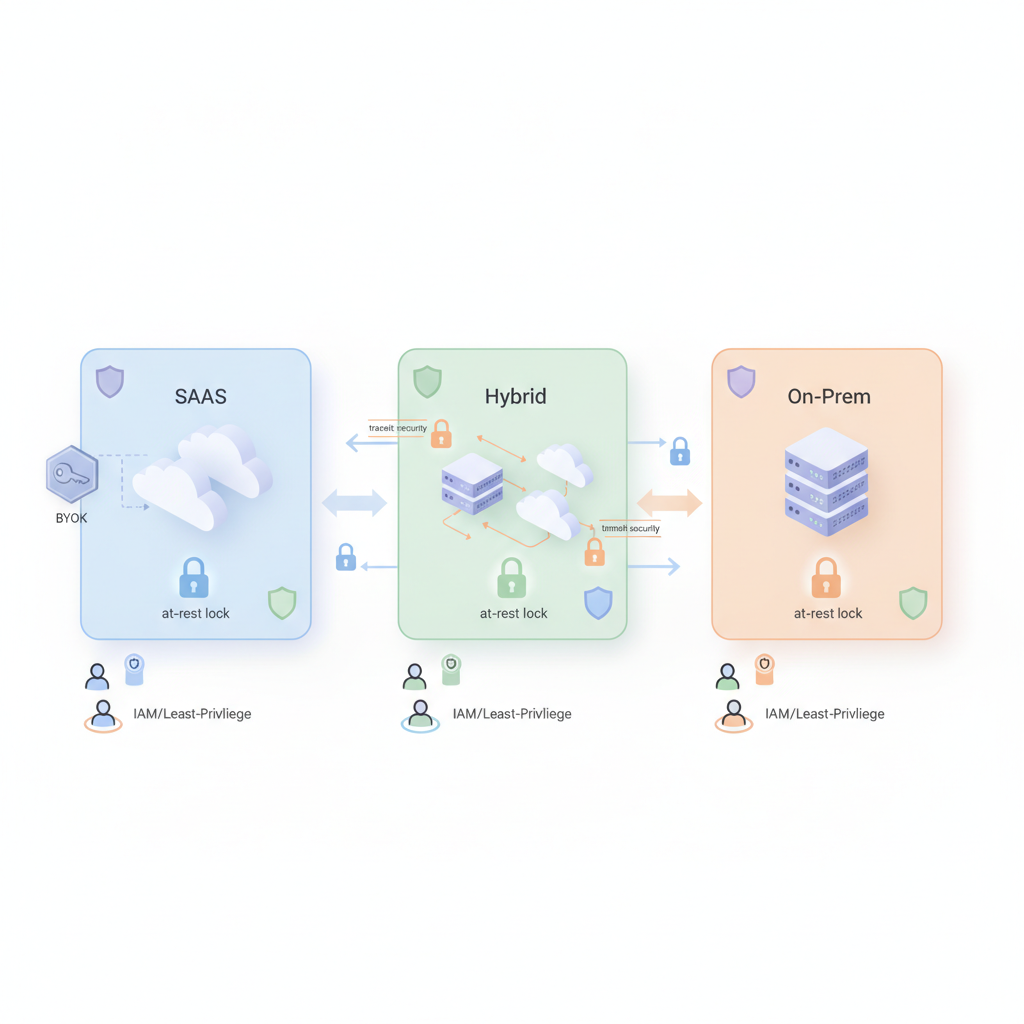
Quick vendor risk classification (SaaS, hybrid, on-prem)
Start with a one-page risk classification that sets the pilot boundary. Use three risk buckets:
- SaaS (multi-tenant) — fastest to deploy, highest transfer risk. Allow only anonymized or synthetic data for pilots unless the vendor offers strict data residency controls.
- Hybrid — vendor manages model/service but stores data in customer-controlled region or VPC. Good balance for pilots requiring near-production fidelity.
- On‑prem or air‑gapped — highest control, slowest to deploy. Reserve for regulated data and public-sector projects.
Concrete rule: for pilot decisioning on live personal data, require at least hybrid hosting with region locking; for sensitive financial or health data, require on‑prem or a validated cloud tenancy in your jurisdiction.
Core technical controls to verify
These controls stop common failure modes: data exfiltration, unauthorized access, and silent model leakage. Verify the vendor documents each control and provides artifacts (architecture diagram, encryption matrix, recent audit report).
Encryption at rest and in transit
Ask for TLS 1.2+ for all network traffic and AES-256 (or equivalent) for data at rest. Confirm where encryption terminates: if vendor-managed keys are used, ask for key rotation policy and proof of secure KMS usage. Example threshold: encryption keys rotated at least annually; session ciphers use forward secrecy. For pilots, insist that backups and logs are covered by the same encryption guarantees.
Key management and BYOK options
Bring-your-own-key (BYOK) reduces vendor access risk. If the vendor offers BYOK, validate the operational steps: how keys are provisioned, whether the vendor can export keys, and the revocation procedure. If BYOK is unavailable, request a written justification and ask for compensating controls such as customer-dedicated HSMs and privileged access logging.
Access controls, IAM, least privilege
Least-privilege must apply to service accounts, admin consoles, and support staff. Ask for role definitions, just-in-time (JIT) access options, MFA enforcement, and audit logging retention. Practical test: request a read-only API key that only returns metadata — use it to validate the vendor's scoping before sending production data.
Run a small, scoped test with synthetic data to validate access controls before any real data transfer.
Compliance & certifications to request
Certifications prove controls and management systems. Request evidence copies and understand scope limitations (e.g., a SOC 2 report covers the audited period, not ongoing changes). Below is a concise mapping you can quote during procurement.
| Certification | What it proves |
|---|---|
| SOC 2 | Operational controls relevant to security, availability, confidentiality (reported period) |
| ISO 27001 | Information security management system and continuous improvement processes |
| CSA STAR | Cloud provider security practices and transparency for cloud services |
| PCI | Controls for cardholder data environments |
| HIPAA | Suitability to handle protected health information (where applicable) |
Quotable line: "SOC 2 validates controls; ISO 27001 validates the management system." Also include the earlier security checklist quote: "If a vendor cannot provide SOC 2 Type II or an equivalent within 30 days, mark as high-risk for production pilots."
SOC 2, ISO 27001, CSA STAR, PCI, HIPAA (where relevant)
Ask for the vendor's SOC 2 Type II or ISO 27001 certificate and the auditor's name. For cloud-native vendors, CSA STAR adds transparency. For payment or health workflows, require PCI or HIPAA attestation and a signed Business Associate Agreement (BAA) for HIPAA-covered data. If the vendor lacks a required certificate, insist on compensating controls and a timebound remediation plan.
Data residency, localization & cross-border transfer questions
Data residency determines which legal regime applies. Ask vendors to declare where data is stored, processed, and backed up; request region locking and contractual guarantees. For connectors that move data, require that transfer destinations are recorded and auditable.
- EU: demand GDPR-compliant processing, data subject rights support, and legal transfer mechanisms (standard contractual clauses or adequacy).
- UK: confirm whether UK adequacy applies and how transfers to non-UK territories are handled.
- US: federal rules vary; pay attention to state laws like CPRA and CCPA when serving Californian users.
Record the exact datacenter regions and backup locations in contract Schedules; verbal commitments are insufficient.
EU (GDPR) specifics and Schrems II implications
Under GDPR, transfers outside the EEA require valid legal mechanisms and technical safeguards. Ask vendors for their data transfer assessments and whether they rely on standard contractual clauses post‑Schrems II. Verify the vendor can support data subject requests and deletion obligations within contractual timelines.
US state-level data rules (CCPA/CPRA) and public sector constraints
US state laws focus on consumer rights and data portability. For pilots that include California residents, confirm the vendor’s consumer rights handling and opt‑out procedures. For public sector pilots, require specific contractual clauses for government data and clarify any export controls or procurement constraints.
Operational security & vendor processes
Operational maturity reduces surprise during incidents. Check the vendor's SDLC, change management, and vulnerability disclosure program. Ask for SLA terms for security support and who within the vendor's organization is responsible for escalations.
Incident response, breach notification timelines, penetration testing cadence
Request the incident response plan (IRP) summary, SLA for breach notification (ideally within 72 hours of detection), and cadence of external penetration tests (annual minimum). Ask whether the vendor shares redacted test reports and whether they permit customer-initiated security assessments in controlled conditions.
Data deletion, retention and backup policies
Get a retention table that maps data classes to retention periods and deletion processes. Confirm backups inherit the same residency and encryption constraints. For pilots, require a documented deletion acceptance test: vendor returns a signed deletion certificate after data is purged.
Integration & third-party risk (connectors, RPA, APIs)
Connectors are frequent attack surfaces. Inventory third parties the vendor relies on, and require a supply‑chain security summary. For APIs and RPA, test throttling, rate limits, and error handling; document retry behavior to avoid duplicated data flows. If a connector stores credentials, insist on vaulting with rotation and audit trails.
Scoring rubric: how to weight security items during selection
Use a 100‑point rubric example: Certifications (20), Data residency controls (20), Encryption & key management (15), IAM & logging (15), Incident readiness (10), Third‑party risk (10), Operational transparency (10). Pass threshold for pilots: 70 points; deploy to production only if score ≥85. Keep the rubric in procurement artifacts and attach vendor evidence to each scored item.
Sample vendor questionnaire & checklist (copyable)
Use this checklist during vendor intake. Copy the questions into procurement documents and mark answers with evidence links.
| Item | Requirement / Example Evidence |
|---|---|
| Data residency | List of storage regions and backup locations; contractual region lock |
| SOC 2 / ISO 27001 | Attach attestation and scope |
| Encryption | TLS versions, at-rest cipher, key rotation policy |
| BYOK | BYOK flow or justification + compensating controls |
| Incident response | IRP summary and breach notification SLA |
| Retention & deletion | Retention table and deletion certificate process |
Conclusion: minimum acceptance criteria for pilots
Minimum acceptance for pilots: documented data residency for the pilot data, SOC 2 Type II or ISO 27001 evidence (or an agreed remediation plan), end‑to‑end encryption, least‑privilege access with MFA, and a signed data processing addendum supporting deletion and subject rights. Use the scoring rubric and the checklist above to standardize decisions across vendors. Remember: the goal of a pilot is learning — keep data scope small, instrument everything, and insist on written artifacts before moving to production.
References
- Artificial Intelligence Risk Management Framework: Generative AI Profile (NIST)
- EDPB Opinion 28/2024 on data protection and AI
- Secure LLM Systems: Essential Authorization Practices (Cloud Security Alliance)
- AWS: Data residency and hybrid cloud security lens
- Google Cloud: Multi-agent AI system architecture
FAQ
What is security & data residency checklist for ai process automation pilots?
The security & data residency checklist for AI process automation pilots is a procurement and technical playbook that lists required controls, certifications, data residency statements, and operational processes vendors must provide before receiving pilot data.
How does security & data residency checklist for ai process automation pilots work?
The checklist works by classifying vendor risk (SaaS/hybrid/on‑prem), verifying core technical controls (encryption, BYOK, IAM), validating certifications (SOC 2, ISO 27001), confirming data residency and transfer mechanisms, and scoring vendors with a weighted rubric to decide pilot readiness.